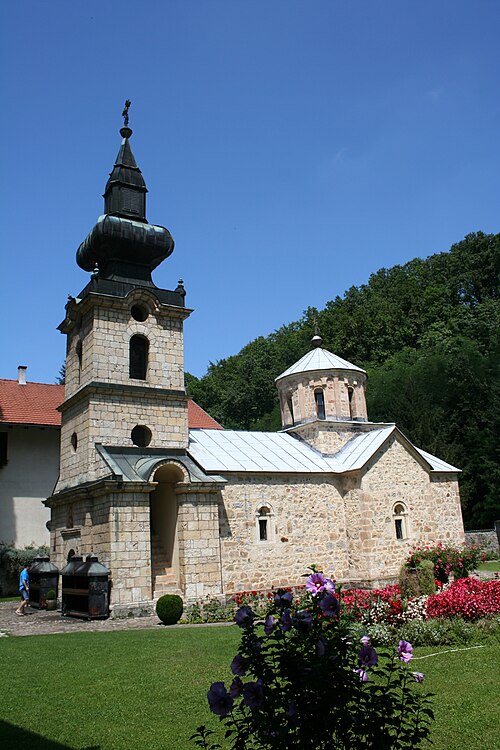
Venerable
Stephen of Tronoša
Archimandrite
Serbian monk and archimandrite who organized the Serbs in the Belgrade Pashalik during the Austro-Turkish War; died 1799.
- Feast
- September 4old style September 17
- Reposed
- 179918th century
- Order
- Venerables
Life
Venerable Stephen of Tronoša (born Stevan Jovanović, 1759-1799) was a Serbian monk and archimandrite, abbot of Tronoša Monastery, and a defender of his people during the Austro-Turkish War. He died in 1799 in Zvornik, according to tradition poisoned after asking the pasha for food for the starving. The Serbian Orthodox Church glorified him among the saints in 2017.
Beginnings
He was born in the village of Tekeriš near Loznica, in the Jadar region. He studied and took monastic vows at Tronoša Monastery, where he became archimandrite at a young age. Vuk Karadžić, who was a pupil at the monastery in 1796, described him as tall and slender, with a fair and cheerful face and a very fine voice, and as a man who gladly sang in church.
At the services he taught the people to fear God and keep his commandments, and he also advised them how to conduct themselves under Turkish rule. He cared for the poor, asking help from the wealthy and giving food and clothing himself. At times he even paid the tax owed to the Turks for those who could not pay it.
The Austro-Turkish War
During the Austro-Turkish War (1788-1791) he was one of the most prominent supporters of the Serbs fighting alongside the Habsburg monarchy, hoping that this would win them freedom from the Turks. His standing led many Serbs to join as volunteers, among them the Serbian Free Corps. The monastery fed a thousand soldiers for four months. He constantly urged unity and forgetting of disagreements, saying that only so could the people stand against the enemy.
On 22 January 1790 he gathered the Serbian leaders at Tronoša, who wrote a petition to the Austrian emperor for troops, arms and ammunition so that they could hold the lands already taken. On 4 August he asked the imperial commissary in Timișoara not to abandon the Serbs, and on 24 August he went there in person on behalf of 119 notables of Serbia, then travelled on to Vienna with the same petition. The truce signed on 23 September 1790 disappointed him. In February 1791 he wrote to the new Metropolitan Stefan Stratimirović, asking him to intercede with the emperor for the Serbs.
Because of his cooperation with the Habsburgs he was forced to flee from the Turks to Srem, where he found shelter in Grgeteg Monastery. The petition he made with hierarchs and leaders asked for amnesty for the Serbs who had fought, and for economic and administrative autonomy on the model of the Danubian Principalities under Russian protection. The Austrians stopped him from taking it to the talks at Sistova. Appointed chief organizer of the settlement of Serbs in Austria, he was removed from the task by the Metropolitan of Belgrade, the Greek Dionysios. At the end of July 1791, deeply disappointed at the injustice done to the Serbs, he returned to Serbia.
Withdrawal and death
The Peace of Sistova brought amnesty but left the loss of property unsettled, and in 1793-1794 the Serbs of the Belgrade Pashalik received rights close to those he had asked for, among them rural autonomy, fixed taxes and greater security. Compromised by his wartime activity, Father Stephen lived in seclusion at Tronoša, away from political events.
In 1799, after a year of drought and famine, he went to Zvornik and asked the pasha for the spoiled grain stored in the towers of the fortress, promising to return it after the harvest. The pasha, suspecting that he was again working for the Austrians, ordered, according to one account, poison to be put in the archimandrite's coffee. Stephen stayed the night in Zvornik and was found dead the next day. His body was carried to Tronoša and buried beside the monastery church, on its right side.
Veneration
Vuk Karadžić devoted several pages to his memory in the journal Danica, out of gratitude to his teacher. The Serbian Orthodox Church numbered him among the saints in 2017, for his love of his people, his sacrifice and his martyrdom, and the theologian Lazar Ljubić composed his service in 2018. His feast is on 4 September by the old calendar, which is 17 September by the new.
Commemorated the same day September 4
 MosesProphet · The LawgiverSep 4
 Joseph the All-ComelyRighteous · Son of JacobSep 4
 Boniface I of RomeSaint · Bishop of RomeSep 4
 Babylas of AntiochHieromartyr · Patriarch of AntiochSep 4
 Hermione of EphesusMartyr · Martyr of EphesusSep 4
 Candida the ElderMartyr · Patron of NaplesSep 4
 Peter ZimonjićHieromartyr · Metropolitan of Dabar and BosniaSep 4
 Theodore, Mian, Julian and KionHoly Martyrs · Martyrs of NicomediaSep 4
- Ultan of ArdbraccanSaint · Abbot-bishop of ArdbraccanSep 4
- Babylas of NicomediaMartyrSep 4
 Sergius DruzhininHieromartyr · Bishop of NarvaSep 4
- TheodoreMartyrSep 4