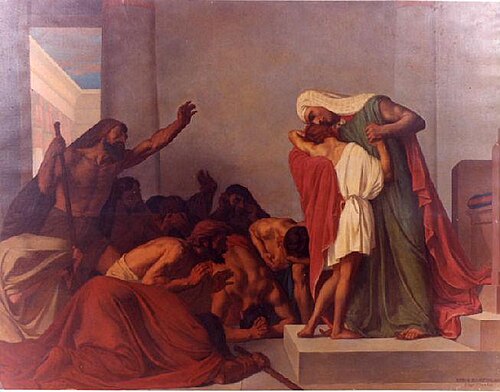
Righteous
Joseph the All-Comely
Son of Jacob
Son of Jacob sold by his brothers into Egypt, where he rose to office and saved his family from famine.
- Feast
- September 4old style September 17
- Born
- 1562 BC15th century BC
- Place
- Ancient Egypt
- Order
- The Righteous
Life
The righteous Joseph the All-Comely was the son of the patriarch Jacob and Rachel, the eleventh of Jacob's twelve sons. Sold by his brothers into slavery in Egypt, he rose, by the providence of God, to govern the land under Pharaoh and saved his family from famine. The Church honours him for his purity, patience and forgiveness, and sees in his life a foreshadowing of Christ. His story is told in the book of Genesis, and the dates of his life cannot be fixed with precision.
The beloved son
Joseph was the son of Jacob's old age, and Jacob loved him more than his other sons and made him a fine coat. The young man told two dreams: in the first the sheaves of his brothers bowed down to his sheaf, in the second the sun, the moon and eleven stars bowed to him. Jacob rebuked him for these dreams, and his brothers, who already hated him for their father's love, thought him arrogant.
When Joseph was sent to see how his brothers fared with the flocks, they resolved to kill him. Reuben asked that no blood be shed and that he be thrown into a pit instead, meaning to take him out later. Judah proposed selling him to Ishmaelite merchants on their way to Egypt, and they sold him for twenty pieces of silver. His coat was dipped in the blood of a goat and brought to Jacob, who mourned his son as dead.
Purity and prison
In Egypt Joseph was bought by Potiphar, captain of Pharaoh's guard, who put him over his whole house when he saw that the Lord was with him. The wife of his master tried to tempt him, but Joseph fled, leaving his cloak in her hand. Falsely accused, he was thrown into prison. The Church calls him All-Comely not only for his appearance but above all for the beauty of his spiritual life.
In prison he interpreted the dreams of Pharaoh's cupbearer and baker. The cupbearer would be restored to his post and the baker hanged, and so it came to pass. The cupbearer forgot Joseph for two years. Then Pharaoh dreamed of seven fat cows eaten by seven lean cows, and seven full ears of grain swallowed by seven withered ones, and the wise men of Egypt could not explain it. The cupbearer remembered Joseph, who told Pharaoh that seven years of plenty were coming, followed by seven years of famine, and advised him to store a fifth of the harvest each year.
Governor of Egypt
Pharaoh set Joseph over the land, gave him the name Zaphenath-Paneah and gave him as wife Asenath, daughter of the priest of On. Their sons were Manasseh and Ephraim. In the good years Joseph filled the storehouses, and when the famine spread over Egypt and Canaan, he sold grain to the people.
The sons of Jacob, all but Benjamin, came to Egypt to buy food. Joseph knew them, but they did not know him. He tested them, kept them for a time in prison, held Simeon back and demanded that Benjamin be brought. When his silver cup was found in Benjamin's sack, Judah offered to stay as a slave in his brother's place. Then Joseph could no longer restrain himself, wept so loudly that the whole house heard, and made himself known. He told them that it was not they who had sent him there but God, to save them from famine. He brought his father, then a hundred and thirty years old, down to Egypt and settled his brothers in the land of Goshen.
After Jacob's death his brothers feared that Joseph would take revenge. He answered, "You meant evil against me, but God meant it for good." Earlier, Jacob had blessed Ephraim and Manasseh as his own sons, setting them at the head of two tribes of Israel.
Repose and veneration
Joseph lived to the age of a hundred and ten and saw his great-grandchildren. Before he died he made the sons of Israel swear to take his bones with them when they left Egypt. Moses took the bones, and according to Scripture they were buried at Shechem. The epistle to the Hebrews names him among those who lived by faith.
The Fathers saw in his life an image of Christ. Saint John Chrysostom said his suffering was "a type of things to come", and Saint Ambrose saw in the sheaf that stands upright a sign of the resurrection. The Church commemorates him on Great and Holy Monday, at the start of Holy Week, and on the Sunday of the Holy Forefathers before the Nativity of the Lord. In icons he is sometimes shown wearing the headdress of an Egyptian vizier.
Commemorated the same day September 4
 MosesProphet · The LawgiverSep 4
 Boniface I of RomeSaint · Bishop of RomeSep 4
 Babylas of AntiochHieromartyr · Patriarch of AntiochSep 4
 Hermione of EphesusMartyr · Martyr of EphesusSep 4
 Candida the ElderMartyr · Patron of NaplesSep 4
 Peter ZimonjićHieromartyr · Metropolitan of Dabar and BosniaSep 4
 Theodore, Mian, Julian and KionHoly Martyrs · Martyrs of NicomediaSep 4
- Ultan of ArdbraccanSaint · Abbot-bishop of ArdbraccanSep 4
- Babylas of NicomediaMartyrSep 4
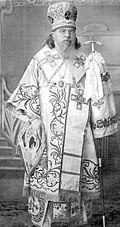 Sergius DruzhininHieromartyr · Bishop of NarvaSep 4
 Stephen of TronošaVenerable · ArchimandriteSep 4
- TheodoreMartyrSep 4