
Prophet
Moses
The Lawgiver
The prophet who led Israel out of Egyptian bondage and received the Law on Mount Sinai.
- Feast
- September 4old style September 17
- Born
- 1393 BC13th century BC
- Place
- Mount Nebo
- Order
- Prophets
Life
The holy Prophet and God-seer Moses was the man through whom, by God's will, the people of Israel were led out of slavery in Egypt and were given the Law on Mount Sinai. The Church honours him as one of the greatest prophets of the Old Testament, and tradition ascribes to him the five books of the Law: Genesis, Exodus, Leviticus, Numbers and Deuteronomy. His life is told in Scripture from Exodus 2 to Deuteronomy 34. His dates cannot be fixed with certainty: Orthodox synaxaria place his birth in 1569 BC, while modern chronologies put him later, in the thirteenth century BC.
Birth and childhood
Moses was born in Egypt of the tribe of Levi, a son of Amram and Jochebed. Pharaoh had ordered the Hebrew infants to be cast into the Nile. His mother laid him in a papyrus basket coated with pitch at the water's edge. Pharaoh's daughter found him, adopted him and named him Moses, "drawn out of the water". Without knowing it, she entrusted his nursing to his own mother.
Raised as the princess's son, he learned all the wisdom of the Egyptians, yet he was not estranged from his fathers' faith and his own people. Doxologia records a tradition that as a child he took Pharaoh's crown, which bore a small carved idol, and trampled it.
Flight to Midian
At forty he killed an Egyptian who was striking an Israelite, and fled to the land of Midian. There he married Zipporah, daughter of the priest Jethro, and had two sons, Gershom and Eliezer. Tending his father-in-law's flocks in the quiet of the mountains and the desert, he prepared himself in prayer for the task God had appointed for him: to shepherd His people.
The burning bush and the sending
After forty more years, on Mount Horeb, God appeared to him in a fire coming out of a bush that burned without being consumed. The holy Fathers saw in the unburnt bush a prefiguration of the virgin birth: the Mother of God bore God in her womb without being consumed. Moses thought himself unworthy and slow of speech, and God gave him his brother Aaron as a helper.
The Exodus and the Law
Moses and Aaron stood before Pharaoh and asked him to let the people go. The plagues sent on Egypt, the last of them the death of the firstborn, finally broke his resistance. The Israelites crossed the Red Sea as on dry land, and the Egyptian army was covered by the waters. The Fathers of the Church see in this crossing a figure of Baptism.
In the wilderness the people received manna and water from the rock. On Mount Sinai Moses entered the cloud of darkness and received the tablets of the Law. When the people worshipped the golden calf, Moses interceded for them. The first two biblical Odes are ascribed to him: "Let us sing to the Lord", sung on the shore of the Red Sea (Exodus 15), and "Attend, O heaven", sung in the land of Moab (Deuteronomy 32).
Forty years in the wilderness and his death
For forty years he guided the Israelites, judged them and prayed for them. Scripture testifies that he was the meekest man on the face of the earth. Because of a word of doubt at the waters of Meribah, he was told that he would not enter the Promised Land. He appointed Joshua son of Nun as his successor.
From the top of Mount Nebo, also called Pisgah, in the land of Moab, the Lord showed him the land of promise. He died there at the age of a hundred and twenty, according to the word of the Lord, and no one knows the place of his burial. The Orthodox synaxarion dates his death to 1449 BC.
Veneration
At the Transfiguration Moses appeared on Mount Tabor with Saint Elijah, bearing witness that the Law and the Prophets proclaim Christ. A story is also told that on the day Saint John of the Ladder was installed as abbot of Sinai, Moses was seen giving orders to the cooks and servants; afterwards Saint John remarked that the Lord Moses does nothing strange in serving in the place that belongs to him.
The Orthodox Church commemorates him on 4 September.
Commemorated the same day September 4
 Joseph the All-ComelyRighteous · Son of JacobSep 4
 Boniface I of RomeSaint · Bishop of RomeSep 4
 Babylas of AntiochHieromartyr · Patriarch of AntiochSep 4
 Hermione of EphesusMartyr · Martyr of EphesusSep 4
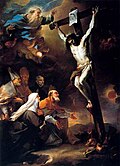 Candida the ElderMartyr · Patron of NaplesSep 4
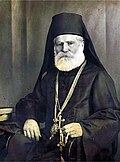 Peter ZimonjićHieromartyr · Metropolitan of Dabar and BosniaSep 4
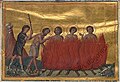 Theodore, Mian, Julian and KionHoly Martyrs · Martyrs of NicomediaSep 4
- Ultan of ArdbraccanSaint · Abbot-bishop of ArdbraccanSep 4
- Babylas of NicomediaMartyrSep 4
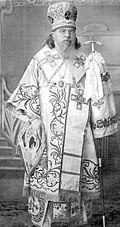 Sergius DruzhininHieromartyr · Bishop of NarvaSep 4
 Stephen of TronošaVenerable · ArchimandriteSep 4
- TheodoreMartyrSep 4