Martyr
Bacchus the New
Christian martyred for the faith of Christ.
- Feast
- December 15old style December 28
- Reposed
- 7868th century
- Order
- Martyrs
Life
Holy Martyr Bacchus the New was born at Maiuma near Gaza in Palestine, which was then under Arab rule. He was the third of seven brothers and was named Dahhak, which, as the hagiographer notes, corresponds to the Greek name Gelasius, from "laughter". His father had once been a Christian but had gone over to Islam and raised his sons in that religion, while his mother remained faithful to Christianity and secretly anointed the children with myron brought from church.
When the father began to marry his sons to Muslim women, Dahhak refused to marry, wishing to become a Christian and receive monastic tonsure. Out of fear of his father he hid his intention and honoured Christ in secret. After his father's death he revealed himself to his mother, who instructed him in the faith. In Jerusalem, where he went to be baptized, he met a monk from the Lavra of Saint Sabbas the Sanctified, who brought him to the abbot of his monastery. After much persuasion the abbot agreed to grant him Holy Baptism, giving him the name Bacchus, and then, not without hesitation because of his tender age, tonsured him a monk.
Bacchus the New at once distinguished himself in fasting and vigil, and among the brethren he was marked by quiet temper, gentleness and humility. Since the baptism of a Muslim was regarded by the Arab authorities as the gravest crime, punishable by death and by burning of the church or monastery where it was done, the abbot, fearing the searches the Arabs carried out regularly, advised him to move from one monastery to another, which he did. He went round the monasteries of Palestine, seeking everywhere models to imitate.
His mother, who had come to Jerusalem for the feast of the Exaltation of the Holy Cross, visited him in the desert, and on returning to Maiuma told her sons of his way of life and of his sorrow at his brothers' remaining in error. The brothers then sold their property and left Maiuma to embrace Christianity with their families. The wife of one of them, a fanatical Muslim, denounced the plan to the authorities. An apostate was paid to pose as a Christian and find out where Bacchus was (according to other accounts, it was a relative of that same daughter-in-law). Bacchus was recognized in Jerusalem as he entered the Church of the Resurrection and was brought to the emir of the city. The emir ordered him put in stocks and sent to the strategos of Palestine, Hartam. In prison he was held with criminals, who mocked him for abandoning Islam, but the martyr kept silent.
After a few days the trial took place. Before a crowd of Muslims, Samaritans, Jews and Christians, the governor questioned Bacchus, but the martyr, instead of answering, sang praise to God. The judge promised him great honours if he returned to Islam, but the saint stood firm. The judge then offered him freedom if he would say only one sentence, "I do not believe as the Christians believe", and Bacchus answered: "On the contrary, as the Christians believe, so do I." The judge and the emir handed him to the executioner to be beheaded, though the Samaritans and Jews demanded a more painful death. At the place of execution the martyr knelt and bowed his neck beneath the sword. The executioner, wishing to frighten him, struck his neck with the flat of the sword, then cut the air with it, but Bacchus showed not the slightest fear and only urged him to carry out the judge's order. At last the executioner beheaded him with one blow. The Christians present tore pieces from the martyr's clothing and gathered the earth on which his blood had been shed. They could bury the body only when the governor received a false report of a Bedouin raid and set out on campaign. The saint was buried with due honour in the church of Saints Cosmas and Damian.
The account of the martyrdom of Bacchus the New (BHG 209) was probably written by a contemporary, who calls him "the ornament of our generation", and is an important source for the history of Christians in Palestine under Muslim rule and for the liturgical practice of its time, since it describes baptism by pouring in detail. Saint Bacchus is commemorated on 28 December, in the new style. His name is not included in the present calendar of the Russian Orthodox Church.
Commemorated the same day December 15
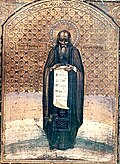 Tryphon of PechengaVenerable · Founder of Pechenga MonasteryDec 15
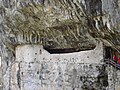 UrbiciusVenerable · Hermit of the Aragon PyreneesDec 15
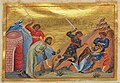 Eleutherius and AnthiaHoly Hieromartyrs · Bishop of Illyricum and his motherDec 15
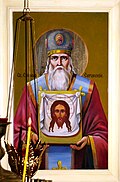 Stephen of SurozhSaint · Archbishop of SugdeaDec 15
- Offa of EssexRight-Believing · King of EssexDec 15
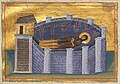 Susanna the DeaconessVenerable Martyr · Deaconess of PalestineDec 15
 Gury KarpovSaint · Archbishop of Taurida and SimferopolDec 15
- Paul of LatrosVenerableDec 15
 Nectarius of BitolaSaintDec 15
- Pardus the HermitVenerableDec 15
- Gurius of PechengaHieromartyr · Abbot of Pechenga MonasteryDec 15
- DrosisMartyrDec 15