Venerable
Basil Kishkin
Hieromonk of Ploshchansk
Russian hieromonk born in 1745, who struggled mostly at the Ploshchansk Hermitage and died in 1831.
- Feast
- September 9old style September 22
- Reposed
- 183119th century
- Place
- Ploshansky Monastery
- Order
- Venerables
Life
Saint Basil Kishkin (in the world Vladimir Timofeevich Kishkin, 1745 - 27 April 1831) was a hieromonk of the Russian Orthodox Church, a spiritual elder, a disciple of Saint Tikhon of Zadonsk, who struggled at Sarov, at Kursk, at Belobereg, on Athos, at Glinsk and above all in the Ploshchansk Hermitage of the Kazan Mother of God, in Oryol province. The Synod of the Ukrainian Orthodox Church (Moscow Patriarchate) decided his canonization in the synaxis of the venerable saints of Glinsk on 8 May 2008, and the Council of Bishops of the Russian Orthodox Church of 30 November 2017 entered him among the saints venerated throughout the Church. He is commemorated on 27 April and on 9 September in our calendar.
Beginnings
He was born in 1745 in the village of Arkhangelskoye at Gnilovodye or, according to other reports, in the village of Klyushnikovo (later in the Fatezh district, Kursk province), in an impoverished noble family. From childhood he loved church services and avoided games. In 1752, at seven, with his father's permission, he entered the Sarov hermitage as a novice. In 1757 he visited the Kyiv Caves Lavra, after which he settled at the Korennaya hermitage. Often visiting Zadonsk monastery, he met there Saint Tikhon of Zadonsk, who became his spiritual guide and taught him the Jesus Prayer. He was closely acquainted with Archimandrite Theodosius (Maslov).
According to some reports, in 1760 he was secretly tonsured a monk at the Miropolie monastery in Kursk province, but in his service record he himself wrote that he received monasticism in the same monastery, but only in 1783, from Abbot Constantine (Saursky). He was ordained hierodeacon by Bishop Theoctistus (Mochulsky) at the Znamensky monastery in Kursk, where until 1794 he did the obedience of sacristan.
Athos, Belobereg and wanderings
In 1795 he set out for Holy Mount Athos. There he struggled in a cell of the Russian skete of the Prophet Elijah, where he learned the communal and skete rules and the Athonite ascetic tradition. In 1797 he moved, with his disciples Israel and Arsenius the Younger, to Neamț monastery in Moldavia. In 1798 he returned to the Korennaya hermitage, where, as confessor of the brothers, he introduced the Athonite rules, which caused the discontent of part of the brothers, who even resolved to kill him, but later repented and were reconciled with the ascetic.
On 27 January 1800 he was given the obedience of head of the desolate Belobereg hermitage in Oryol province. Soon after the appointment of the new abbot some sixty new monks came to the monastery, among them the Optina elder Leo (Nagolkin), Hieromonk Cleopas II (Antonov), Schemamonk Theodore (Polzikov) and Schemamonk Athanasius (Okholopov), a participant in the translation of the Philokalia. Among the disciples were Abbot Philaret (Danilevsky), Hieromonk Seraphim (Vedenisov) and Macarius (Glukharev). During his leadership the cells and refectory were repaired with the funds of benefactors. On 28 December 1800 he was ordained hieromonk, at the Chelna monastery, by Bishop Dositheus.
After the abbacy of Belobereg the elder struggled also at the Svensk men's monastery, the Sevsk convent, at Rykhlovo, at the Kremen and Koren hermitages, and made a missionary journey on the Don, where he converted a leader of the Molokans, sectarians. In 1816, seeking quiet, he moved to the deserted Glinsk hermitage. The abbot there, Philaret, took care of the outward welfare of the monastery, and Elder Basil of the inner order: he edified the brothers, comforted the faint-hearted, humbled the proud, reconciled the quarrelsome by his meekness and sought above all to root out drunkenness and urged the brothers to avoid anger and abide in mutual love, so as not to be a stumbling-block to the world. In the ten years of Fr. Basil's stay at Glinsk, all his cares tended to the glory of God and the good of the monastery, but for all that he did not escape temptations and was driven out of the monastery by the envy of others.
Ploshchansk and the end
In 1827 he moved to the Ploshchansk hermitage in Oryol province, where he grew close to the dean, the Optina elder Macarius (Ivanov), to whom he confessed until his death. In October 1829, while felling trees, he fell and was unconscious for several hours. Coming to himself, he received the Mystery of Holy Unction, communed of the Holy Mysteries and prophesied that he would die in eighteen months. After that he went into seclusion in a narrow room, where he began his preparation for death; in that cell the elder acquired unceasing prayer. A week before his death, on the first day of Pascha, 19 April 1831, the venerable one communed, and his face visibly shone. All the remaining days he was ill. On the very day of his repose he asked his disciple to light candles before the icons, to call the abbot and to gather the brothers to take leave. The saint reposed at the age of eighty-six and was buried at the Ploshchansk hermitage, opposite the altar of the Kazan church.
Relics and veneration
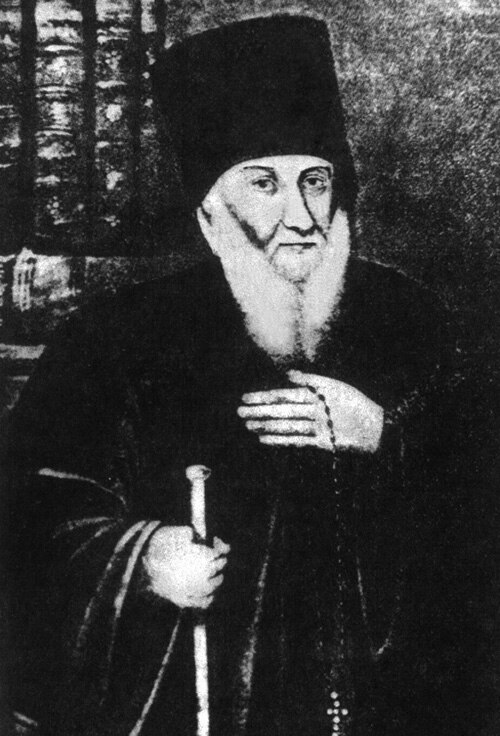
Out of humility, the elder forbade being painted. Nevertheless there exists a portrait of the ascetic, made secretly from him in the 1810s at the order of Saint Anthony (Smirnitsky) of Voronezh: the elder is shown with a prayer rope and staff. Copies of these images were in the abbot's quarters at Belobereg and Ploshchansk. The saint's life was compiled in the late 1870s by his disciple, the nun Angelina, and in 1882 was corrected and supplemented at Belobereg by the elder's disciple, the monk Arsenius (Kirilov). The relics of Saint Basil are kept at the Ploshchansk hermitage of the Kazan Mother of God in the Bryansk region; a part is kept at the Slavic-Greek-Latin Academy. According to reports of the Soviet authorities of the 1950s, "at the site of the former Ploshchansk monastery... believers... take sand from the grave of the 'saint' monk and water from the spring".
On 8 May 2008 the Holy Synod of the Ukrainian Orthodox Church (Moscow Patriarchate) decided the canonization of Hieromonk Basil (Kishkin) in the synaxis of the venerable saints of Glinsk. At the Council of Bishops of the Russian Orthodox Church of 30 November 2017 he was entered among the saints venerated throughout the Church. On 17 June 2018, at the Ploshchansk hermitage, Metropolitan Alexander (Agrikov) of Bryansk and Sevsk led the services for the general glorification of Saint Basil (Kishkin).
Commemorated the same day September 9
 JoachimRighteous · Father of the TheotokosSep 9
 Ciarán of ClonmacnoiseVenerable · Abbot of ClonmacnoiseSep 9
 Joseph of VolotskVenerable · Abbot of Volokolamsk MonasterySep 9
 Gorgonius of NicomediaMartyr · Martyr of NicomediaSep 9
 Philaret of GlinskVenerable · Abbot of Glinsk HermitageSep 9
- Zenobius MazhugaSaint · Metropolitan of the Georgian ChurchSep 9
 Andronik LukashVenerable · Schema-archimandrite and elderSep 9
 Joanicius of RakotinciVenerableSep 9
 Zacharias LobovHieromartyr · Archbishop of VoronezhSep 9
- Joachim of OpochkaVenerable · Disciple of St. Euphrosynus of PskovSep 9
- Nikita of ConstantinopleFool-for-Christ · Clerk of ConstantinopleSep 9
- AelrhiwSaintSep 9