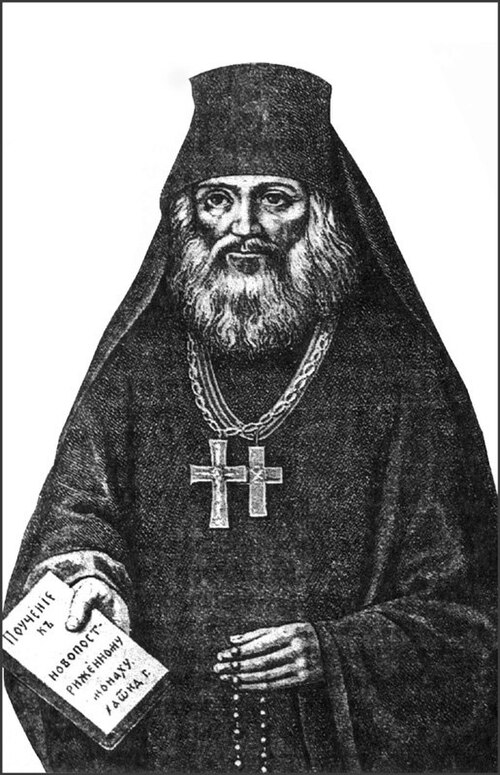
Venerable
Philaret of Glinsk
Abbot of Glinsk Hermitage
Abbot and restorer of the Glinsk Hermitage, born in western Ukraine in 1773; died in 1841.
- Feast
- September 9old style September 22
- Reposed
- 184119th century
- Place
- Glinsk Hermitage
- Order
- Venerables
Life
Saint Philaret of Glinsk (1773-1841), in the world Foma Danilevsky, was abbot and restorer of the Glinsk Hermitage, in present-day Ukraine. He was canonized by the Ukrainian Orthodox Church (Moscow Patriarchate) for local veneration. He is commemorated on 31 March (old style), the day of his death, and in the Synaxis of the Saints of Glinsk.
Youth and the road to monasticism
He was born in 1773 (some sources give 1777) in western Ukraine, into a family of Orthodox Cossacks. After learning to read and write, he joined the local village church as a reader but soon set out to travel to the holy places and stopped at the Kiev Caves Lavra. He lived there for quite some time, in the obedience of cell attendant and canonarch (cantor). In 1802 he moved to the Sofroniev-Molchensk Caves Hermitage, where he was appointed rubrics-keeper (ustavnik) and in the same year was tonsured a monk with the name Philaret. In 1803 he was ordained hierodeacon and in 1806 hieromonk. He was made the monastery's dean and gave himself with great self-denial to various monastic labours: solitude, silence, fasting, vigils, prostrations and unceasing prayer. He loved to write books of music and wrote four whole irmologia.
The restorer of Glinsk
On 11 May 1817 Father Philaret was appointed builder of the Glinsk Hermitage of the Nativity of the Mother of God, which had fallen into great decline, both materially and spiritually. He set about correcting things with all possible zeal: he forbade women to be received in the cells, introduced the rule of Mount Athos into the services and, as an exemplary rubrics-keeper, brought order and beauty into the monastery. On 5 July 1821 he was personally presented to Emperor Alexander I and asked him to enlarge the hermitage's staff, to grant 300 desyatinas of forest and to pay the monastery's debts. The emperor agreed to help.
The news of the hermitage's flourishing drew many benefactors. New buildings appeared in the monastery, the sacristy was renewed, and the monks were a school of piety and an example of virtue.
Writings and veneration
His labours include four rules, written according to the common-life rule of Athos, for convents of the dioceses of Kursk, Orenburg and Yekaterinburg, as well as the "Extended Instruction to a Newly Tonsured Monk", printed in 1824 and sent to all dioceses of the Russian Church. Abbot Philaret left ascetic instructions for monastics, among them "Before and After Tonsure" and "On the Duty of a Confessor Serving Nuns". On the basis of oral tradition he compiled the "History of the Glinsk Men's Hermitage of the Nativity of the Mother of God".
He reposed on 31 March (12 April) 1841, in the monastery entrusted to him. On 8 May 2008 the Holy Synod of the Ukrainian Orthodox Church (Moscow Patriarchate) decided on the canonization of thirteen ascetics of Glinsk, among them Philaret; on 25 March 2009 three more names were added. The common commemoration in the Synaxis of the Saints of Glinsk was fixed for 22 September in the new style. After the Bolshevik revolution the monastery was closed, and it was reopened only after the collapse of the USSR and Ukraine's independence, in August 1994.
Commemorated the same day September 9
 JoachimRighteous · Father of the TheotokosSep 9
 Ciarán of ClonmacnoiseVenerable · Abbot of ClonmacnoiseSep 9
 Joseph of VolotskVenerable · Abbot of Volokolamsk MonasterySep 9
 Gorgonius of NicomediaMartyr · Martyr of NicomediaSep 9
 Basil KishkinVenerable · Hieromonk of PloshchanskSep 9
- Zenobius MazhugaSaint · Metropolitan of the Georgian ChurchSep 9
 Andronik LukashVenerable · Schema-archimandrite and elderSep 9
 Joanicius of RakotinciVenerableSep 9
 Zacharias LobovHieromartyr · Archbishop of VoronezhSep 9
- Joachim of OpochkaVenerable · Disciple of St. Euphrosynus of PskovSep 9
- Nikita of ConstantinopleFool-for-Christ · Clerk of ConstantinopleSep 9
- AelrhiwSaintSep 9