Saint
Zenobius Mazhuga
Metropolitan of the Georgian Church
Metropolitan of the Georgian Orthodox Church, born in Hlukhiv in 1896 and died in Tbilisi in 1985; in the schema Seraphim.
- Feast
- September 9old style September 22
- Reposed
- 198520th century
- Place
- Tbilisi
- Order
- Hierarchs
Life
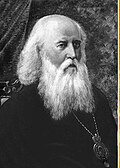
Saint Zenobius Mazhuga (1896 to 1985), in the schema Seraphim, was a metropolitan of the Georgian Orthodox Church, born at Hlukhiv in Ukraine and died at Tbilisi. A monk formed at the Glinsk Hermitage, he endured prison and exile in the years of Soviet persecution, and then served for decades in Georgia as a humble hierarch, a sought-after spiritual father and a man of prayer. He is venerated as one of the saints of Glinsk, commemorated together on 9 (22) September.
Childhood and Glinsk
He was born on 14 September 1896 in the town of Hlukhiv in Chernigov province, to a labourer's family, and his baptismal name was Zacharias Ioakimovich Mazhuga. He was orphaned early, was raised in the home of an uncle and lived in poverty. He was placed in the house of industry of the Glinsk Hermitage, where he finished the parish school and learned tailoring. In 1912 he became a novice at Glinsk, and his spiritual father was Father Gerasim.
In the First World War he was called into the active army, where he chilled his feet and fell ill with eczema, which tormented him all his life. Later thrombophlebitis and wounds that would not heal were added. After demobilization he returned to Glinsk. In June 1920 he was tonsured a rassophore and in March 1921 a monk, with the name Zenobius, after the Hieromartyr Zenobius of Aegae. It is said he was tonsured on the Annunciation of 1917, but the archival data do not confirm this.
The Caucasus, prison and exile
In 1922, after the closing of the Glinsk Hermitage, he moved to the Caucasus and settled at the Dormition monastery of Dranda, near Sukhumi. He was ordained hierodeacon, and in 1925 hieromonk. From 1925 to 1930 he served at the church of Saint Nicholas in Sukhumi. With others he organized in the mountains a monastic community in which elders from various monasteries lived, from the Kyiv Caves Lavra, from Pochaev and from other places. After a few years the authorities expelled him from Georgia and he settled at Rostov-on-Don, where he served at the church of Saint Sophia.
In 1936 he was arrested and sentenced to exile in Central Asia. For seven months he was held in a transit camp, where he fell ill with malaria, and he was then sent to the Urals, where he spent five years. In detention he went on serving: he baptized, heard confessions and buried prisoners, using a towel in place of the stole.
Service in Georgia
After his release he returned to Georgia. At Tbilisi he met Patriarch Kallistrate of Georgia and, with his blessing, served from 1942 to 1945 at the Sioni Cathedral of the Dormition and was confessor of the Saint Olga hermitage at Mtskheta. In 1945 he was raised to the rank of hegumen. From 1945 to 1947 he served at the church of Saint Nicholas in the village of Kirovo (Armenia), and from 1947 to 1950 was rector of the church of the Holy Spirit in Batumi. In 1950 he became an archimandrite and rector of the Alexander Nevsky church in Tbilisi. On 11 June 1952 he was named a member of the Holy Synod of the Georgian Church.
On 30 December 1956 he was consecrated bishop, and on 6 March 1957 he was named bishop of Stepanovan, vicar of the Patriarch of All Georgia. In 1960 Patriarch Ephrem II transferred him to the see of Tetritskaro. In 1972 he was raised to metropolitan.
Until the end of his life he lived in a cell beside the Alexander Nevsky church in Tbilisi and declined the patriarch's offer to move to a residence suited to his dignity. He served the Liturgy every day. Among his spiritual children was the future Patriarch Ilia II, whom he tonsured a monk. He was respected by the Moscow patriarchs Alexy I and Pimen. Two years before his death he secretly received the great schema, with the name Seraphim, after Saint Seraphim of Sarov.
In 1975, together with Schema-Archimandrite Vitaly (Sidorenko), he founded, in the latter's house in the Tbilisi suburb of Didube, the Holy Russian-Iveron convent, which became, by some estimates, a Russian spiritual centre of Transcaucasia. A spiritual son of his was Archimandrite Modest (Potapov), who also renewed two monasteries at Rostov-on-Don.
The gift of foresight
The saint was endowed by God with the gift of seeing events both future and already accomplished. He foresaw much in the fate of his spiritual children and warned them of troubles. He saw the inner state of a person and knew by which path to lead each soul to salvation.
He several times foretold the priesthood of people who had not even thought of it. Once, in the village of Burdino with his cell attendant Alexander, he said it would be good if Alexander too took the path of service. Alexander replied that he was too shy, and pastoral work requires constant dealing with people. The saint answered that he should go to the seminary. The prediction was fulfilled a few years after the hierarch's death in 1985. Alexander entered the Moscow Seminary and was ordained deacon by Archbishop Alexander, and the next year priest by Patriarch Ilia II at the Sioni Cathedral. After the Moscow Academy he remained there as a teacher. Today he is Archpriest Alexander Chesnokov, in the diocese of Yekaterinodar and Kuban.
Death and glorification
He fell asleep in the Lord on 8 March 1985. The funeral by monastic rite was served by Patriarch Ilia II, and the saint was buried beside the north wall of the Alexander Nevsky church in Tbilisi.
On 25 March 2009 the Holy Synod of the Ukrainian Orthodox Church numbered him among the locally venerated saints, with the day of commemoration 9 September by the old calendar. The glorification service took place on 21 August 2010 at Glinsk, led by Metropolitan Vladimir of Kyiv. On 30 November 2017 the Bishops' Council of the Russian Orthodox Church numbered him among the saints venerated throughout the Church, in the synaxis of the saints of Glinsk, with common commemoration on 9 (22) September. It was noted then that the Georgian Church, in whose jurisdiction he ended his service, also venerates him as an ascetic and supports his glorification in the synaxis of Glinsk.
He received several church distinctions, among them the Orders of Saint Nina first and second class (Georgian Church), Saint Vladimir first class (Russian Church), Apostle Mark second class (Patriarchate of Alexandria), Saint George the Great Martyr first and second class (Georgian Church) and Saints Cyril and Methodius second class (Church of the Czech Lands and Slovakia).
Commemorated the same day September 9
 JoachimRighteous · Father of the TheotokosSep 9
 Ciarán of ClonmacnoiseVenerable · Abbot of ClonmacnoiseSep 9
 Joseph of VolotskVenerable · Abbot of Volokolamsk MonasterySep 9
 Gorgonius of NicomediaMartyr · Martyr of NicomediaSep 9
 Philaret of GlinskVenerable · Abbot of Glinsk HermitageSep 9
 Basil KishkinVenerable · Hieromonk of PloshchanskSep 9
 Andronik LukashVenerable · Schema-archimandrite and elderSep 9
 Joanicius of RakotinciVenerableSep 9
 Zacharias LobovHieromartyr · Archbishop of VoronezhSep 9
- Joachim of OpochkaVenerable · Disciple of St. Euphrosynus of PskovSep 9
- Nikita of ConstantinopleFool-for-Christ · Clerk of ConstantinopleSep 9
- AelrhiwSaintSep 9