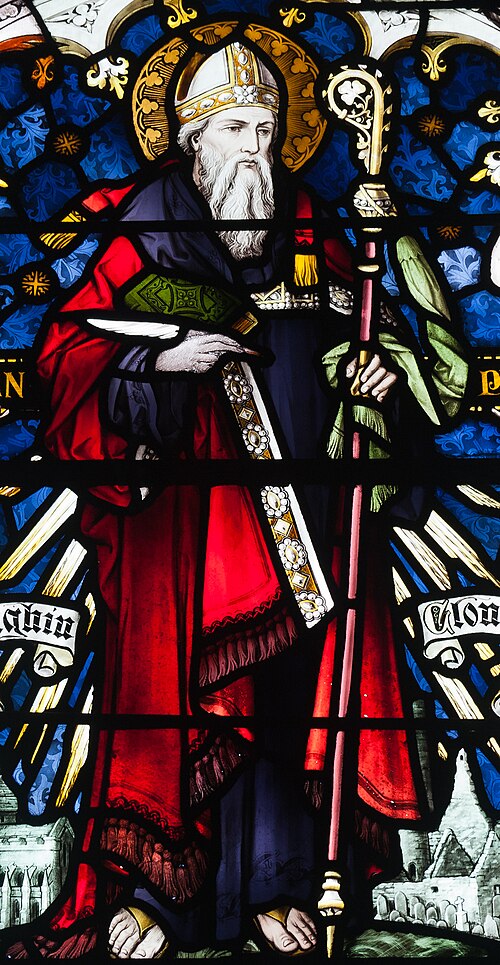
Venerable
Ciarán of Clonmacnoise
Abbot of Clonmacnoise
One of the Twelve Apostles of Ireland, founder and first abbot of Clonmacnoise.
- Feast
- September 9old style September 22
- Reposed
- 5466th century
- Place
- Clonmacnoise
- Order
- Venerables
Life
The Venerable Ciarán of Clonmacnoise was one of the twelve apostles of Ireland and the first abbot of the monastery of Clonmacnoise. He is sometimes called Ciarán the Younger, to distinguish him from Saint Ciarán the Elder, bishop of Osraige in the fifth century. His name appears in many forms: Kieran, Kyran, Queran.
He was born around 516 in County Roscommon, in Connacht, the son of a carpenter and chariot maker; according to tradition he was called Ciarán mac an tSaeir, son of the carpenter. As a boy he herded cattle. He was a disciple of Saint Finnian at Clonard and became a teacher himself. Saint Columba of Iona said of him: He was a lamp, blazing with the light of wisdom. About 534 he left Clonard for Inishmore, to Saint Enda of Aran, who ordained him priest and advised him to build a church and monastery in the middle of Ireland. Later he went to Saint Senan on Scattery Island (about 541). In 544 he finally settled at Clonmacnoise, where he founded the monastery with ten companions. As abbot he worked on the first buildings, but about seven months later he died of plague, at around the age of thirty-three (the year of death is given between 546 and 549).
Many legends are told of him. One of the best known says that his cow, which he had taken with him to Clonard and which gave milk to all in the monastery, supplied the parchment for the Book of the Dun Cow (Leabhar na hUidre), one of the oldest and most important Irish literary collections, compiled by a Clonmacnoise scribe in 1106. Another story says that he lent his copy of the Gospel of Matthew to a fellow student, and when Finnian tested the class, Ciarán knew only half. His fellow students called him Ciarán half-Matthew, but Finnian told them: Not Ciarán half-Matthew, but Ciarán half-Ireland, for he will have half the country and the rest of us the other half. It is also told that a young fox carried his writings to his teacher, and that the other Irish saints envied him so much that all but Columba prayed for his early death, and that he asked his disciples to leave his bones on the hillside and to keep his spirit, not his relics.
The monastery of Clonmacnoise became one of the most important centres of learning and religious life in Ireland. The abbacy, called Comarba of Saint Ciarán, was not hereditary, reflecting the humble origins of the founder. It survived the plunderings of the Vikings and the Anglo-Norman wars and was destroyed only at the Dissolution of the Monasteries, in 1552. The ruins still exist, and the Clonmacnoise Crozier is kept in the National Museum of Ireland. His feast is on 9 September.
Commemorated the same day September 9
 JoachimRighteous · Father of the TheotokosSep 9
 Joseph of VolotskVenerable · Abbot of Volokolamsk MonasterySep 9
 Gorgonius of NicomediaMartyr · Martyr of NicomediaSep 9
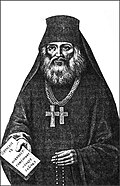 Philaret of GlinskVenerable · Abbot of Glinsk HermitageSep 9
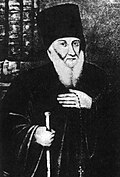 Basil KishkinVenerable · Hieromonk of PloshchanskSep 9
- Zenobius MazhugaSaint · Metropolitan of the Georgian ChurchSep 9
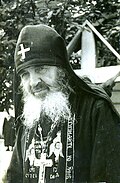 Andronik LukashVenerable · Schema-archimandrite and elderSep 9
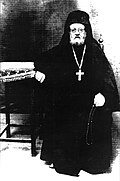 Joanicius of RakotinciVenerableSep 9
 Zacharias LobovHieromartyr · Archbishop of VoronezhSep 9
- Joachim of OpochkaVenerable · Disciple of St. Euphrosynus of PskovSep 9
- Nikita of ConstantinopleFool-for-Christ · Clerk of ConstantinopleSep 9
- AelrhiwSaintSep 9