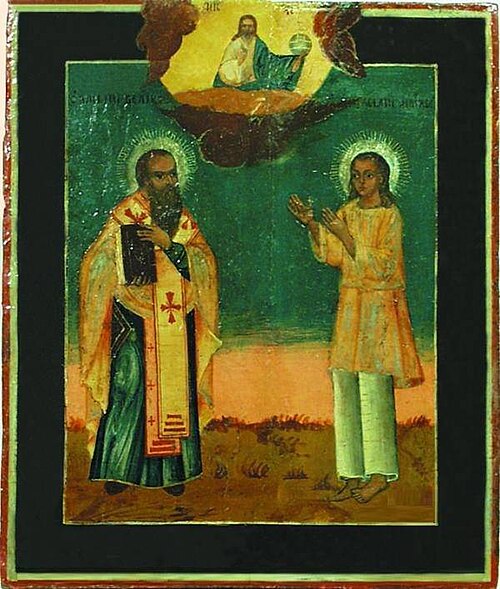
Martyr
Basil of Mangazeya
Boy from Yaroslavl killed at Mangazeya about 1602, honored as the first martyr of Siberia.
Life
Saint Basil of Mangazeya the Martyr (about 1588 at Yaroslavl, about 1602 at Mangazeya) is venerated as the first martyr of Siberia. A young servant of a merchant, falsely accused of theft, he died under torture, according to his life, in the time of the voivode S. Pushkin. Venerated first locally, after the miracles at his grave, he was long tolerated and not confirmed by the church authorities, and finally entered the official calendar at the beginning of the twentieth century. He is regarded as patron of hunters and trappers.
The life
The life of Basil of Mangazeya is known from his vita, preserved in five redactions whose origin is linked with the Trinity Monastery of Turukhansk. The oldest redaction dates from 1670 to 1676 and was written with the participation of the hieromonk Tikhon, who in 1670 moved Basil's relics to the Turukhansk monastery.
According to the life, Basil was the son of the Yaroslavl merchant Fyodor, who gave his son as a worker to a merchant who went to trade at Mangazeya. One day, while Basil was praying in church, thieves robbed his master's shop, and the merchant accused the youth of complicity. The merchant tried to obtain a confession from Basil and beat him, but the youth denied his guilt. Then he was brought to the voivode of the town, S. Pushkin, who subjected Basil to torture, from which he died. In other versions of the life, the voivode struck Basil on the temple with a bunch of keys; or Basil "suffered for chastity" (from the "Description of the Russian Saints", end of the seventeenth to the eighteenth century), and on this basis a redaction of the life written in the middle of the nineteenth century by Hegumen Iliodor of the Turukhansk monastery says that the youth rejected the sinful advances of the merchant, who in revenge accused Basil of theft.
The year of Basil's death, in the opinion of S. V. Bakhrushin, is set conventionally, since the compilers of the life used only the recollections of old-timers. His martyrdom is placed in the first years of the town of Mangazeya (1600 to 1602); the voivode S. Pushkin was at Mangazeya from July 1601 to January 1603; local traditions also date Basil's death to the day of Pascha.
History of the veneration
Basil was buried beside the administrative hut. The place was damp and soon a board was laid on it for ease of passage. In 1649 a resident of Mangazeya, Stepan Shiryaev, discovered that the board had broken, and the edge of a coffin could be seen beneath it. Soon reports of healings appeared, attributed to the relics of the newly revealed servant of God, and the burial place was first fenced, then in 1652 a chapel was built. Information about the miracles of the new saint was sent to the bishop of Tobolsk, who, no later than 1653, wrote to Moscow asking whether he should examine the relics. The request received no answer. In the chapel, supplications to Basil were served, and in August 1659 the relics were examined. After that regular services to Saint Basil began, which allows the conclusion of a local canonization.
In 1670 the builder of the Turukhansk monastery, the hieromonk Tikhon, moved Basil's relics from Mangazeya to his monastery and placed them in the Trinity church, to the right of the royal doors. In 1671 a petition for confirmation of the canonization of Basil was sent to Moscow, but it too was left unanswered. Local veneration continued: the voivode of Tobolsk, I. B. Repnin, sent the monastery an embroidered cover for the saint's shrine, icons of Basil were painted, and his name appears in the Kaidalov calendars (end of the seventeenth century).
The spread of the veneration of Basil of Mangazeya was especially furthered by the hierarch Philotheus (Leshchinsky). He asked Peter I for permission to move the relics to Tobolsk but was refused. On 10 May 1719 Philotheus moved Basil's relics from the Trinity church of the Turukhansk monastery to a new Annunciation church (in memory of this a local monastery feast was established). He also wrote a canon to the saint. During Philotheus's time on the see of Tobolsk, three services were composed for Basil of Mangazeya: for the memory of the appearance, in the town of Mangazeya, from the depths of the earth, of the healing relics of the martyr Saint Basil; for the transfer of the relics from the town of Mangazeya into the bounds of the new town of Turukhansk, to the monastery of the Holy Trinity on the river Tunguska; and for the transfer of the relics of the new martyr Basil, wonderworker of Mangazeya, from the old church to the new. The fame of the Siberian saint reached the capital: Empress Anna Ioannovna sent the Turukhansk monastery an altar Gospel whose cover bore an image of Saint Basil with a cross in his hand and the inscription "Martyr Basil of Mangazeya".
Under Philotheus's successor, Metropolitan Anthony (Stakhovsky), this veneration was stopped; the relics, at the bishop's order, were buried in the ground and a chapel was built over them. The Tobolsk consistory by a decree of 1755 forbade offering supplications to Saint Basil and commemorating him at the dismissal, but in 1756 it was permitted to hold memorial services for him by a special order. In 1788 the bluff on which the chapel stood began to crumble and a coffin with relics emerged from the ground. Hegumen Michael moved it back into the church and placed it under the floor slab. In 1803, during an epidemic, popular disturbances arose, attributing the disease to the lack of due veneration of the saint. This was reported to the Holy Synod and to the Minister of the Interior V. P. Kochubei, and by order of the Archbishop of Tobolsk it was permitted to return the icons of Basil of Mangazeya to the church and the former veneration.
Local veneration of Basil did not cease in the nineteenth century; he came to be honored as patron of hunters and trappers, and his icons were widely distributed. In 1893 a petition was again sent to the Synod to confirm the saint's canonization. The Synod asked for records of miracles, and at the beginning of the twentieth century the name of the martyr Basil of Mangazeya was entered in the "Orthodox Calendar" published by the Synod. After the closing of the Turukhansk monastery in 1921 the saint's relics were lost; fragments of them were found again in 1997 and placed in a shrine in the monastery church. His memory is kept (old style) on 23 March, 10 May, 6 July, 23 May (Synaxis of the Saints of Rostov and Yaroslavl) and 10 June (Synaxis of the Siberian Saints).
Commemorated the same day March 23
 PhiletusMartyr · Martyr of IllyriaMar 23
 Nikon of the Kiev CavesVenerable · Abbot of the Kiev CavesMar 23
 Sergius SrebrianskyConfessor · ArchimandriteMar 23
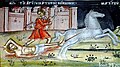 Nikon of SicilyHieromartyrMar 23
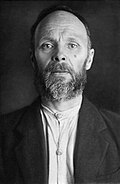 Alexei SkorobogatovMartyrMar 23
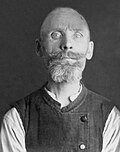 Basil KoklinHieromartyr · PriestMar 23
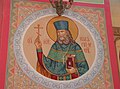 Macarius of OrenburgHieromartyr · Archpriest of OrenburgMar 23
- Aethelwold of FarneVenerableMar 23
- Amphilochius of IllyriaMartyrMar 23
- Anastasia BobkovaVenerable MartyrMar 23
- Barbara KonkinaVenerable MartyrMar 23
- CiannatVenerableMar 23