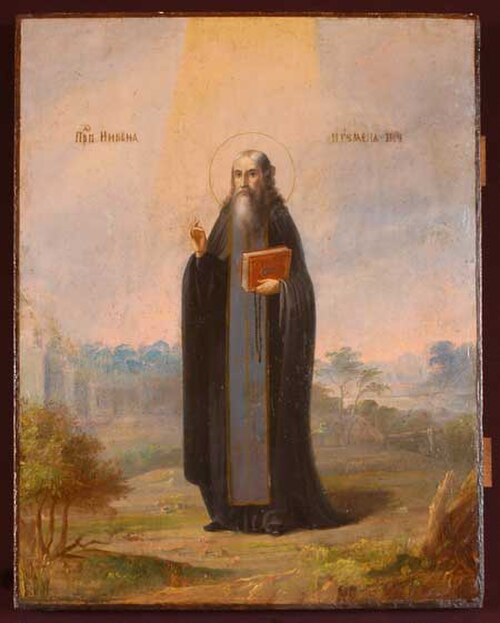
Venerable
Nikon of the Kiev Caves
Abbot of the Kiev Caves
Abbot of the Kiev Caves from 1078 to 1088, a scholar and founder of the monastery at Tmutarakan.
- Feast
- March 23old style April 5
- Reposed
- 108811th century
- Order
- Venerables
Life
Saint Nikon the Great was one of the first disciples of Saint Anthony of the Caves, the spiritual father who tonsured Saint Theodosius, the founder of a monastery of the Mother of God at Tmutarakan on the Black Sea, and abbot of the Kiev Caves Monastery from 1078 to 1088. The chronicle calls him “the wise” and “the great”, and many historians see in him one of the founders of chronicle writing in Kievan Rus'. His relics rest in the Near Caves of the Lavra.
First disciple of Saint Anthony
Nothing is known of his life before he came to the Caves. No later than 1058 he settled with Saint Anthony in the cave on the bank of the Dnieper, already a monk and a priest. Anthony, who was not a priest, entrusted him with tonsuring those who came; so it was Nikon who tonsured the young Theodosius, the future abbot and father of coenobitic life in Rus'.
The chronicler Nestor calls him “the wise” and “the great” Nikon: the first word reflects his learning, the second the particular authority he held among the monks of Rus'. In those years he was in effect the leader of the monks of Kievan Rus'. For this reason the historian M. D. Priselkov suggested that behind the name Nikon was hidden the former Metropolitan Hilarion, who had once dug the cave in which Anthony later settled. Serious arguments stand against this hypothesis: their views of princely power differ, the chronicle speaks of Hilarion as of someone else, and Hilarion, a priest already in the time of Prince Vladimir, could hardly have lived until 1088. Anthropological study indicates that Nikon died at the age of fifty-five to sixty.
The anger of Prince Izyaslav
In the early 1060s Nikon tonsured two prominent men: Varlaam, son of the boyar John, and Ephrem, a eunuch and leading official of the grand prince's court. Grand Prince Izyaslav of Kiev was furious and summoned Nikon. The Life of Saint Theodosius relates that Nikon answered that he had tonsured them by the grace of God and at the command of the heavenly King, and when the prince threatened him with prison and with filling in the cave, he said that he would submit, but that it was not right for him to turn back the soldiers of the heavenly King.
Anthony and the brethren took their garments and set out to leave the city. Then the prince's wife begged him not to be angry, reminding him that in her own homeland, when the monks had left because of some trouble, many misfortunes had fallen on the land. The prince feared the wrath of God, let Nikon return to his cave and sent after the others, who only after nearly three days were persuaded to come back. Even so, the men of the boyar John, Varlaam's father, came and laid waste the monks' dwelling.
Founder at Tmutarakan
In 1061, after these events, Nikon left the Caves together with another monk, a former boyar from the monastery of Saint Mina, wishing to live apart. They went down the Dnieper to the Black Sea and there parted: the other went to an island on the way to Constantinople, while Nikon went to the “island of Tmutarakan”, where he found a free place near the town. There he built a church and a monastery of the Most Holy Mother of God, modelled on the Caves Monastery, and his contemporaries compared it to the Caves.
In the struggle for Tmutarakan between Prince Gleb, son of Svyatoslav, and Rostislav, son of Vladimir, Nikon sided with Rostislav and became close to the voivode Vyshata, son of Ostromir. In February 1067 Rostislav was poisoned by a Byzantine official from Chersonesus. The people of Tmutarakan then sent Nikon to Prince Svyatoslav to ask for a new prince. On the way he passed through the Caves Monastery, where his disciple Theodosius was now abbot, and Theodosius begged him to return. Nikon went with Prince Gleb to Tmutarakan, set the affairs of the monastery in order and in 1068 returned to Theodosius.
Beside Saint Theodosius
Back in Kiev, Nikon submitted to Theodosius with all joy, and the abbot loved him and honoured him as a father. Being the eldest of the brethren, he was often entrusted by Theodosius with the community, and when the abbot was absent Nikon took his place. When Theodosius taught the brethren in church, he would ask Nikon, together with Stephen, the future abbot, to read to them from books for their edification.
In these years several currents could be distinguished in the monastery, according to their form of ascetic life and their political sympathies: a mystical and ascetic one around Anthony, and one of common life and close alliance with the princely power around Theodosius. Nikon belonged to neither: he was a man of letters with his own path, with ties to princes on every side. The chronicle praises both Rostislav and Gleb, whom Nikon had known, at their deaths, and its praise of Izyaslav and his son Yaropolk suggests that he was close to that branch of the ruling family. Some have even supposed that he was the same person as Boyan, the singer of the Lay of Igor's Campaign, but this hypothesis has no basis.
During the Kiev uprising of 1068-1069 and the troubles after 1073, when Izyaslav was driven out by his brothers Svyatoslav and Vsevolod, Nikon again left for Tmutarakan with two monks. The Life of Theodosius says that, seeing the quarrels of the princes, he withdrew to the island where he had founded his monastery, although the blessed Theodosius had often begged him not to part from him as long as they both lived. He remained bound to Tmutarakan until his death, and the chronicle's reports about that region continue until early 1094.
Abbot of the Caves
Nikon returned to the monastery only after the death of Theodosius (1074) and the return of Izyaslav (1077). In 1078, already old and against his will, he was elected abbot of the Caves Monastery, and he remained in this office until his death. He strove to continue all the undertakings of Theodosius and is described as a strict father who was quick to forgive. The disagreements among the brethren that had begun under Theodosius and Stephen continued; the Patericon preserves the memory of disobedient brothers who would not accept his rule and who, in their delusion, came to see the abbot in the form of a donkey.
Nikon wished to adorn the monastery's great church and prayed to God for this. According to the Patericon, in 1083 Greek iconographers arrived unexpectedly from Constantinople, to whom Saints Anthony and Theodosius had appeared in a vision sending them to Kiev; when Nikon showed them images of the two saints, the craftsmen recognised them. They adorned the church with icons and mosaics, and alongside them the first known Russian iconographer, Saint Alypius of the Caves, began his work. The church, however, was not consecrated until after Nikon's death. Priselkov believed that Nikon was preparing the glorification of Theodosius, and that this was when Nestor wrote his life.
The Patericon also shows Nikon as a witness to property agreements and to spiritual brotherhoods placed under the protection of the Mother of God. He reposed on 23 March 1088 (some scholars have proposed 1094) and was buried in the monastery.
Nikon's chronicle
Leading Russian scholars such as A. A. Shakhmatov, M. D. Priselkov and D. S. Likhachev held that Nikon kept a chronicle that was later continued and incorporated into Nestor's Tale of Bygone Years. They point to the agreement between the years of his life and the chronicle's reports about Kiev and Tmutarakan, and attribute to him a compilation made in the 1070s, perhaps in 1073. Nikon would have copied and edited the older Kievan chronicles and added the events of 1061-1088. Other scholars, such as M. Aleshkovsky, reject this view and think that his notes may have entered the chronicle only after his death.
Supporters of the hypothesis see in Nikon the one who introduced year-by-year narration and precise dates in Rus'. According to Likhachev he stood above his predecessors as a historian: he commented on older reports, checked them against other sources, connected different parts of the chronicle and weighed several versions of events. Through him, Likhachev wrote, a genre unknown to Byzantine literature was born, the chronicle. The archaeologist M. K. Karger called him “the first archaeologist of Kiev” because of his notes on ancient sites, which helped reconstruct the appearance of Kiev in the tenth and eleventh centuries.
On his journeys he came to know the Dnieper route well, and perhaps also Chersonesus, whose topography appears in the account of Prince Vladimir's baptism. The chronicle also mentions the ruins of old Slavic towns at the mouths of the Dniester and the Danube, where the fort called Kievets stood. Some scholars attribute to Nikon the account of the duel between Prince Mstislav of Tmutarakan and the Kasog prince Rededya (1022), the version of Vladimir's baptism at Chersonesus and the story of Princess Olga's three acts of vengeance on the Drevlians (946).
Veneration
The relics of Saint Nikon rest in the Near Caves (of Saint Anthony) of the Kiev Caves Lavra, and his image is preserved in the wall paintings of the Lavra's churches. He is commemorated on 23 March, the day of his repose, on 28 September in the Synaxis of the Venerable Fathers of the Near Caves, and in the Synaxis of the Saints of Tula.
Commemorated the same day March 23
 PhiletusMartyr · Martyr of IllyriaMar 23
 Sergius SrebrianskyConfessor · ArchimandriteMar 23
 Basil of MangazeyaMartyrMar 23
 Nikon of SicilyHieromartyrMar 23
 Alexei SkorobogatovMartyrMar 23
 Basil KoklinHieromartyr · PriestMar 23
 Macarius of OrenburgHieromartyr · Archpriest of OrenburgMar 23
- Aethelwold of FarneVenerableMar 23
- Amphilochius of IllyriaMartyrMar 23
- Anastasia BobkovaVenerable MartyrMar 23
- Barbara KonkinaVenerable MartyrMar 23
- CiannatVenerableMar 23