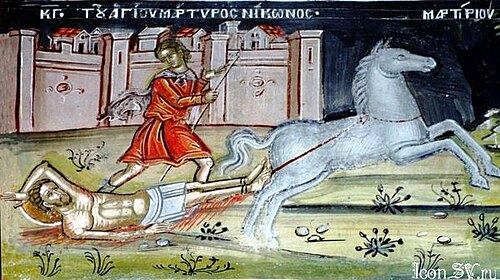
Hieromartyr
Nikon of Sicily
Born at Naples into a noble family with a pagan father and Christian mother, a soldier and then bishop; died a martyr.
Life
Venerable martyr Nicon of Sicily (killed, according to our record, around the year 251) was a bishop, born at Naples into a noble family, a soldier and then a monk, killed in Sicily together with his one hundred and ninety-nine disciples. He is commemorated on 23 March (Old Style). His story is preserved in the Life written by his disciple Heromenus, and the date and details cannot be checked from other sources.
Naples and baptism
He was born and grew up at Naples, in a noble family. His father, a pagan Hellene, brought him up in idolatry, while his mother, a Christian, brought him up in the faith. Grown to manhood, he was a soldier. In a bloody battle, in particular danger, he remembered his mother's teaching, signed himself with the sign of the Cross and called on Christ as God; afterwards he felt an unusual courage, struck down many enemies with his spear and put the rest to flight. Returning home, he resolved to be baptized. He promised his mother, who felt her death approaching, to return to bury her, and went to seek a priest to baptize him, which was hard because of the persecution.
After long searching, far from his homeland, he met Theodosius, bishop of Cyzicus, who baptized him and tonsured him a monk. By humility, meekness, zeal, love and other monastic virtues Nicon amazed the brothers and Theodosius. After three years, by God's will, Theodosius reposed, and Nicon, with the monks, came by ship to Naples, where he found his mother alive, who, seeing him after so long a time as a bishop, died.
Sicily and martyrdom
Nine of his friends from earlier military service, hearing his sermons, went after him and his brothers by ship to Sicily, to Mount Taormina, where they settled. The place was beautiful and solitary, and the soil good for tilling. They planted vineyards and fruit trees and began to live there. Nicon baptized the nine friends and tonsured them monks. Many years passed, but the persecution of Christians continued. Pagans denounced Nicon and his brothers to the governor of Sicily, Quintian, who ordered them seized for not obeying the emperor's laws and not honouring the pagan gods. Nicon and his disciples were seized. On the way Nicon strengthened his disciples, and before the governor they firmly confessed themselves Christians. Seeing them unmoved, the governor decided to put the disciples to death at once, lest they draw others by their faith, and to leave Nicon for torments.
One hundred and ninety-nine disciples were killed with the sword, and their bodies, by the executioner's order, were thrown to be burned. Bishop Nicon, having a vision in a dream, told it to his attendant, Heromenus, who later wrote his Life and passion; Nicon foretold, according to the vision, the fierce and near death of Quintian. The executioner ordered him tied to four chariots, by hands and feet, and burned from below with fire. Nicon lay on the burning coals as on flowers, singing a psalm to God. After many other tortures the governor ordered his head cut off. His body was left unburied, cast as food for beasts and birds. The same day Quintian, going to seize the property of Saint Agatha, whom he had tortured not long before, was drowned at a river crossing. The bishop of Messina went with his clergy to take the bodies of the martyrs and buried them all with honour, "in a famous place", as the Life says.
Commemorated the same day March 23
 PhiletusMartyr · Martyr of IllyriaMar 23
 Nikon of the Kiev CavesVenerable · Abbot of the Kiev CavesMar 23
 Sergius SrebrianskyConfessor · ArchimandriteMar 23
 Basil of MangazeyaMartyrMar 23
 Alexei SkorobogatovMartyrMar 23
 Basil KoklinHieromartyr · PriestMar 23
 Macarius of OrenburgHieromartyr · Archpriest of OrenburgMar 23
- Aethelwold of FarneVenerableMar 23
- Amphilochius of IllyriaMartyrMar 23
- Anastasia BobkovaVenerable MartyrMar 23
- Barbara KonkinaVenerable MartyrMar 23
- CiannatVenerableMar 23