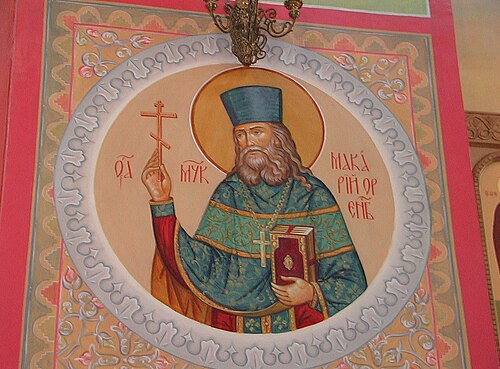
Hieromartyr
Macarius of Orenburg
Archpriest of Orenburg
Archpriest of the Orenburg diocese, who died in 1931 and was canonized in 2000 by the Council of Bishops.
Life
Saint Macarius Fyodorovich Kvitkin, hieromartyr, was an archpriest of the Orenburg diocese. He refused to renounce the faith and the priesthood, was arrested in January 1931 and shot on Palm Sunday, 5 April 1931. The Russian Orthodox Church glorified him as a hieromartyr in 2000.
Childhood and priesthood
He was born on 23 July 1882 into the Orthodox townsfolk family of Fyodor Semyonovich and Ekaterina Alekseevna in Orsk. He had three sisters and a brother. From childhood he was deeply devout, often went to church, and read and sang in the choir. He graduated from a teachers' gymnasium and taught for seven years in a parish school, and in 1905 he finished the Orenburg seminary. In 1904 he married Efrosinia Kondratievna Beznosova, and they had five children.
In 1907 Bishop Joachim of Orenburg appointed him psalm-reader at the Alexander Nevsky church in Novo-Alexandrovka. He was an active missionary in the region and a member of the diocesan missionary society. On 4 February 1913 he was ordained deacon by Bishop Theodosius and sent to the village of Berdyash. He then served in several places in the diocese, and shortly before the revolution of 1917 he was ordained priest. Between 1918 and 1920 he served at Novo-Troitsk, then at Verkhnyaya Pavlovka, and from 1920 in the village of Pervaya Alexandrovka, in a house of prayer. In 1924 the parishioners built a small wooden church there, which was closed in 1925.
In the autumn of 1925 Bishop Jacob of Orenburg appointed him second priest of the church of Saint Seraphim of Sarov in Forstadt, a suburb of Orenburg. He was invited there as a firm opponent of the Living Church, known for his uncompromising defence of Orthodoxy.
Years of persecution
When Metropolitan Sergius issued his declaration on 16 (29) July 1927, stating that there was no persecution of the Church in the Soviet Union, the priests of the Orenburg diocese drew away from him. Seeing, however, the futility of opposition in the face of ever more merciless persecution, they stopped criticizing his actions. The general assembly of the parish expressed its trust in Father Macarius and kept him as rector of the church of Saint Seraphim. For this the authorities laid enormous taxes on the community and then began to take away sacred vessels, gold and silver coverings of icons and Gospel books, supposedly as payment of the tax.
Atheists proposed that Father Macarius renounce God and the priesthood in the regional newspaper and admit that his faith was obscurantism, promising him in return a teacher's post or even a school directorship. He refused flatly, saying that he did not fear death, that he left his children to the will of God, but that the vow he had made to God he would never break. All his children grew up to be believers. In 1930 the church was closed on the pretext of unpaid taxes, and the bishop blessed him to serve at the church of Saint Nicholas in Forstadt. In the same year he was deprived of civil rights. The family, with four children, lived in an old bathhouse adapted for dwelling and ate the bread and potatoes that parishioners secretly brought.
Arrest and martyrdom
In 1929-1930 the OGPU arrested thousands of believers who did not accept Metropolitan Sergius's policy. In January 1931, 157 people were arrested in the Orenburg region: nine priests, twenty-seven monks and one hundred twenty-one laypeople. Father Macarius was among them. On the night of 21 to 22 January 1931 security officers came to search his home, and the search lasted from midnight until four in the morning.
He was accused of refusing to marry those who had obtained a civil divorce and remarried, considering such marriages adulterous, and of commemorating only Metropolitan Peter, the locum tenens, at the services. On 23 January he answered at interrogation that he had not married those divorced by the civil authority, since he held this contrary to Holy Scripture, and that regarding the omission of Metropolitan Sergius's name he had no firm opinions and no intention of breaking prayerful and canonical communion with him. On 6 March the investigation ended. All the arrested were accused of having formed a single counter-revolutionary religious organization called "the True Ones".
On 26 March 1931 an OGPU troika sentenced the accused to various terms, and thirty-six to death. Three were shot on the night of 31 March. By a decision of the troika on 31 March, Father Macarius Fyodorovich Kvitkin and thirty-two others were sentenced to death. On Palm Sunday, 5 April 1931, at 4:25 in the morning, all of them were shot. The bodies were secretly taken away and buried in an unknown common grave. In 2020 his burial place was established at the old city cemetery of Orenburg.
Rehabilitation and veneration
On 2 November 1989 he was posthumously rehabilitated by the prosecutor's office of the Orenburg region. In 1981 the Council of Bishops of the Russian Orthodox Church Outside Russia numbered him among the New Martyrs of Russia, and on 13-16 August 2000 the Jubilee Council of Bishops of the Russian Orthodox Church glorified him as a hieromartyr. His icon was painted in 1984 at the Holy Trinity Monastery by Archimandrite Cyprian. He is commemorated on 5 April, the day of his martyrdom, and at the Synaxis of the New Martyrs and Confessors of Russia.
Commemorated the same day March 23
 PhiletusMartyr · Martyr of IllyriaMar 23
 Nikon of the Kiev CavesVenerable · Abbot of the Kiev CavesMar 23
 Sergius SrebrianskyConfessor · ArchimandriteMar 23
 Basil of MangazeyaMartyrMar 23
 Nikon of SicilyHieromartyrMar 23
 Alexei SkorobogatovMartyrMar 23
 Basil KoklinHieromartyr · PriestMar 23
- Aethelwold of FarneVenerableMar 23
- Amphilochius of IllyriaMartyrMar 23
- Anastasia BobkovaVenerable MartyrMar 23
- Barbara KonkinaVenerable MartyrMar 23
- CiannatVenerableMar 23