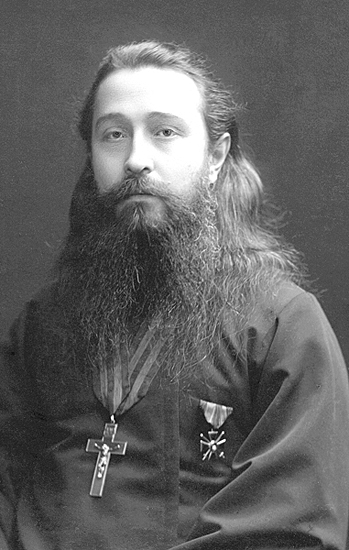
Confessor
Sergius Srebriansky
Archimandrite
Russian archimandrite, 1870 to 1948, a confessor of the faith under the Soviet persecutions.
- Feast
- March 23old style April 5
- Reposed
- 194820th century
- Place
- Parizhskaya Kommuna, Voronezh Oblast
- Order
- Confessors
Life
Saint Sergius Srebriansky, the Archimandrite and Confessor (in the world Mitrofan Vasilievich Srebriansky, 1870 to 1948), was a regimental priest, spiritual father of the Convent of Martha and Mary in Moscow, founded by Grand Duchess Elizabeth Feodorovna, and, after its closing, an elder of prayer in the village of Vladychnya, in the Tver region. He bore arrest and exile, served in secret and passed away in 1948. The Russian Church canonized him in 2000, and his relics rest in the cathedral at Tver.
Family and priestly service
He was born on 1 (13) August 1870, in the village of Trehsviatskoe in Voronezh province, to a priest's family. He graduated from the theological school at Voronezh (1889) and the seminary there (1892) and studied at the Warsaw Veterinary Institute. In 1893 he married Olga Ispolatovskaya, daughter of the priest of the village of Vladychnya in the diocese of Tver. From March 1893 he was deacon at the church of Saint Stephen in the Ostrogozhsk district, and from 1896 priest of the 47th Tatar Dragoon Regiment.
From 1897 he was rector of the church of the Protection of the Mother of God of the 51st Chernigov Dragoon Regiment in the city of Orel, whose chief was Grand Duchess Elizabeth Feodorovna. During his service he led the building of the church and set up a library and a school beside the parish. All the sums received from benefactors he gave to the church, school and library. In 1904 and 1905 he was with the regiment in the Russo-Japanese War and kept in the active army a detailed diary, published in the journal "Herald of the Military Clergy" and then as a separate book.
At the Convent of Martha and Mary
From 1908 he was spiritual father of the Convent of Martha and Mary in Moscow, founded under the guidance of Grand Duchess Elizabeth Feodorovna, and rector of the church of the Protection of the Mother of God in the convent. He wrote a brochure describing and interpreting the spiritual meaning of the paintings and icons of Mikhail Nesterov for that church. After the arrest and death of the Grand Duchess he continued to care spiritually for the sisters of the convent.
Being a married priest, he and his wife raised three orphaned nieces, among them Alexandra Martinovna Khostnik, daughter of Martin Khostnik, author of a Slovenian-Russian dictionary. They wished to have children but it did not happen. Seeing in this God's will, calling them to a particular Christian labour, the couple moved into the convent and vowed to abstain from married life.
On 25 December 1919 Patriarch Tikhon, who knew Father Mitrofan well, thanked him for his many labours and gave him the patriarchal blessing with a letter and an icon of the Saviour. At that time the question of monasticism was settled for him and for his wife, Olga. Mitrofan was tonsured with the name Sergius, and Olga with the name Elizabeth. Soon after, Patriarch Tikhon raised Father Sergius to the rank of archimandrite.
Persecution and Vladychnya
On 23 March 1923 he was arrested and spent five months in prison without charge. Then, by an OGPU order of 24 August 1923, he was exiled for a year to Tobolsk. After exile he returned to Moscow and was arrested again, but soon released. After the closing of the Convent of Martha and Mary, in 1925, he went to the village of Vladychnya, in the Tver region, where he served in the local church. He was known as a man of prayer and holy life. People began to come to him for help and some, through their faith and the prayers of the righteous man, received healings.
In 1930 he was arrested and sentenced to five years of exile in the Northern Region. He lived in a village on the river Pinega, where the nun Elizabeth came to him, and worked felling timber. After two years he was released early, for age, illness and good work, and again lived at Vladychnya. The village church being closed, he walked to pray in the neighbouring village, and after the authorities expressed displeasure at this, he prayed in his own house. He continued to serve in secret, despite the authorities' ban, putting civilian clothes over his cassock and going from house to house to perform the services. One such house was that of his wife's brother, Polyeuctus Ispolatovsky, and Eugenia, in the village of Kryuchkovo. With Polyeuctus he had studied at the Warsaw Veterinary Institute and then been together in the war of 1914.
During the war a Soviet military unit was stationed at Vladychnya, the village being near the front. Almost daily German aircraft flew over the unit's position, but not one bomb fell on the church or the village. The faithful connected this with the elder's prayers. Father Sergius is depicted in Pavel Korin's painting "Russia Departing".
Death and veneration
He fell asleep on 6 April 1948 at Vladychnya. After his death veneration of him as an ascetic and man of prayer grew with time. Many of the faithful came to his grave in Vladychnya to pray and to receive spiritual comfort and intercession. Many go also to the spring beside the village from which the saint drew water.
On 19 September 1999 he was canonized as a locally venerated saint of the Tver diocese. In August 2000 the Jubilee Bishops' Council of the Russian Church canonized him among the New Martyrs and Confessors of Russia. On 11 December 2000 his relics were moved to the Resurrection Cathedral at Tver, in a side altar, for general veneration. The saint is commemorated on 23 March (5 April by the new calendar), on 28 November (11 December) for the finding of the relics, and in the Synaxis of the New Martyrs. Of his writings there remain "Instruction of a Spiritual Father to the Sisters of the Convent of Martha and Mary" (1909), an explanatory word on the convent, a description of the church of the Protection in the convent and the "Diary of a Regimental Priest".
Commemorated the same day March 23
 PhiletusMartyr · Martyr of IllyriaMar 23
 Nikon of the Kiev CavesVenerable · Abbot of the Kiev CavesMar 23
 Basil of MangazeyaMartyrMar 23
 Nikon of SicilyHieromartyrMar 23
 Alexei SkorobogatovMartyrMar 23
 Basil KoklinHieromartyr · PriestMar 23
 Macarius of OrenburgHieromartyr · Archpriest of OrenburgMar 23
- Aethelwold of FarneVenerableMar 23
- Amphilochius of IllyriaMartyrMar 23
- Anastasia BobkovaVenerable MartyrMar 23
- Barbara KonkinaVenerable MartyrMar 23
- CiannatVenerableMar 23