Hieromartyr
Boris Bogolepov
A Russian priest who died a martyr for his faith in Christ during the communist persecution.
- Feast
- September 18old style October 1
- Reposed
- 193720th century
- Order
- Martyrs
Life
Holy Hieromartyr Boris Bogolepov, a priest, was born on 18 June 1889 in Moscow and received the crown of martyrdom by shooting on 1 October 1937. From July 1936 he served at the Holy Trinity church in the village of Korobino, in the Tver region. He graduated from the Moscow Theological Seminary and was ordained priest. He was glorified among the saints in August 2000, at the Jubilee Council of Bishops, for veneration in the whole Church. He is commemorated on 1 October, on 7 February, in the Synaxis of the New Martyrs and Confessors of the Russian Church, and on 18 July, in the Synaxis of the Saints of Tver.
Family and taxes
He had a large family: four daughters and a son. The elder daughters lived on their own, and his son Andrei, thirteen, and his daughter Evgenia, eight, lived with their father, with his wife Ekaterina Alekseevna and with his grandmother Maria Ivanovna, Father Boris's mother. In January 1937 the village soviet demanded from the priest his taxes for the previous year: fifty kilograms of meat and a hundred and sixty roubles each of culture tax, income tax and self-taxation. He refused to pay and to give explanations, and the case went to court. At the trial he defended himself by saying he had neither means nor livestock or poultry. He was sentenced to a year and a half in a labour camp. Father Boris did not accept the charge and appealed, to which the authorities did not dare reply, and the priest was not arrested.
The trials
In April 1937 a new trial took place. This time he was accused of having performed the funeral service and taken part in the burial of a parishioner before her husband had received the death certificate from the village soviet, and of baptising infants without prior registration at the civil registry. The priest answered that he knew the regulation but had broken it and would break it, because baptism was his first duty. Asked why he had buried the woman without a certificate, he said that under the new constitution faith is not persecuted. He was sentenced to six months in a labour camp and appealed again. On 19 April the community of the church asked the district committee whether Soviet laws permitted processions at Easter and, in general, processions with icons and prayer services in believers' homes. The committee answered that the instruction granting the right remained in force, but that permission was required, and later forbade visits to houses because of a scarlet fever epidemic. The priest thought it absurd to submit and began to serve prayer services at the invitation of peasants, in the village and in distant villages.
Arrest and death
At the end of July the Bureau of Correctional Labour summoned Father Boris for 27 July to go to the camp, but he did not appear and left home for a time. What the petty persecutors could not achieve was finished by a decree of Stalin, and Father Boris was arrested. The chairman of the village soviet wrote that the priest went without permission with icons through the peasants' yards, that he was fined seventy-five roubles and refused to pay, that he called Soviet propaganda empty talk, that he brought icons to a village on a feast day and kept a work shift from the harvest, and that he collected money for the repair of the church. On 8 September he was interrogated. He said that he had not engaged in counter-revolutionary agitation, that he had acted according to the law on freedom of conscience, and that for a believer agitation against religion is empty talk. On 27 September the NKVD troika condemned him to death, and on 1 October 1937 he was shot.
Commemorated the same day September 18
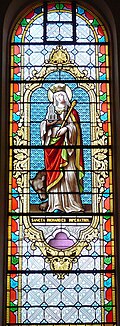 RichardisRight-Believing · Carolingian empressSep 18
 Ariadne of PhrygiaMartyr · Martyr of PhrygiaSep 18
 Constantius of the Theban LegionMartyr · Soldier of the Theban LegionSep 18
 Eumenes of GortynaSaint · Bishop of Gortyna in CreteSep 18
 Euphrosyne of SuzdalVenerable · Princess and nun of SuzdalSep 18
 Hilarion of OptinaVenerable · Hieroschemamonk of OptinaSep 18
 Sophia and Irene of EgyptHoly MartyrsSep 18
- Bidzina CholokashviliMartyr · Leader of the Bakhtrioni UprisingSep 18
 Juventinus and MaximinusMartyrSep 18
- Romylos of RavanicaVenerableSep 18
 Amphilochius SkvortsovHieromartyr · Bishop of MelekessSep 18
 Ilarion FeleaConfessor · Priest and theologianSep 18