Martyr
Castorius of Rome
Martyr of Rome, who suffered for Christ.
- Feast
- December 18old style December 31
- Era
- unknown
- Order
- Martyrs
Life
Holy Martyr Castorius of Rome was one of those who suffered at Rome together with the Holy Martyr Sebastian of Milan, in the persecution of Diocletian. The Church commemorates him on 31 December (new style).
Sebastian and the martyrs
Sebastian was born in the city of Narbonne in Gaul and was educated at Milan. In the time of the emperors Diocletian and Maximian (284-305) he was commander of the palace guard. He enjoyed authority and love among the soldiers and courtiers, for he was brave, wise, truthful in speech, just in judgment, prudent in counsel and faithful in service. A secret Christian himself, he helped his fellow believers much. The Christian brothers Marcellinus and Marcus, in prison, at first steadfast in confession, wavered under the tearful pleas of their pagan parents, Tranquillinus and Marcia, their wives and children. Sebastian went to the emperor's treasurer, in whose house Marcellinus and Marcus were held, and delivered an inspired sermon, urging them not to abandon the banner of their victories for the tears of women. He persuaded the brothers to go to martyrdom. His word shook all who were present. They saw the saint's face shining like an angel's, seven angels clothed him in a bright garment, and a wonderful Youth blessed him, saying: "You will always be with Me." The wife of the treasurer Nicostratus, Zoe, who had lost her voice six years before, fell at the feet of Sebastian and asked him by signs to heal her. The saint marked her with the sign of the cross, she spoke at once and glorified the Lord Jesus Christ and said she had seen an angel with an open book from which Sebastian read his sermon. Then all who were present believed. Nicostratus took off the chains of Marcellinus and Marcus and proposed that they flee, but the brothers refused.
Nicostratus asked the chief of the prisons of Rome, Claudius, to send him all the prisoners at his house. Sebastian saw that all were worthy of Baptism, and the presbyter Polycarp prepared them by the word of instruction. In the evening Polycarp baptized Tranquillinus, his relatives and friends, Nicostratus and his family, Claudius and his sons, and sixteen prisoners. In all, 64 people. Before the prefect Chromatius, Nicostratus told how Sebastian had converted them and healed many. Chromatius was persuaded, was enlightened and believed in Christ, and with him his son Tiburtius and all his household were baptized. The number of the newly enlightened rose to 1400. Chromatius gave up the office of prefect and, with the blessing of the bishop of Rome, Gaius, left with the presbyter Polycarp for his estates in the south of Italy. Those who could not go to martyrdom left with them. Tiburtius stayed in Rome with Sebastian, desiring martyrdom. There remained Tranquillinus, ordained a presbyter by Gaius, Marcellinus and Marcus, deacons, Nicostratus, his wife Zoe and brother Castorius, Claudius, his son Symphorianus and his brother Victorinus. They gathered in the emperor's palace, at the house of the official Castulus, a secret Christian, but soon the time came for them to suffer for the faith.
Martyrdom
First the holy Zoe was seized, while praying at the tomb of the Apostle Peter. She boldly confessed Christ and passed away hung by her hair over putrid refuse; her body was thrown into the Tiber. The presbyter Tranquillinus was stoned at the tomb of the Apostle Peter, and his body too was thrown into the Tiber. The holy Nicostratus, Castorius, Claudius, Victorinus and Symphorianus were seized on the river bank while searching for the bodies of the martyrs. They were brought to the prefect and refused the command to sacrifice to idols. Stones were tied to their necks and they were drowned in the sea. Saint Tiburtius was betrayed by the false Christian Torquatus. Failing to make him renounce, the judge ordered the young Tiburtius set on burning coals, but the Lord protected him: he walked on the coals without feeling heat. The tormentors beheaded him, and an unknown Christian buried him. Torquatus also handed over the deacons Marcellinus and Marcus and the official Castulus. After tortures Castulus was thrown into a pit and covered alive with earth, and the feet of Marcellinus and Marcus were nailed to a stump. They stood all night in prayer, and in the morning were pierced with spears.
The last taken to torment was Saint Sebastian. The Emperor Diocletian himself questioned him and, seeing him unshaken, ordered him taken out of the city, tied to a tree and shot with arrows. The wife of the official Castulus, Irene, came at night to bury him, but found him alive and took him to her house. Sebastian soon recovered. The Christians urged him to leave Rome, but he refused. Approaching a pagan temple, he saw the emperors heading toward it and rebuked them openly for their impiety. Diocletian ordered him taken to the hippodrome and killed. Saint Sebastian was put to death, and his body was thrown into a refuse pit. The martyr appeared in a dream to the Christian Lucina and commanded her to take his body and bury it in the catacombs. The pious Christian buried it with honour.
Commemorated the same day December 18
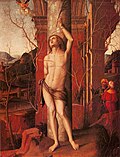 SebastianMartyr · Roman soldierDec 18
 Modestus of JerusalemSaint · Patriarch of JerusalemDec 18
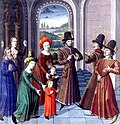 Mark and MarcellianHoly Martyrs · Martyrs of RomeDec 18
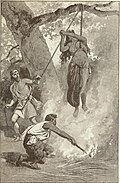 Zoe of RomeMartyr · Martyr of RomeDec 18
 Gatianus of ToursSaint · First Bishop of ToursDec 18
 Winibald of HeidenheimVenerable · Abbot of HeidenheimDec 18
 Thaddeus UspenskyHieromartyr · Archbishop of TverDec 18
 Sebastian of SokhotaVenerable · Abbot of the Transfiguration MonasteryDec 18
- Carion the HermitVenerable · Hermit of ScetisDec 18
 Daniel the HesychastVenerable · Abbot of Voroneț MonasteryDec 18
 Nicholas KlementyevHieromartyr · Archbishop of Veliky UstyugDec 18
- Aedhgein of Ard LonainSaintDec 18