Hieromartyr
Christopher Nadezhdin
A hieromartyr of the Russian Church, commemorated in the Orthodox calendar.
Life
Holy Hieromartyr Christopher Nadezhdin, an archpriest, priest of the church of Saint John the Warrior in Moscow, was condemned and executed in 1922, together with the archpriests Vasily Sokolov and Alexander Zaozersky, the hieromonk Macarius (Telegin) and the layman Sergius Tikhomirov, at the time of the resistance to the confiscation of church valuables. He is commemorated on 26 May.
Studies and ordination
He was born on 21 February 1869 in the village of Nizhny Beloomut in the Zaraisk district, Ryazan province, in the family of the priest Alexei Nadezhdin. He studied at the theological school in Zaraisk, and in 1889 finished the theological seminary at Ryazan and was appointed teacher of singing and calligraphy at the Don theological school; on 20 November 1891 he became inspector of the school. In 1892 he entered the Moscow Theological Academy, with the scholarship of Archbishop Macarius of the Don. Intense study and the desire to master the subjects deeply, together with the preparation of his candidate's work begun almost on entering the academy, seriously upset his health, and the academy's physician insisted that he be sent in the summer of 1895 to Samara province for koumiss treatment. In 1897 he graduated from the academy and defended the work An Outline of the History of Orthodox Polemical Literature against the Schism in the Seventeenth and Early Eighteenth Centuries (until the founding of the Holy Synod), receiving the degree of candidate of theology. In his review, Ilya Gromoglasov praised the author's extraordinary scholarly diligence, for he not only gathered all the printed polemical monuments of the period, but found in the academy library and in the repositories of Moscow and Petersburg a number of new sources, hitherto unknown to scholars. At the academy he made friends with Ivan Vasilievich Uspensky, later Archbishop Thaddeus of Tver, a hieromartyr, whose views on ascetic struggle, on the ceaseless fight against thoughts and on zealous service of God were very close to his own.
At the end of the academy, its rector, Bishop Theodore, offered him a place as missionary in Novocherkassk, but his aged parents, anxious at the separation, insisted that he serve near them. On 10 February 1899 he became religion teacher at the zemstvo school of his native village. In 1900 he was appointed head of the religious and moral readings on Sundays and feasts and of the girls' parish school in Nizhny Beloomut. On 10 July 1900 Bishop Polyeuctus (Pyaskovsky) of Ryazan ordained him deacon, and the next day priest at the Transfiguration church in Nizhny Beloomut. On 23 June 1902 he was appointed priest at the church of the Forerunner in Starokonyushenny Lane in Moscow and religion teacher at the Mednikov gymnasium. On 10 July 1906 he was moved to the church of the Holy Martyr John the Warrior, where he served until his death. Besides the priestly duties, which he fulfilled with zeal, preaching the word of God tirelessly, he was religion teacher at the Lomonosov girls' gymnasium and later at the Helbig one. In 1915 and 1916 he held talks outside the services with the people, which sometimes three hundred attended. The parish then numbered nearly two thousand souls. On 3 January 1921 he was appointed dean.
Trial and martyrdom
On 23 March 1922 the godless authorities arrested him, accusing him that on 4 March he had given in church a sermon in which he said that the present ruin was a consequence of the moral decline of the people, and that he had read in church Patriarch Tikhon's appeal concerning the confiscation of church valuables and circulated it in the churches of his deanery. At the interrogation he said that he did not admit guilt of agitation against the decree on confiscation. The sermon of 4 March, he said, was an explanation of the church name of the approaching Sunday, the Sunday of Orthodoxy. Disobedience to the Church leads in practice to the ruin we see; we have fallen morally to such a degree that God's judgment justly comes upon us, and this is expressed perhaps also in the confiscation of valuables to help the hungry, which might not reach the hungry. The Patriarch's appeal had been brought to him twice, through persons unknown to him, but without doubt from the supreme church authority; he read it personally in his church on 12 March after the Liturgy, and through believers sent it to the churches of the deanery. In the courtroom he said that he had read the Patriarch's appeal and considered it religious, that he saw nothing counter-revolutionary in it. On 7 May, in his last word, he said that a man who goes to church and hears the word of God must help the poor, that he had considered it his sacred duty to call his flock to this obligation and that no great feast had passed without his calling to help the hungry; that he received donations, that he did not permit himself to take payment for services; that he welcomed the separation of Church from state, for then the priest becomes freer; that he had never sought to rouse his flock, but to bring calm.
On 8 May 1922 the tribunal's sentence was read: eleven people condemned to death, among them the priests Vasily Sokolov, Christopher Nadezhdin, Alexander Zaozersky, the hieromonk Macarius (Telegin) and the layman Sergius Tikhomirov. After the trial they were all taken to the solitary block of the Butyrka prison, placed one to a cell and deprived of walks. When it became known that the execution had been suspended, the condemned, with the permission of the prison chief, petitioned for an easing of conditions, but the request was rejected. The same day Stalin sent the members of the Politburo a note, writing that Kamenev proposed to limit the shooting to two priests and asking for a vote; he personally voted against cancelling the decision. Lenin, Trotsky, Stalin and Zinoviev voted for the sentence. On 9 May Patriarch Tikhon sent Kalinin a plea for mercy. On 11 May the Politburo met again; Trotsky proposed to use the moment for an appeal from the progressive clergy and to divide the condemned into two groups. The Renovationists also asked for mercy, though considering the sentence perfectly just. On 14 May a commission removed six others from the list of the eleven, and on 18 May the Politburo took the final decision to shoot the five. The archpriests Vasily Sokolov, Christopher Nadezhdin, Alexander Zaozersky, the hieromonk Macarius (Telegin) and the layman Sergius Tikhomirov received a martyr's end at the end of May 1922 and were buried near the Kalitnikovo cemetery.
He is commemorated on 26 May, on 7 February, in the Synaxis of the New Martyrs and Confessors of the Russian Church, on 5 September, in the Synaxis of the Saints of Moscow, and on 10 December, in the Synaxis of the New Martyrs and Confessors of Radonezh (new style, some days movable).
Commemorated the same day May 13
 Servatius of MaastrichtSaint · Bishop of TongerenMay 13
 Euthymius the AthoniteVenerable · Georgian monk on Mount AthosMay 13
 Agnes of PoitiersVenerable · Abbess of the Holy Cross ConventMay 13
 Glyceria of HeracleaMartyr · Virgin of HeracleaMay 13
 Macarius of KanivVenerable Martyr · Archimandrite of KanivMay 13
 MaelVenerable · Hermit on Bardsey IslandMay 13
 Pausicacus of SynadaSaint · Bishop of SynadaMay 13
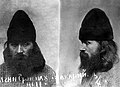 Macarius TeleginVenerable Martyr · Hieromonk of Chudov MonasteryMay 13
 Gabriel the IberianVenerable · Monk of Iviron MonasteryMay 13
 Glykeria of NovgorodRighteous · Righteous virginMay 13
 Macarius of GlushitsaVenerableMay 13
- Natalis of MilanSaint · Archbishop of MilanMay 13