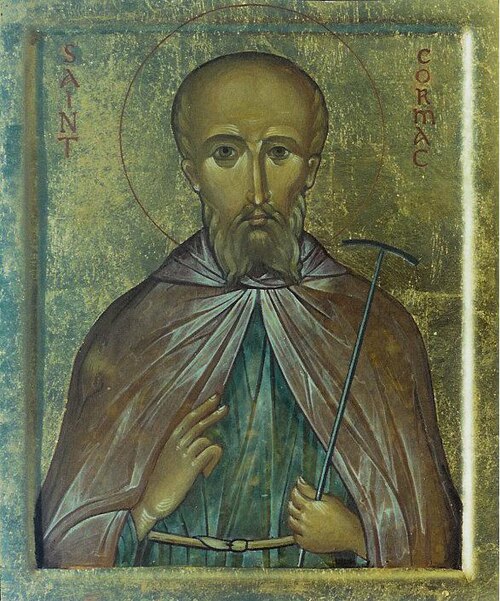
Venerable
Cormac Ua Liatháin
An Irish monk, a disciple of Saint Columba and Abbot of Durrow, reposed around 590.
- Feast
- June 21old style July 4
- Reposed
- 5906th century
- Place
- Durrow Monastery
- Order
- Venerables
Life
Saint Cormac Ua Liatháin (also called Cormac of the Sea or Corbmac) was an Irish saint of the sixth century, a disciple of Saint Columba, known only from the Life of Saint Columba written by Adomnán of Iona. The calendar calls him abbot of the monastery of Durrow and gives his repose around 590. In Adomnán's narrative he is mentioned three times. He is described as a hermit who searches for islands on which to live in prayer, and he is said to have founded monasteries.
The first time, Columba foretold that Cormac had just set sail from the district of Erris beyond the river Moy to find a place of retreat and would find none, because God would not allow it, since he was travelling with a monk who was away without his abbot's permission. The second time Cormac set out to sea again. Columba, who was then in Pictland with King Bridei, knew that he would reach the Orkney islands and asked the king to protect any of his brethren who came there. The king obeyed, and Cormac was kept from harm. A few months later at Iona they were talking about Cormac, and Columba said that he would arrive that very day, which came to pass.
The third voyage on the ocean lasted fourteen days, driven by a southerly wind that carried him far to the north; his boat was attacked by a swarm of large flightless insects, and Cormac feared they would puncture the skin covering of the boat. He prayed, and Columba, present in spirit, called his monks to prayer, and God turned the wind back to the south. On another occasion Cormac, together with Saints Cainnech, Comgall and Brendan, found Columba on the island of Hinba, and they chose him to celebrate the Liturgy; during it Brendan saw a ball of radiant fire above Columba's head. He is commemorated on 21 June as a saint of the West before the Great Schism (a saint of the undivided Church), by the New Calendar.
Commemorated the same day June 21
 Nicholas IIPassion-Bearer · Emperor of RussiaJun 21
 Julian of TarsusMartyrJun 21
 Luarsab II of KartliMartyr · King of KartliJun 21
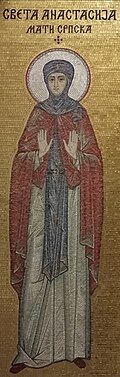 Anastasia of SerbiaVenerable · Wife of Stefan NemanjaJun 21
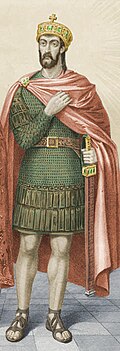 Archil of KakhetiMartyr · Georgian prince of KakhetiJun 21
 George LavrovConfessor · Archimandrite of Danilov MonasteryJun 21
 Julian of OrtaSaint · DeaconJun 21
 Fyodor IvanovichRight-Believing · Prince of StarodubJun 21
- Alexander IvanovskyHieromartyr · PriestJun 21
- Vasil DimitrovSaintJun 21
- Abraham of PinegaVenerable · Venerable of PinegaJun 21
- AgofredusVenerableJun 21