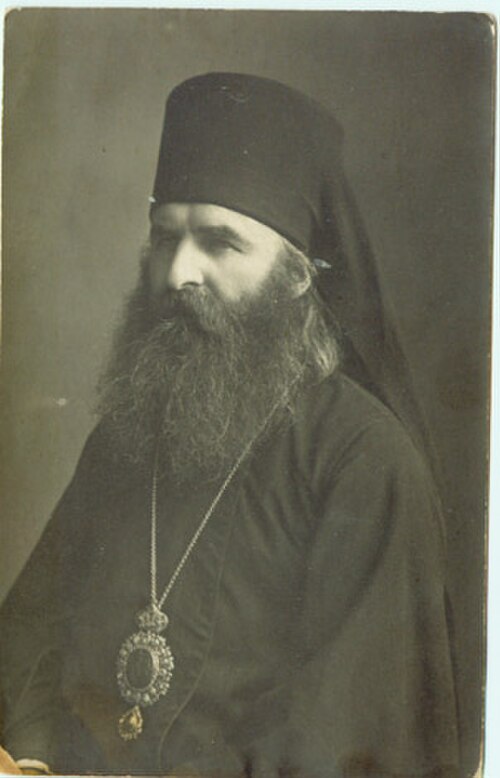
Hieromartyr
Damascene Tsedrik
Bishop of Glukhov
Bishop of Glukhov, vicar of the Chernigov diocese, who died a martyr in the Karlag camp in 1937; glorified in 2000.
- Feast
- September 2old style September 15
- Reposed
- 193720th century
- Place
- Karlag
- Order
- Martyrs
Life
The Holy Hieromartyr Damascene Tsedrik, in the world Dmitry Dmitrievich Tsedrik, was Bishop of Glukhov, vicar of the Chernigov diocese. A missionary among the Buryats and Kalmyks, a front-line priest in the First World War and later a confessing bishop, he passed through prisons, exile and camps and was shot in 1937 in the Karaganda camp. The Russian Orthodox Church numbered him among the saints in 2000.
Childhood and education
He was born on 29 October 1877 in the small town of Mayaki in the Odessa district of Kherson province, into the family of a poor postal clerk with seven children. In 1887 he entered the Kherson theological school, graduating in 1893 among the first in his class, and was then admitted to the Odessa seminary, where his brother Nicholas was also studying.
The family could not pay for two sons at once, so Dmitry had to leave the seminary. In 1895 he entered the Kherson teachers' seminary, where tuition was free and needy students received a stipend on condition that they afterwards teach for at least four years. After graduating he taught at the public school in the town of Beryslav.
Missionary and monk
In 1900 Dmitry enrolled in the two-year missionary courses at the Kazan Theological Academy, which trained missionaries for the peoples of Asia. Besides theology, the students learned Buryat, Kalmyk, Mongolian and other languages. The courses were headed by Archimandrite Andrew (Ukhtomsky), and the teaching council by Bishop Anthony (Khrapovitsky), rector of the academy.
In Kazan he became friends with Professor Viktor Nesmelov, author of works on philosophical anthropology, and joined the philosophical circle Nesmelov led. He also grew close to Bishop Anthony, and under his influence he was tonsured a monk on 9 June 1902 with the name Damascene, in honour of Saint John of Damascus. A few days later he was ordained hierodeacon, and on 30 June hieromonk.
Transbaikalia and Vladivostok
He was sent to the Transbaikal Spiritual Mission. From October 1902 to November 1903 he headed the missionary school in Chita, then served as missionary in the Aga and Irgen districts, inhabited by Buryats and Tungus, and from 1904 at the Kurumkan-Garga mission station. Knowing the Buryat language, he translated liturgical hymns into it and formed a church choir of baptized Buryats.
In 1905 he entered the Oriental Institute in Vladivostok as a student. At the same time he taught singing and then religion at the city's boys' gymnasium and served in the institute church and at the church of Sedanka station. He graduated from the institute in 1909.
Among the Kalmyks and at the front
In 1910 he was appointed missionary in the village of Bolkhuny in Astrakhan province, and from 1911 he worked as a missionary among the Kalmyks in the Don diocese.
After the outbreak of the First World War he served from the spring of 1915 on the Caucasian front, heading a Red Cross medical and feeding unit, and from 1916 also a unit fighting infectious diseases. In 1917 he was a medical orderly and military chaplain in a reserve regiment on the South-Western front. He received the Order of Saint Anna, third and second class. In the summer of 1917 he took part in the congress of learned monastics at the Moscow Theological Academy.
The years of revolution
In May 1918 he was demobilized. That same year he was arrested with his brother in Oryol province and sentenced to death; he escaped execution, but his brother was shot. He then moved to Kiev, where he lived in Saint Michael's Golden-Domed Monastery and was enrolled at the Theological Academy.
In the autumn of 1919 he went to the Crimea, and the next year Archbishop Dimitri (Abashidze) raised him to the rank of archimandrite and appointed him superior of the Saint George Monastery at Balaklava. Archbishop Nicodemus (Krotkov) wrote of him that he zealously defended the Church's interests before the authorities and was a lover of beautiful services, a fine reader and singer, a diligent preacher and a capable practical worker.
When the Renovationist schism began in 1922, he remained faithful to the patriarchal Church. In November 1922 he was tried in Simferopol together with several Crimean hierarchs and clergy, but was acquitted. Early in 1923 he was arrested again, spent several months in prison with Bishop Eusebius (Rozhdestvensky), and was then expelled from the Crimea.
Bishop of Glukhov
On 14 September 1923 he was consecrated in the Donskoy Monastery in Moscow as Bishop of Glukhov, vicar of the Chernigov diocese, with the charge of temporarily administering the diocese. The consecration was led by Saint Patriarch Tikhon. In January 1924 he arrived in Glukhov, where he organized the diocesan chancery and the administration of the vicariates and deaneries and travelled through the diocese.
He was soon imprisoned in Glukhov, and in 1924-1925 exiled to Kharkov. In 1925 he was sent to Moscow, outside Ukraine, and lived at the Danilov Monastery. In August 1925 he went secretly to Poltava, where, with Archbishop Gregory, he consecrated Archimandrite Basil (Zelentsov) as Bishop of Priluki.
Exile in Siberia
On 30 November 1925 he was arrested in Moscow in the case of the patriarchal locum tenens, Metropolitan Peter (Polyansky), and held in Butyrka prison. In May 1926 he was sentenced to three years of exile in Siberia, which he spent in Krasnoyarsk, serving in the city's churches and later in the village of Poloy.
He did not accept the 1927 Declaration of Metropolitan Sergius (Stragorodsky), which called for full loyalty to the Soviet state, and sent the metropolitan two letters of sharp criticism. In December 1928, on his return from exile, he had a long conversation with him in Moscow but could not accept the new course of church policy.
At Starodub
Forbidden to return to his diocese, he settled in Starodub at the invitation of priests of the former Chernigov diocese. Many like-minded clergy and faithful came to see him. Yet he feared a schism and urged those who asked him to rally around Metropolitan Sergius in order to keep him from acts that would disgrace the Church.
In April 1929, after the metropolitan instructed the clergy to provide the authorities with information on church communities, he stopped commemorating him at services. In May 1929 he declined Metropolitan Seraphim (Chichagov)'s invitation to become his vicar in Leningrad. That summer he sent the exiled locum tenens, Metropolitan Peter, a letter and copies of the correspondence of other critical hierarchs, and in October he wrote again to Metropolitan Sergius that he was breaking liturgical communion with him.
Solovki and the epistles
On 27 November 1929 he was arrested in Starodub and sentenced to three years in the camps, which he served at Solovki. After his release he returned to Starodub, worked to unite the clergy of southern Russia who did not commemorate Metropolitan Sergius, and served in secret in private homes in Kiev.
In the late 1920s and the 1930s he wrote and sent out some one hundred and fifty epistles. In them he contrasted the Church seen as an administrative structure needing state recognition with the Church as the mystical union of all believers in Christ, established by God. He often wrote of the "last times" for the Church, when the outward splendour of churches would lose its meaning and the purity of the faith would have to be kept in the "catacombs" and the "wilderness".
He did not join any of the movements opposed to Metropolitan Sergius, saying that until he received clarification from the locum tenens he remained a restraining force within the Church. He kept in touch with Metropolitan Kirill (Smirnov) of Kazan and corresponded actively with Archbishop Seraphim (Samoilovich).
Last years and martyrdom
In 1934 he was arrested again and exiled for three years to Arkhangelsk. There he was arrested on 2 March 1936 and sentenced to five years in the camps, which he served in the Burma section of the Karaganda camp in Kazakhstan, working as a bookkeeper.
On 13 August 1937 he was arrested in the camp on charges of anti-Soviet agitation and organizing illegal gatherings; the occasion was the celebration of Pascha. He did not admit guilt. He was sentenced by an NKVD troika and shot on 15 September 1937, receiving the crown of martyrdom. The place of his grave is unknown.
Glorification
Bishop Damascene's name was placed on the list of new martyrs prepared by the Russian Church Outside of Russia in 1981. In August 2000 the Jubilee Bishops' Council of the Russian Orthodox Church numbered him among the Holy New Martyrs and Confessors of Russia. He is commemorated on 2 September (15 September New Style), the day of his martyrdom, and in the Synaxis of the New Martyrs of the Russian Church.
Commemorated the same day September 2
 Mammes of CaesareaMartyrSep 2
 NonnosusVenerable · Prior of Monte SoratteSep 2
 Agricola of AvignonSaint · Bishop of AvignonSep 2
 Antoninus of PamiersMartyr · Apostle of the RouergueSep 2
 Justus of LyonSaint · Bishop of LyonSep 2
 Elpidius the CappadocianVenerable · Abbot of CappadociaSep 2
 Barsanuphius LebedevHieromartyr · Bishop of KirillovSep 2
- Maxima of RomeMartyrSep 2
 Vladimir MorinskyHieromartyr · PriestSep 2
 German RyashentsevHieromartyr · Bishop of VyaznikiSep 2
- Hieu of TadcasterVenerable · Abbess of TadcasterSep 2
- John MelnichenkoHieromartyr · PriestSep 2