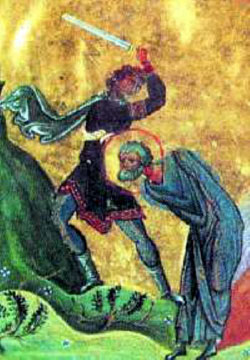
Martyr
Dasius of Durostorum
Roman soldier
Roman soldier of Durostorum, beheaded in the early 4th century for refusing to join a pagan rite.
- Feast
- November 20old style December 3
- Born
- 2013rd century
- Order
- Martyrs
Life
Saint Dasius the Martyr was a Roman soldier at Durostorum (today Silistra in Bulgaria, on the lower Danube) in the time of the persecution of Diocletian. He was beheaded in the early fourth century because he refused to take part, as "king", in the pagan festival of the Saturnalia. Bulgarian sources count him the first martyr known on the soil of present-day Bulgaria, and the Church commemorates him on 20 November.
The soldier of Durostorum
Dasius was a soldier of the Eleventh Claudian Legion, whose frontier camp stood at Durostorum in Lower Moesia. According to Bulgarian sources he was of Thracian origin and a Christian. Other Christians were in the legion, and they died as martyrs in the time of Diocletian's persecutions. Dasius is remembered as the first of twelve martyrs executed at Durostorum in that period.
During the noisy pagan celebrations Dasius kept apart and walked along the bank of the Danube. He was a steadfast Christian in an army in which many Christians had at first served undisturbed, but which, after the decree of the year 304, forced them to choose between renouncing the faith and death.
The king of the Saturnalia
The story of his martyrdom survives in a Greek Passion, also called the Acts of Dasius, discovered in the 1890s by Franz Cumont in an eleventh-century manuscript. Before that the saint was known only from short entries in medieval martyrologies. Cumont dated the text to the fifth or sixth century and thought it might rest on an older Latin text written a few decades after the events. Other scholars, among them Pillinger, have questioned some of his conclusions. The text has Dasius profess the creed of 381, which shows that its present form is no older than the late fourth century.
One third of the Passion describes the pagan festival in the garrison. According to it, each year a soldier was chosen by lot as "king" of the Saturnalia for thirty days. He was clothed in royal garments and allowed every wish, and at the end he was sacrificed at the altar of Saturn (Cronos), in some versions cutting his own throat. In one year the lot fell on Dasius, who was a Christian. For him it was a double condemnation, since he would spend a month worshipping idols and then lose his life as a sacrifice to a pagan god. He chose to refuse the role and accept torment and death.
According to the Serbian sources Dasius says: "If I must die, better to die as a Christian, for Christ."
Trial and death
The Passion records a trial in which Dasius is questioned by a legate called Bassus. He also refuses to honour the imperial cult, and the situation presupposes the fourth edict of Diocletian, of 304, which required soldiers to sacrifice to the emperor. Dasius boldly confessed faith in Jesus Christ and rebuked idolatry. He was subjected to severe tortures and then beheaded with the sword by a certain John Aniketos. Even the day and hour are recorded: a Friday, 20 November, at the fourth hour.
Hagiographical tradition gives slightly earlier dates for the martyrdom, 292, 302 or 303. Cumont suspected that the account of his killing by someone named John, a Christian name, might be a translation error, and that the original text perhaps said John "buried" him.
The custom and the scholars
What the Passion says about the Saturnalia has caused much discussion. The custom of sacrificing the king appears in no other source, though the Saturnalia are among the best known of Roman festivals. The emperor Nero is known to have played the king in his youth. Cumont doubted that the sacrifice was real and thought it likelier that the king had to sacrifice to Saturn. Parmentier considered that the story reflects fourth-century Christian propaganda, which depicted pagan customs as abhorrent. Frazer, in The Golden Bough, took the account to be accurate and saw in it an ancient survival. Ivan Venedikov saw in the same text an early source for the New Year procession of the Kukeri in Bulgarian folklore.
Relics and veneration
Veneration of the saint was widespread in the fifth to seventh centuries. In the Martyrologium Hieronymianum, written about 600, his name appears in various forms and on different days, among them 5 August, 21 December at Axiopolis (Cernavoda) and 20 October at Pozzuoli. The oldest known icon of him is in the Menologion of Basil II, from the late tenth or early eleventh century, under 20 November.
After the Avar invasion of Moesia, according to some sources, the relics were taken to Ancona in Italy. Bulgarian sources say they went first to Constantinople and reached Italy at the time of the Fourth Crusade. They are kept in a marble sarcophagus in the Diocesan Museum beside Ancona Cathedral. On his visit to Bulgaria in 2002, Pope John Paul II gave the church in Silistra the right humerus of the saint, taken from the relics at Ancona, in a small marble chest made to resemble the sarcophagus. His service has been found in a codex in Paris. The Church honours him on 20 November.
Commemorated the same day November 20
 Edmund of East AngliaPassion-Bearer · King of East AngliaNov 20
 Proclus of ConstantinopleSaint · Archbishop of ConstantinopleNov 20
 Bernward of HildesheimSaint · Bishop of HildesheimNov 20
 Gregory of DecapolisVenerable · Monk and wonderworkerNov 20
 TheoktistosConfessorNov 20
 Hilarion PisaretsVenerable Martyr · HieromonkNov 20
 Simplicius of VeronaSaint · Bishop of VeronaNov 20
- Anatolius of NicaeaMartyrNov 20
- Diodorus of YuryegorskVenerable · Founder of the Demyan HermitageNov 20
- Joseph of PersiaHieromartyr · Disciple of Bishop NarsesNov 20
 Eutychius KachurVenerable Martyr · HegumenNov 20
- Tatiana FomichevaVenerable Martyr · NunNov 20