Passion-Bearer
Edmund of East Anglia
King of East Anglia
Last Anglo-Saxon king of East Anglia, killed by the Danes in 869.
- Feast
- November 20old style December 3
- Reposed
- 8699th century
- Place
- Hoxne
- Order
- Martyrs
Life
Saint Edmund, martyr, was king of East Anglia from about 855 until his death in 869, and he was killed by the Danes. He is commemorated on 20 November.
The king
Few certain facts are known about Edmund, because the Vikings devastated East Anglia and destroyed the records of the time. From the coins he struck it is seen that he succeeded Æthelweard, since the same moneyers struck for both, so the power passed without disturbance. The coins show that he reigned for many years; some bear his name, Eadmund rex Anglorum, that is, “Edmund, king of the Angles”. He is thought to have been of East Anglian stock, but the accounts of his family and accession written in the twelfth century are inventions. The annals say that he was crowned at fourteen, on Christmas Day, but it is not known where these dates came from.
His death
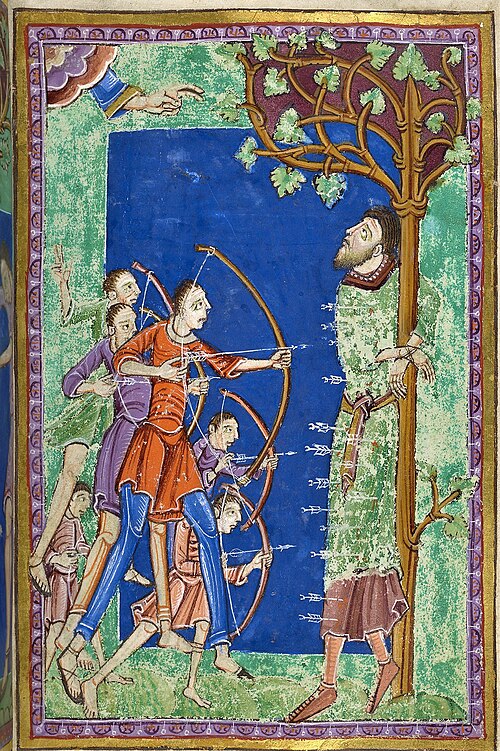
In the autumn of 865 a great army of Vikings came to East Anglia; Edmund made peace with it and gave it horses and supplies, and the army stayed until the following summer, then moved on to York. The Vikings later returned to East Anglia, and the Anglo-Saxon Chronicle relates that King Edmund fought against them, the Danes took the victory, killed the king and conquered all that land. The sources of later centuries do not agree: some say he died in battle, others, among them the work of the monk Abbo of Fleury from about 986, that he was captured and killed because he refused to renounce Christ. According to this tradition he was bound to a tree and shot with arrows, and then his head was cut off. The place is not known, nor whether he died in battle or after it.
Veneration
According to tradition the saint’s head was hidden in a thicket of brambles, and people found it by the cry of a wolf that was guarding it. His body was buried in a wooden chapel near the place of his death. In the tenth century his relics were moved to Beodericsworth, now Bury St Edmunds, and it was told that they were found uncorrupted. In 1010 they were brought for a time to London, for safekeeping. His veneration grew in the Middle Ages, and from about 918, when East Anglia passed to Wessex, coins were struck in his memory. He and Edward the Confessor were regarded as the patrons of England, until in the fifteenth century they were replaced by Saint George.
Commemorated the same day November 20
 Proclus of ConstantinopleSaint · Archbishop of ConstantinopleNov 20
 Bernward of HildesheimSaint · Bishop of HildesheimNov 20
 Gregory of DecapolisVenerable · Monk and wonderworkerNov 20
 TheoktistosConfessorNov 20
 Dasius of DurostorumMartyr · Roman soldierNov 20
 Hilarion PisaretsVenerable Martyr · HieromonkNov 20
 Simplicius of VeronaSaint · Bishop of VeronaNov 20
- Anatolius of NicaeaMartyrNov 20
- Diodorus of YuryegorskVenerable · Founder of the Demyan HermitageNov 20
- Joseph of PersiaHieromartyr · Disciple of Bishop NarsesNov 20
 Eutychius KachurVenerable Martyr · HegumenNov 20
- Tatiana FomichevaVenerable Martyr · NunNov 20