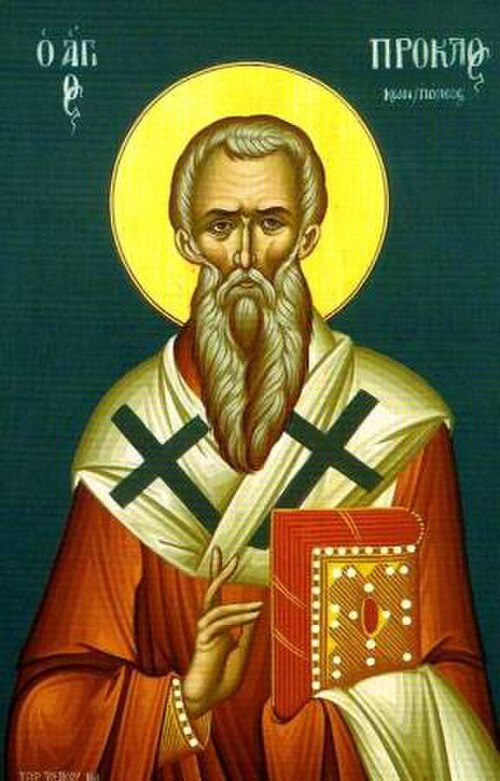
Saint
Proclus of Constantinople
Archbishop of Constantinople
Archbishop of Constantinople from 434 to 446, renowned preacher, active in the Nestorian controversy.
- Feast
- November 20old style December 3
- Reposed
- 4465th century
- Place
- Constantinople
- Order
- Hierarchs
Life
Saint Proclus, hierarch, was archbishop of Constantinople from 434 until his death, in 446 or 447, a renowned preacher, who took part in the struggle against Nestorius. He is commemorated on 20 November.
Beginnings
Proclus was born around 390 and became a reader at Constantinople while young. He studied rhetoric and the classical authors, and tradition calls him friend and disciple of Saint John Chrysostom, who is said to have ordained him; some scholars show that this link was added later, and that he was in fact disciple and secretary of Archbishop Atticus, who ordained him deacon and priest. In 426 Sisinnius consecrated him bishop of Cyzicus, but the inhabitants would not receive him, since they had chosen another, and Proclus remained at Constantinople and preached in the churches of the city as a renowned orator.
The struggle against Nestorius
After the death of Sisinnius, the emperor set Nestorius, an orator from Antioch, on the throne. When Nestorius and his followers began to preach against calling Mary the Mother of God, a title more than a century old, Proclus broke from him. In 430, on a feast of the Mother of God, Nestorius invited him to preach, and he delivered the famous sermon in praise of the Virgin Mary, called the most famous Marian sermon in history, later placed at the beginning of the acts of the First Council of Ephesus. The sermon greatly helped against Nestorius, who was deposed at Ephesus. Cyril of Alexandria wrote to him, thanking him for his part in the struggle. After the death of Maximian, on Great Thursday of 434, Proclus was set on the throne, with the assent of the emperor Theodosius II and the will of the bishops, before his predecessor was buried.
Archbishop
In 436 the bishops of Armenia asked him about teachings of Nestorian origin, attributed to Theodore of Mopsuestia, and he answered in the Tome to the Armenians, asking that they be rejected, but without condemning any person. A rescript of the emperor, obtained by him, calmed the dispute. In 438, through his care, the relics of Saint John Chrysostom were brought from Comana to Constantinople. It is told that in an earthquake that lasted for months, while the faithful held litanies, a boy was lifted into the air and heard the angels singing “Holy God, Holy Mighty, Holy Immortal”; the people began to sing the prayer and, adding “have mercy on us”, the earthquake stopped. From that time the Trisagion has been sung at services.
Commemorated the same day November 20
 Edmund of East AngliaPassion-Bearer · King of East AngliaNov 20
 Bernward of HildesheimSaint · Bishop of HildesheimNov 20
 Gregory of DecapolisVenerable · Monk and wonderworkerNov 20
 TheoktistosConfessorNov 20
 Dasius of DurostorumMartyr · Roman soldierNov 20
 Hilarion PisaretsVenerable Martyr · HieromonkNov 20
 Simplicius of VeronaSaint · Bishop of VeronaNov 20
- Anatolius of NicaeaMartyrNov 20
- Diodorus of YuryegorskVenerable · Founder of the Demyan HermitageNov 20
- Joseph of PersiaHieromartyr · Disciple of Bishop NarsesNov 20
 Eutychius KachurVenerable Martyr · HegumenNov 20
- Tatiana FomichevaVenerable Martyr · NunNov 20