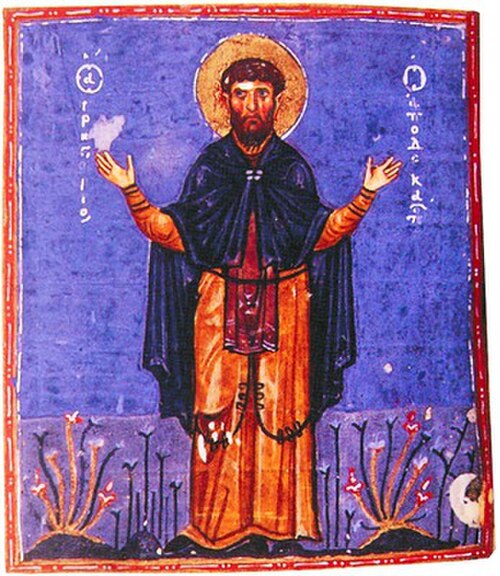
Venerable
Gregory of Decapolis
Monk and wonderworker
Byzantine monk of the ninth century, known for miracles and his travels across the Byzantine world; died in 842.
- Feast
- November 20old style December 3
- Reposed
- 8429th century
- Place
- Constantinople
- Order
- Venerables
Life
The Venerable Gregory of Decapolis was a Byzantine monk of the ninth century, known for miracles and for his travels across the Byzantine world, for which he is called "the New Wonderworker". He was born before 797 at Irenopolis in the Isaurian Decapolis, whence his sobriquet, and fell asleep on 20 November 842 or earlier. The Church remembers him on 20 November. His whole relics are in Romania, at Bistrița monastery in Vâlcea county.
Youth
His parents were named Sergios and Maria, and he had at least one brother. A later relative of the family was Euthymius, patriarch of Constantinople at the start of the tenth century. According to his Life, he began his schooling at eight, but when his parents wanted to marry him he fled to the mountains, around 815 to 816. There he met the former bishop of Irenopolis, forced to leave his see because of his opposition to renewed iconoclasm. After his blessing and on his mother's advice, he entered the monastery where his brother was already a monk. Soon he fell out with the abbot, who held with the iconoclasts, and left for the monastery of his maternal uncle, Symeon. He stayed there fourteen years, advancing in virtue, then asked leave to retire as a hermit into a cave, around 830. There he had a vision of the Tabor light, as well as an appearance of a woman who healed him miraculously of bodily desire by some sort of operation, a possible allusion to his being a eunuch.
Travels
About 832 to 833, after a "divine command", he began to wander across the Byzantine world. He went first to Ephesus, whence he took ship for Prokonnesos, Ainos and Christoupolis. From there he went overland to Thessalonica and Corinth. From Corinth he took ship again to Rome, by Rhegion and Naples. He stayed three months in a cell at Rome, then went to Syracuse in Sicily, where again he spent time in contemplation in a tower in the harbour. From Sicily he returned to Thessalonica via Otranto, where he was taken for an Arab spy and mistreated, around 834. At Thessalonica he taught several pupils, among them Joseph the Hymnographer. A few years later, perhaps in 836 or 837, he went, accompanied by Joseph according to the latter's life, to Constantinople, where he stayed at the church of Antypas or the church of Saints Sergius and Bacchus, and visited the monastic community of Mount Olympus in Bithynia. He preached to the people to reject the iconoclast heresy and was an advocate of the icons, but was not persecuted. It is told that he drove out a serpent and demons that took the form of flies and scorpions, made many prophecies and healed diseases. His sermons made many sinners, among them a harlot of Syracuse and an unbelieving monk, Zacharias, change their lives.
End and relics
His last years were marked by illness, first epilepsy, then dropsy. He died on 20 November 842, or according to different interpretations 841 or earlier. According to some sources, before death he asked to be taken to Mount Olympus. Around 850 his remains were moved to a monastery founded by Joseph the Hymnographer near the tomb of Saint John Chrysostom, in the church of the Holy Apostles. The relics worked miracles. Today they lie whole at Bistrița monastery in Oltenia, while portions are in a cross of Patriarch Nikon and at the Annunciation church at Lalsk. His life, from the second half of the ninth century, is attributed to the monk and writer Ignatius the Deacon, though the authorship is disputed. The only surviving writing of his own is a sermon on the, probably historical, conversion of a Muslim to Christianity. In iconography he is shown as a monk with a trim round white beard.
Commemorated the same day November 20
 Edmund of East AngliaPassion-Bearer · King of East AngliaNov 20
 Proclus of ConstantinopleSaint · Archbishop of ConstantinopleNov 20
 Bernward of HildesheimSaint · Bishop of HildesheimNov 20
 TheoktistosConfessorNov 20
 Dasius of DurostorumMartyr · Roman soldierNov 20
 Hilarion PisaretsVenerable Martyr · HieromonkNov 20
 Simplicius of VeronaSaint · Bishop of VeronaNov 20
- Anatolius of NicaeaMartyrNov 20
- Diodorus of YuryegorskVenerable · Founder of the Demyan HermitageNov 20
- Joseph of PersiaHieromartyr · Disciple of Bishop NarsesNov 20
 Eutychius KachurVenerable Martyr · HegumenNov 20
- Tatiana FomichevaVenerable Martyr · NunNov 20