Hieromartyr
Demetrius Kedrolivansky
A Russian priest who died a martyr for his faith in Christ during the communist persecution.
- Feast
- February 4old style February 17
- Reposed
- 193820th century
- Order
- Martyrs
Life
Holy Hieromartyr Demetrius Kedrolivansky, a priest, was born on 15 May 1890 in the village of Sharapovo, in the Yegoryevsk district of the Ryazan province, in the family of the psalm-reader Vasily Nikodimovich Kedrolivansky and his wife Lyubov Ivanovna, who worked at the church baking the prosphora. He received the crown of martyrdom by shooting on 17 February 1938, at Butovo, near Moscow. He is commemorated on 17 February, on 29 May, in the Synaxis of the New Martyrs of Butovo, on 10 August, in the Synaxis of the Saints of Tambov, and on 5 September, in the Synaxis of the Saints of Moscow.
Youth and exile
After the clerical school he entered the Ryazan seminary, but could not finish it: his father died, and his mother asked him to return home, as the sole support, for three girls were left in her care. He served as psalm-reader at the Trinity church in Sharapovo, then, after marrying Alexandra Nikandrovna Preobrazhenskaya, in the village of Kuznetsy, and in 1922 returned to Sharapovo, where in 1925 he was ordained deacon. In the same year he was fined for speaking at a meeting against self-taxation. In 1929 he was arrested and sentenced to five years of exile for failing to pay the agricultural tax on time. He served the exile at Kozlov, in the Tambov region, where the whole family followed him. There he served as deacon. For two years in a row the harvest had been poor and famine had come; people died in the streets, and the priest's family went hungry, to the point that one of the girls, exhausted, no longer rose from bed. The bishop proposed that he go to serve in a village, where he might find at least something to eat, and he was ordained priest for the village of Sychevka.
At Sychevka there happened to him something he did not forget all his life. A woman of the parish died, and her relatives called him on the third day to perform the funeral service. The woman lay in the coffin, and the priest began the rite. Suddenly he saw that the dead woman's hand moved, drew near and saw that she had opened her eyes. He stopped the service, and the woman rose from the coffin and asked why he had come. The priest, confused, said he had come to see how she was and to anoint her. The woman answered that she saw he had not come for that, and she stood up. The people of the village asked her what she had seen beyond, and she answered as much as she could. She died after two weeks, having fulfilled all for which the Lord had prolonged her life.
Return and persecution
Two weeks before the end of the exile, the chairman of the village soviet warned him that the next day a heavy tax would be brought to him and then he would be unable to leave, for non-payment he would be imprisoned again. That same night the family gathered their things, found a horse with a driver and left for Sharapovo. There, at the Trinity church, the rector was Archpriest Nikolai Speransky, and Father Demetrius served as second priest, living with his family in the psalm-reader's house, because their own house had been taken by the authorities. In 1936 he asked the bishop's blessing to serve in another village, for it was hard for him to feed his five children, and the bishop sent him to the church of Saint Nicholas in the village of Krugi, where an elderly priest served. The parish was poor, and the parishioners often had nothing to pay for the services. If someone died, they said he must be buried, and he said that of course he would bury him. So it was with baptisms. The relatives of the baptised feared to be godparents, and the priest's children became godparents for nearly a third of the village.
In the summer of 1937 the persecution intensified, and from autumn agents of the NKVD began to collect information on the priest. The chairman of the village soviet said that the priest forced old women to go through the yards and collect money for the church, frightening them that otherwise the church would close. The woman who cleaned the church, a nun, said that the priest spoke against the collective farms and praised the old teaching. Two months before the arrest the authorities began to summon him to talks and proposed that he give up his priestly rank, make a public declaration at the club and write to the newspaper, promising that they would not arrest him. The priest refused categorically. His wife also begged him to give it up, so that the children might be able to study, but he did not yield even to this.
Arrest and death
Father Demetrius was arrested at one o'clock at night, on 20 January 1938, and imprisoned at Yegoryevsk. Shortly before he had paid the tax due, and after the arrest the family was left without means. Alexandra Nikandrovna grieved greatly, but on the same day the parishioners began to come, one after another, bringing money, some saying that they owed him for a funeral or a baptism, and many giving out of love for their pastor. A young man from Krugi, a guard at the prison, told the priest's wife where the priest was and carried notes between them. At the investigation the priest denied that he had praised life under the tsar and slandered Soviet power. On 11 February 1938 the troika sentenced him to death and decided to move him to Moscow. The guard told the priest's wife that someone should come at twelve o'clock at night to the prison gate. In a blizzard a column of some twenty prisoners came out of the prison, surrounded by an armed guard and packs of dogs. His daughter Claudia tried to give him a parcel of food, but the dogs would not let her come near. The father, in the third row, cried out to her to go home, that he would return soon. He was taken to Butyrka, where on 15 February he was photographed. On 17 February 1938 he was brought to Butovo and put in a barracks. An NKVD officer checked by the photograph that it was he and told him that he had been sentenced to death. Then they led him to the edge of a deep ditch and shot him and buried him right there, in an unknown common grave.
Commemorated the same day February 4
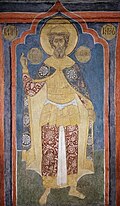 George of VladimirRight-Believing · Grand Prince of VladimirFeb 4
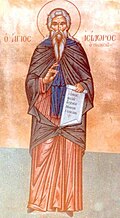 Isidore of PelusiumVenerable · Hermit near PelusiumFeb 4
 Theophilus of AdanaSaint · Steward of the Church of AdanaFeb 4
 Abraham of ArbelaSaint · Bishop of ArbelaFeb 4
 Nicholas the StuditeVenerable · Abbot of the Stoudios MonasteryFeb 4
 Cyril of NovoezerskVenerable · Founder of Novoezersk MonasteryFeb 4
 Alexei SharovHieromartyr · ArchpriestFeb 4
 Catherine of SimbirskVenerable Martyr · Nun at SimbirskFeb 4
 John TikhomirovHieromartyr · PriestFeb 4
- Anthony of SupraślVenerable MartyrFeb 4
 Nicholas PospelovHieromartyr · ArchpriestFeb 4
 Methodius KrasnoperovHieromartyr · Bishop of PetropavlovskFeb 4