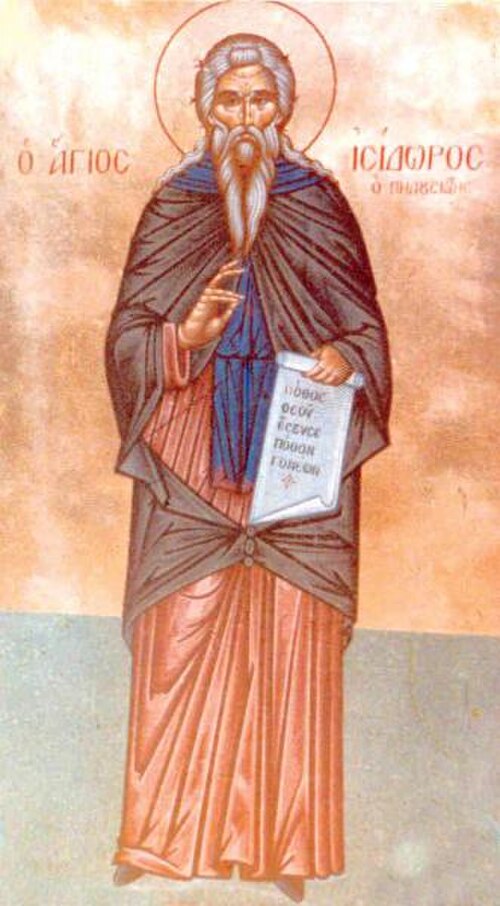
Venerable
Isidore of Pelusium
Hermit near Pelusium
Egyptian monk and church writer who withdrew to a mountain near Pelusium and died around 440.
- Feast
- February 4old style February 17
- Reposed
- 4405th century
- Place
- Egypt
- Order
- Venerables
Life
Saint Isidore of Pelusium was a monk and church writer of Egypt at the turn of the fourth and fifth centuries. He withdrew to a mountain near the city of Pelusium, in the tradition of the Desert Fathers, and is known above all for his letters to bishops, emperors and people of every sort. He died around 440, according to some sources later, near 450. The Church commemorates him on 4 February.
Life
He was born at Alexandria, into a wealthy Christian family, and was a relative of Archbishop Theophilus of Alexandria. He was the only child of his parents, who taught him the books of the Church and the Greek language, in which he excelled. He had a broad formation: theology, ancient Greek literature, philosophy, rhetoric and other sciences. When he learned that the Alexandrians and the bishops wanted to make him patriarch, he fled by night to Pelusium and became a monk in a monastery there, or, according to other sources, lived as a hermit on the mountain of Pelusium. He became known for the exactness with which he kept the rule and for his austerities, and his letters give reason to believe that he was abbot, perhaps also priest.
On a journey to Constantinople he saw and heard Saint John Chrysostom, whom he followed as a disciple. He defended John in the time of the persecution launched by Empress Eudoxia and Patriarch Theophilus. After the holy hierarch's death, he urged that the Church of Alexandria put his name in the diptychs, which was done later. When the dispute with the Nestorians flared up, he wrote to Emperor Theodosius II and urged him to convene the Third Ecumenical Council at Ephesus, in 431. He also wrote to Cyril of Alexandria, advising him to put aside contentions and not to involve the living Church in his personal vengeance.
The letters
His only surviving work is a great collection of extracts from his correspondence, with more than two thousand letters; the historian Nicephorus says he wrote more than ten thousand, in which he rebuked one, advised another and consoled a third. They are short, a few lines each, and fall into three kinds: on dogma and Scripture, on church and monastic discipline, and on practical morality for laymen of every rank. They are found in volume 78 of the Patrologia Graeca. Some are valuable for the interpretation of the Greek Bible. Unlike other ascetic writers, Isidore did not concern himself with mystical theory but with moral questions; in several letters he repeats that nothing is equal to virtue. He held that good works are worth more than golden-tongued preaching. Of novice monks, he advised that they should not be shown at the outset all the severity of the rule, lest they be discouraged, nor left in idleness, but led gradually toward what is most perfect. He also defended the veneration of the relics of the martyrs as a source of healing.
Veneration
Isidore died around 440 to 450, in deep old age. He is counted among the Fathers of the Church, and his letters made him known throughout Christendom. He is commemorated on 4 February.
Commemorated the same day February 4
 George of VladimirRight-Believing · Grand Prince of VladimirFeb 4
 Theophilus of AdanaSaint · Steward of the Church of AdanaFeb 4
 Abraham of ArbelaSaint · Bishop of ArbelaFeb 4
 Nicholas the StuditeVenerable · Abbot of the Stoudios MonasteryFeb 4
 Cyril of NovoezerskVenerable · Founder of Novoezersk MonasteryFeb 4
 Alexei SharovHieromartyr · ArchpriestFeb 4
 Catherine of SimbirskVenerable Martyr · Nun at SimbirskFeb 4
 John TikhomirovHieromartyr · PriestFeb 4
- Anthony of SupraślVenerable MartyrFeb 4
 Nicholas PospelovHieromartyr · ArchpriestFeb 4
 Methodius KrasnoperovHieromartyr · Bishop of PetropavlovskFeb 4
 Vasily ZelentsovHieromartyr · Bishop of PrilukiFeb 4