
Hieromartyr
Methodius Krasnoperov
Bishop of Petropavlovsk
Bishop of Petropavlovsk and vicar of the Omsk diocese, who died a martyr in 1921; canonized in 2000.
- Feast
- February 4old style February 17
- Reposed
- 192120th century
- Place
- Petropavl
- Order
- Martyrs
Life
Saint Methodius (in the world Mikhail Platonovich Krasnoperov, 30 July 1868 - 17 February 1921), hieromartyr, was Bishop of Petropavlovsk, vicar of the Omsk diocese, killed by bayonets of Red soldiers. He was numbered among the New Martyrs of Russia by the Council of Bishops of the Russian Orthodox Church in August 2000. He is commemorated on 4 February by the old calendar (17 February by the new).
Youth and priesthood
He was born on 30 July 1868 in the village of Vyatskoye in the Sarapul district, Vyatka province, in the poor family of a psalm-reader, Platon Krasnoperov. He graduated from the church school of Sarapul, then the Vyatka seminary, in 1890. On 22 October 1891 Bishop Athanasius (Parkhomovich) of Sarapul ordained Mikhail priest at the Tikhvin Mother of God church in the village of Pazdery, Sarapul district. On 19 February 1896 he was appointed supernumerary priest at the Ascension cathedral in Sarapul, and also head and catechist of the Saint Nicholas parish school. During his priestly service he was widowed and resolved to give himself wholly to the Church; for this he considered it necessary first to complete his education and in 1898 entered the Kazan Theological Academy. The rector of the academy was then Bishop Anthony (Khrapovitsky); meetings with him and his talks on monasticism inclined Fr. Mikhail to receive monastic tonsure. On 11 February 1900, during his third year of study, Bishop Anthony tonsured him a monk with the name Methodius and at the same time appointed him dean of the clergy studying at the academy. In 1902 he graduated from the missionary group of the Tatar section of the academy with the degree of candidate in theology (thesis: "The Pastor of the Church according to the teaching of the Holy Apostle Paul"). On 16 August of that year he was appointed assistant overseer of the Ufa church school.
As a hieromonk he visited the "night shelters", sought to help their residents, prayed with them, held vigils, read akathists and in Great Lent heard their confessions before communion. From 1903 he was inspector of the Alexandrovsk missionary seminary and member of the Ardon section of the Vladikavkaz diocesan scholarly council. In 1905 he was appointed acting rector of the seminary. On 20 November 1906 he was appointed rector of the Ufa seminary, raised by office to the rank of archimandrite. A pious pastor and gifted preacher, he was often entrusted to speak in the Ufa cathedral. He organized religious-moral and temperance readings in a hall of the Ufa parish school. In a year of poor harvest, by his appeal he collected more than twenty thousand rubles for the hungry. From 1908 he was at the same time editor of the unofficial part of the "Ufa Diocesan Gazette" and assistant chairman of the council of the "Brotherhood of the Resurrection of Christ". From 1912 he was also chairman of the diocesan charitable commission for aiding the population.
Bishop
From 10 February 1913 he was Bishop of Akmolinsk, vicar of the Omsk diocese. He was helper and comrade-in-arms of Archbishop Andronik (Nikolsky). They waged a struggle against the vice of drunkenness, which in the early twentieth century took on ever more threatening proportions in Russia, and against sects taking root in Siberia, Baptists and Khlysty. The next year the city duma of Petropavlovsk petitioned for moving the bishop's residence to Petropavlovsk. The wish of the authorities and townspeople was so great that they undertook, if the petition were granted, to give two thousand rubles yearly from the city funds for the bishop's lodging. Soon the petition reached the emperor and the assent followed. From 6 November 1914 he was Bishop of Petropavlovsk, vicar of the Omsk diocese, after the vicariate was moved from Akmolinsk to Petropavlovsk.
He often served. In 1915 he led a procession with the icon of Saint Nicholas granted by Nicholas II, from Petropavlovsk to Akmolinsk (500 versts between the towns), visiting parishioners on the way, serving and distributing spiritual literature. On the return he went by another route, visiting new villages. He was respected by Orthodox believers and by Muslims alike. After the overthrow of the monarchy, on 27 March 1917 the Soviet of workers' and soldiers' deputies sent a telegram to Kerensky and the chief procurator of the Holy Synod asking that Bishop Methodius be removed from Petropavlovsk for "reactionary activity", but the request was left without action.
Martyrdom
In 1921 a peasant uprising broke out in Western Siberia, caused by the arbitrariness of the Bolshevik requisition detachments. The insurgents managed to take several towns, among them Petropavlovsk. The uprising was cruelly suppressed. On 17 February 1921 a Bolshevik punitive detachment occupied Petropavlovsk. Bishop Methodius had that day served the Divine Liturgy and a service of supplication in the church of Saint Nicholas. After the service he went out to the square in front of the church, where the people had gathered, and was stabbed with bayonets by Red soldiers. According to tradition, a cross was thrust, when he was already dead, into one of the wounds. In reality he was executed, with ten laymen from among captured insurgents, by order of the commander of the group of troops guarding the Omsk-Chelyabinsk railway line, N. I. Koritsky, in accordance with a sentence of the "extraordinary field military-revolutionary tribunal". The place of their burial is unknown.
Canonization
The name of Bishop Methodius was entered in a draft list by name of the new martyrs and confessors of Russia in preparing the canonization carried out by the Russian Orthodox Church Outside of Russia in 1981; but that canonization itself was not by name, and the list of new martyrs was published only at the end of the 1990s. Bishop Methodius was numbered among the New Martyrs of Russia in 2000, at the Council of Bishops of the Russian Orthodox Church.
Writings
The speech at his nomination as Bishop of Akmolinsk, vicar of the Omsk diocese, and the candidate's work "The Pastor of the Church according to the teaching of the Holy Apostle Paul" (Izvestiya Kazanskoi Eparkhii, 1903, no. 3).
Commemorated the same day February 4
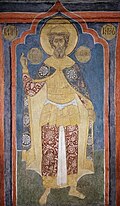 George of VladimirRight-Believing · Grand Prince of VladimirFeb 4
 Isidore of PelusiumVenerable · Hermit near PelusiumFeb 4
 Theophilus of AdanaSaint · Steward of the Church of AdanaFeb 4
 Abraham of ArbelaSaint · Bishop of ArbelaFeb 4
 Nicholas the StuditeVenerable · Abbot of the Stoudios MonasteryFeb 4
 Cyril of NovoezerskVenerable · Founder of Novoezersk MonasteryFeb 4
 Alexei SharovHieromartyr · ArchpriestFeb 4
 Catherine of SimbirskVenerable Martyr · Nun at SimbirskFeb 4
 John TikhomirovHieromartyr · PriestFeb 4
- Anthony of SupraślVenerable MartyrFeb 4
 Nicholas PospelovHieromartyr · ArchpriestFeb 4
 Vasily ZelentsovHieromartyr · Bishop of PrilukiFeb 4