Saint
Theophilus of Adana
Steward of the Church of Adana
A 6th-century cleric of Adana who fell into a pact with the devil and was restored through repentance.
- Feast
- February 4old style February 17
- Reposed
- 5386th century
- Place
- Adana
Life
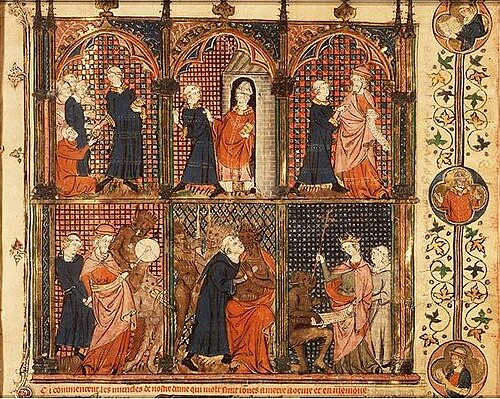
Theophilus of Adana (Theophilus the Penitent, Theophilus of Cilicia) was a cleric of the sixth-century Church, who died around 538, of whom the story says that he made a deal with the devil to gain an ecclesiastical position. He is venerated as a saint in the Orthodox and Catholic Churches; the Catholic Church commemorates him on 4 February, and the Orthodox Church on 23 June (by the Julian calendar, in the Menaion of Saint Demetrius of Rostov). The record gives 4 February, which is the Catholic day. The tale about him is apocryphal, although he is regarded as a historical person; his story is one of the oldest popular tales of a pact with the devil and was an inspiration for the Faust legend. Eutychianus of Adana, who claimed to have been an eyewitness of the events, was the first to record the story.
Being archdeacon of Adana (today in Turkey), Theophilus was steward of the bishop. After the bishop's death he was unanimously elected bishop, but from humility refused the office. Another man was chosen in his place. After the new bishop unjustly deprived him of the stewardship, Theophilus regretted his humility so much that he sought out a Jewish sorcerer, who helped him make contact with Satan himself. In exchange for the unclean help, Satan demanded that Theophilus renounce Christ and the Virgin Mary; Theophilus did so, and the devil rewarded him with the high position he desired.
Years later, fearing for his immortal soul, Theophilus repented and began to beg the Virgin Mary to forgive him. After forty days of fasting the Mother of God appeared to him and rebuked him. Theophilus begged forgiveness, and the Virgin promised to intercede before God. Then he fasted three more days, during which the Mother of God appeared to him again and granted absolution. Three days later Theophilus woke and found the sinister contract on his chest. He took it and carried it to the lawful bishop, confessing everything he had done. The bishop burned the document, and Theophilus was freed from the burden of the pact with the devil.
The story lay at the basis of the verse legend The Fall and Conversion of Theophilus by the German nun Hrotsvitha of Gandersheim, a poet of the Ottonian renaissance, and on the same subject the first German-language spiritual drama, in the genre of the miracles of the Mother of God, was composed around 1450. In Russia the story of Theophilus was known from the seventeenth century. In the Russian translation of the tale On the Repentance of Theophilus, the church steward in the city of Adana (seventh century), Theophilus in prayer calls the Mother of God the Seeking of the Lost. The veneration of icons with this name began in Russia in the eighteenth century; since the tale gives no iconography of the image before which Theophilus prayed, the venerated icons are tied to this story only by the epithet of the Mother of God.
Commemorated the same day February 4
 George of VladimirRight-Believing · Grand Prince of VladimirFeb 4
 Isidore of PelusiumVenerable · Hermit near PelusiumFeb 4
 Abraham of ArbelaSaint · Bishop of ArbelaFeb 4
 Nicholas the StuditeVenerable · Abbot of the Stoudios MonasteryFeb 4
 Cyril of NovoezerskVenerable · Founder of Novoezersk MonasteryFeb 4
 Alexei SharovHieromartyr · ArchpriestFeb 4
 Catherine of SimbirskVenerable Martyr · Nun at SimbirskFeb 4
 John TikhomirovHieromartyr · PriestFeb 4
- Anthony of SupraślVenerable MartyrFeb 4
 Nicholas PospelovHieromartyr · ArchpriestFeb 4
 Methodius KrasnoperovHieromartyr · Bishop of PetropavlovskFeb 4
 Vasily ZelentsovHieromartyr · Bishop of PrilukiFeb 4