Martyr
Demetrius Spiridonov
A Russian believer who died a martyr for his faith in Christ during the communist persecution.
- Feast
- November 16old style November 29
- Reposed
- 193820th century
- Place
- Athonite libraries (scholar), Mount Athos
- Order
- Martyrs
Life
Holy Martyr Demetrius Spiridonov (1871-1938) was a layman, a scholar and a historian of the Church, and received the crown of martyrdom by shooting on 29 November 1938, at Simferopol. He is commemorated on 29 November, on 7 February, in the Synaxis of the New Martyrs and Confessors of the Russian Church, on 2 December, in the Synaxis of the New Martyrs and Confessors of the Crimean Metropolis, and on 28 December, in the Synaxis of the Saints of Crimea.
The scholar
Dmitry Spiridonovich Spiridonov was born in 1871. Already at the Tauride seminary he stood out among his companions by remarkable gifts, and there he grew close in spirit to Archpriest Nikolai Mezentsev, their friendship lasting until their martyrdom. He continued his studies at state expense at the Theological Academy in Saint Petersburg, which he finished with success. During his studies he regularly helped his younger brother, Eleazar, sending him books, advice and moral support. He was very religious; his humility and meekness gave rise to that astonishing delicacy, free of any suspicion, at which many marvelled. He allowed himself no rough deed, not even a rough word, even when a severe admonition was plainly required. The elevated state of his mind, immersed in the high subjects of the theological sciences, and his prayerful withdrawal from daily cares led him to continue his studies at Moscow University, as a free listener.
On returning to Crimea he taught at the Tauride seminary. His scholarly work was highly valued and, on the recommendation of Arseny Ivanovich Markevich, a historian, ethnographer, archaeologist and scholar of Crimea, on 13 December 1907 Spiridonov was admitted to the Tauride Scholarly Archival Commission. On 28 November 1908 he gave a brilliant report on the martyrdom of Saint Clement, Pope of Rome, in Crimea. From 1913 to 1916 he stayed in Greece, occupied with scholarly work, where he grew close to many Greek bishops and university professors. In the Tauride Diocesan Gazette he published many works on questions of church history: Early Christian Martyrs, Novatian and His Schism, and a translation from the Greek of Saint Clement of Rome's On Virginity. In his writings he showed thoroughness, great erudition and a brilliant knowledge of the subject. About that time he married Anisia Ivanovna. The marriage was happy, but they had no children.
From 1918 to 1922 he was a teacher in Yevpatoria, and from 1919 secretary of the council of the Greek society and chairman of the twenty of the Greek church of the Holy Prophet Elijah, whose rector was his brother, the priest Eleazar. On 6 August 1922 he was elected deputy chairman of the Commission. From that time date his works Natives of the North Coast of the Black Sea in the History of Ancient Greek Thought and On the Mariupol Greeks. The shocks of the revolution and the civil war led him to seek a more suitable place for scholarly work. In 1922 he made an unsuccessful attempt to emigrate to Greece. After the official refusal he moved to Simferopol and taught at the Tauride University, and at the sovietisation of Crimea he left teaching in protest and took a job at the local history museum, where he devoted himself to scholarly work. In 1928 he published Notes from the History of Hellenism in Crimea. On 15 January 1931 the concluding meeting of the Commission was held, at which he too was present. He soon became deputy director of the museum and was in charge of all the scholarly work; for a short time he was also director. In those years he kept up a wide scholarly correspondence with scholars of various universities: with Professor Adolf Harnack of the University of Berlin, with Professor Ellis Minns of Cambridge, with the American professor Alexander Vasiliev and many others. He was always spoken of as a very cultured and very learned man, with deep faith.
Faithful to the end
The atmosphere in the country became suffocating, even for those who moved their life into the sphere of spiritual and scholarly interests. As a man of the Church, he did not want confrontation with a power alien to his ideas and in 1934 again applied officially to the Greek embassy to leave the USSR, explaining that he needed to continue the study of the folk dialects of the Mariupol and Stalino districts, begun in 1926. His request was refused. In those years he concentrated his attention on prayer and study and only in them found consolation and moral justification. Although it was proposed to him, he did not accept holy orders. This avoidance of responsibility cannot be explained by cowardice or fear of persecutors, who could at any time take from him not only freedom but life itself. On the contrary, according to witnesses, he had a gentle resolve and could, without noisy assurances, quietly take the necessary decision and carry it out best. As director of the museum he was not afraid to take an active part in the life of the Church. Until his arrest he remained not only a parishioner but also an active member of the twenty of the Holy Trinity church in Simferopol, whose rector was then Archpriest Mitrofan Vasilkioti, a very old man, who could no longer leave the church grounds without help. Spiridonov took part in resolving various church problems: when local atheists took down the bells, he wrote, with others, to the Greek consul, asking protection; in 1934, when the church was practically closed, thanks to his skilled participation and fearless position, all the possible means were used and the only Orthodox church in the city was kept.
In January 1938 the special sector of the Crimean regional committee decided to intensify the fight against religion. On 20 January 1938 Dmitry Spiridonovich was arrested, with the whole group of the twenty of the church. About that time in Yevpatoria some fifty Greeks connected with the church of Saint Elijah were arrested. The case against the Greeks was built around the most prominent member of the twenty, Konstantin Ivanovich Popandopulo, because he knew the Greek consul in Moscow. Spiridonov, K. I. Spiridonova, Popandopulo, I. P. Pambukov and twenty-six more people were charged under Article 58 of the Criminal Code. In the indictment the investigator Khanzhin wrote that those in this case were participants in a counter-revolutionary Greek-nationalist organisation in Yevpatoria, liquidated in 1937, created in 1922, with fifty-one members. Spiridonov was said to have written, in the name of the organisation, slanderous information about life in the USSR, which he sent to the Greek consulate, and to have kept in touch with Archpriest Mezentsev, already convicted. By the decision of the troika of 5 November 1938, under the chairmanship of Captain Yakushev, Spiridonov was sentenced to the highest measure, though he categorically rejected all the charges. He was shot on 29 November 1938.
Commemorated the same day November 16
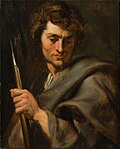 MatthewApostle · Apostle and EvangelistNov 16
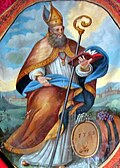 Othmar of St. GallVenerable · First Abbot of St. GallNov 16
- Philoumenos HasapisHieromartyr · Abbot of Jacob's WellNov 16
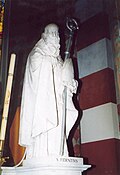 Fidentius of PaduaMartyrNov 16
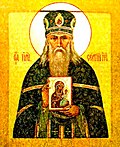 Sergius of Malaya PinegaVenerable · HieroschemamonkNov 16
- Africus of CommingesSaint · Bishop of CommingesNov 16
 Michael AbramovHieromartyr · ArchpriestNov 16
- Akylina of DramaVenerable · Abbess in DramaNov 16
- Aelfric of AbingdonSaint · Archbishop of CanterburyNov 16
- AfanSaintNov 16
- Ananias BoykovMartyrNov 16
 Anianus of AstiSaint · Bishop of AstiNov 16