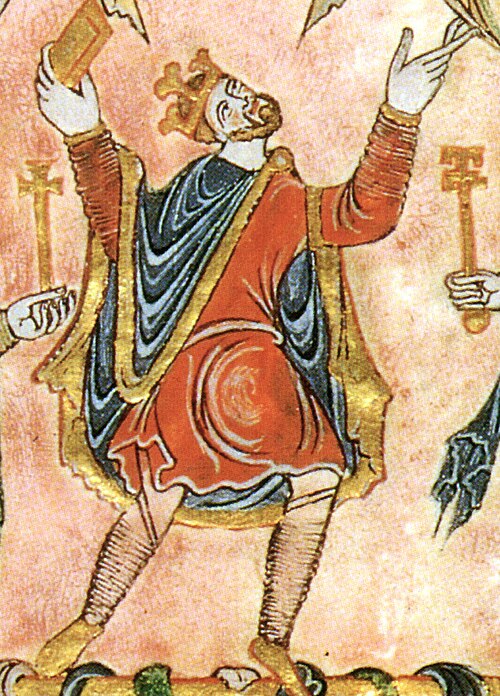
Right-Believing
Edgar the Peaceful
King of England
King of England from 959 to 975, known for the peace of his realm and support of monastic reform.
- Feast
- July 8old style July 21
- Reposed
- 97510th century
- Place
- Winchester
Life
Edgar the Peaceful was king of England from 959 to 975, known for the quiet of his land and for his support of the Benedictine monastic reform. He is not a saint of the general Orthodox calendar: his veneration as a saint dates from the western Middle Ages, and today he appears in some Orthodox lists of western saints (on 8 July, 21 July old style), in some modern Roman Catholic sources and in the calendars of some Orthodox communities of the western rite.
Beginnings
He was born in 943 or 944, the year his mother, Ælfgifu, died, the younger son of King Edmund I. His mother was venerated as a saint at Shaftesbury Abbey. He was brought up in the household of Æthelstan, called the Half-King, and his wife Ælfwynn, then educated at Abingdon Abbey by Æthelwold, the future bishop of Winchester. The household in which he grew up, like his teacher, was linked with the circle of monastic reformers headed by Dunstan, and many historians think that youth formed his love for monks.
After the death of Edmund, in 946, his brother Eadred ruled, and in 955 Edgar's elder brother, Eadwig, took the throne, an unpopular king, in conflict with the nobles and the Church, above all with Dunstan, whom he sent into exile. In 957 the nobles of Mercia and Northumbria turned to Edgar and chose him king north of the Thames. He became master of all England on 1 October 959, after Eadwig's death.
The reign
One of his first decisions was to recall Dunstan from exile. He made him a bishop and then archbishop of Canterbury, and he remained his counsellor throughout the reign. Another close counsellor was Æthelwold, made bishop of Winchester in 963. Edgar kept in office the experienced men Eadwig had appointed. The court moved each year from estate to estate, and according to a chronicler the king travelled the kingdom in winter and spring to see whether the laws were being observed and whether the poor were being oppressed by the powerful. A historian of today finds this account a little rose-tinted.
In his time no Viking attack took place, in a brief lull between the mid-950s and the 980s. His reign met little opposition from within or without, and Edgar sent an embassy to the Emperor Otto the Great. His laws, above all the Andover Code, dealt with the proper course of justice, with tithes and with uniform measures of coinage, weights and measures. Towards the end of his reign he introduced a uniform silver coinage, about 96 percent silver, struck to the same design in all of the forty or so mints. Later chroniclers saw his reign as a golden age.
Support for monastic reform
When Edgar came to the throne there were only two Benedictine monasteries in England. His support was decisive for the renewal of monastic life, a reform led by Dunstan, Æthelwold and Oswald, bishop of Worcester from 962 and archbishop of York from 971. At Winchester, Æthelwold replaced the secular clergy of the cathedral with monks, with papal approval and the king's help, and at Ely in 970 he refounded a monastery, with rich gifts from the king. Edgar and the queen made grants on condition that Æthelwold translate the Rule of Saint Benedict into English, to help the instruction of the laity.
Around 970, at the king's command, a synod held at Winchester drew up the Regularis Concordia, a monastic rule common to all the monasteries of England. The text required the monasteries to say psalms several times a day for the king and queen. For this support, monk writers praised him highly, compared him to the Good Shepherd and made his reign an ideal "golden age" of the English Church. Historians today observe that the reform touched mostly the south and part of Mercia, and that the monasteries had acquired many estates with the king's help, which led to disputes after his death.
The coronation at Bath
The year 973 was a turning point. On Whit Sunday, 11 May 973, Edgar and his wife, Ælfthryth, were consecrated king and queen at Bath, in a service performed, by one account, by Dunstan and praised in a poem in the Anglo-Saxon Chronicle. The Chronicle presents it as his first coronation, and historians ask whether he had not been crowned earlier; some say he waited until he neared the age of thirty. The order of the service at Bath lies at the base of the one still used for crowning British monarchs.
After that Edgar went with his fleet to Chester, where, according to the chronicle, six kings swore loyalty to him on land and sea. Later storytellers say he took the helm of a boat on the River Dee while the kings rowed. Historians do not agree whether it was a meeting of equals or a display of his supremacy.
His youth and shortcomings
The sources do not hide that Edgar was not blameless. An Orthodox list of western saints says he repented after a depraved youth. Later writers tell of his relations with women, among them nuns of the convent at Wilton. With Wulfthryth he had a daughter, Edith, venerated as a saint, and with Æthelflæd a son, Edward. With Ælfthryth he had two sons, Edmund and Æthelred. The sources cannot always be checked: some come from much later writers, who often mixed legend with history.
The laws attributed to him prescribed harsh punishments for thieves, and a contemporary hagiographer wrote of terrible mutilations. Historians observe that his surviving laws do not say so directly. The peace he brought was a peace of firm authority.
Death and veneration
Edgar died on 8 July 975 at Winchester, aged thirty-one or thirty-two, and was buried at Glastonbury, the abbey of his father and of Dunstan. There is no evidence that he was venerated as a saint before the middle of the eleventh century, and his cult did not spread widely. After him the throne was disputed between his son Edward, supported by Dunstan, and Æthelred, supported by his mother. Edward came to the throne, was murdered in 978 and is himself venerated as a saint (Edward the Martyr). The reign of Æthelred ended with the conquest of England by the Danes.
Historians today regard Edgar's reign as the high point of Anglo-Saxon kingship, but they do not agree on his political legacy. The Orthodox Church as a whole does not have him in its calendar, and his veneration belongs to the tradition of the saints of England before the schism, kept by some Orthodox communities.
Commemorated the same day July 8
 Adrian III of RomeSaint · Bishop of RomeJul 8
 Kilian of WürzburgHieromartyr · Bishop of WürzburgJul 8
 Procopius of ScythopolisGreat Martyr · Reader and exorcist at ScythopolisJul 8
 Procopius of UstyugFool-for-Christ · Fool for ChristJul 8
 Withburga of DerehamVenerable · Abbess of DerehamJul 8
- Auspicius of ToulSaint · Bishop of ToulJul 8
 Colman of WürzburgHieromartyr · Irish missionary at WürzburgJul 8
 MorwennaVenerable · Saint of CornwallJul 8
 Procopius of UstiaRighteousJul 8
 Theophilus the Myrrh-streamerVenerable · AthoniteJul 8
- Epictetus and AstionHoly Venerable Martyrs · Martyrs of HalmyrisJul 8
- AbdaMartyrJul 8