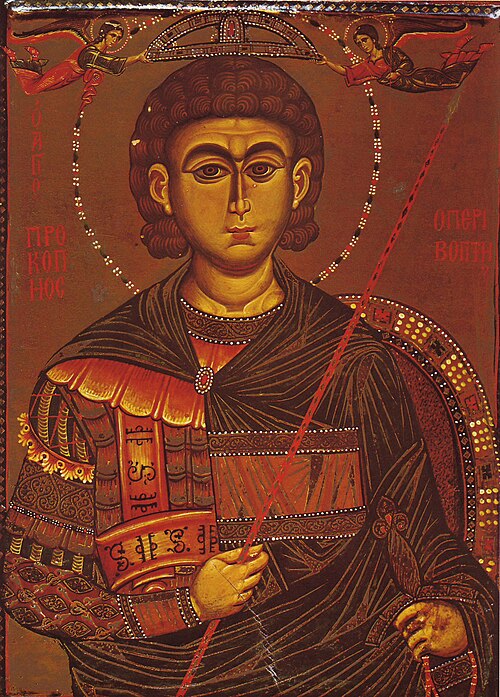
Great Martyr
Procopius of Scythopolis
Reader and exorcist at Scythopolis
Reader and exorcist in the church of Scythopolis, an ascetic and scholar, martyred in 303.
- Feast
- July 8old style July 21
- Reposed
- 3034th century
- Place
- Caesarea Maritima
- Order
- Great Martyrs
Life
Saint Procopius the Great Martyr, also called Procopius of Scythopolis or of Caesarea in Palestine, suffered in the persecution of Diocletian and was beheaded at Caesarea in Palestine in the year 303. The oldest report of him, in Eusebius of Caesarea, shows him as a reader and exorcist in the church of Scythopolis, while later tradition presents him as a converted officer. The Church keeps his feast on 8 July.
The story in the early sources
Eusebius, who wrote of his martyrdom, says that he was born at Jerusalem and lived at Scythopolis, where he held three offices in the Church. He read the Scriptures, interpreted them in the Syriac language and healed by prayer those who were possessed by evil spirits. He was sent with his companions from Scythopolis to Caesarea Maritima, where he was beheaded. Eusebius's account also survives in ancient Syriac, Georgian and Latin translations. A Ukrainian tradition adds that he lived on bread and water alone, two or three times a week, and studied the Holy Scriptures all his life. He is counted as the first martyr for Christ in Palestine.
His life according to tradition
His later Life, quite different, says that he was born at Jerusalem with the name Neanias, of Christopher, a Christian of noble birth, and of Theodosia, a pagan. Left without a father, he was raised by his mother in the pagan faith, and she brought him to the emperor Diocletian. The emperor made him duke of Alexandria and ordered him to pursue the Christians.
On the road to Apamea, near the city, there was an earthquake and the sky lit up with lightning, and Neanias heard a voice threatening him with death if he persecuted the Christians. A cross as of crystal then appeared to him, and the voice said that it was Jesus crucified, the Son of the living God. It was an event like that of the Apostle Paul. At Apamea he asked to be instructed in the faith and was baptised, receiving the name Procopius.
Returning to Scythopolis, he made a cross of gold and silver after the likeness of the one that had appeared to him. Three images with Hebrew letters appeared on it, in the middle the word Emmanuel and at the sides the names Michael and Gabriel. With this cross at the head of his army he defeated the enemies who invaded the land. When his mother, glad of his victories, asked him to thank the gods by offering sacrifice, Procopius answered that he had won by the power of Christ and not of idols. She denounced him to the emperor.
Martyrdom
Brought before the governor Justus, he was handed, we are told, the emperor's letter commanding him to worship the Roman gods, and he tore it up. He was imprisoned and tortured at Caesarea. In prison, according to his Life, Christ appeared to him again, baptised him and gave him the name Procopius.
Twelve women came to his prison window and declared that they too were servants of Christ. They were thrown into the same prison, and Procopius taught them the faith and how to receive the crown of martyrdom. Bulgarian sources speak of twenty maidens. Seeing their sufferings and the courage of her son, the mother of Procopius believed in Christ. At the place of execution Procopius lifted his hands to the east and prayed for all the poor and those in need, for widows and orphans and above all for the Church, that it might grow and endure. According to his Life the prayer was heard, and he went gladly to the Lord under the sword, on 8 July 303, beheaded by order of the governor Flavian. His body was buried secretly by the local Christians.
Veneration
The name of Saint Procopius is mentioned in the marriage service, alongside Saints Constantine and Helen, because he prepared for martyrdom the maidens who suffered after him. At Scythopolis a chapel was dedicated to him, and the emperor Zeno built a church in his honour at Caesarea Maritima in 484. His relics were moved to the church of Saint Michael in Antioch, and in Constantinople four churches were dedicated to him. In the West, Bede listed him in his martyrology under 8 July, and his name entered the Roman Martyrology. He is the patron of several places in Serbia, and in Bulgarian tradition he is the protector of bees and hives.
Commemorated the same day July 8
 Adrian III of RomeSaint · Bishop of RomeJul 8
 Edgar the PeacefulRight-Believing · King of EnglandJul 8
 Kilian of WürzburgHieromartyr · Bishop of WürzburgJul 8
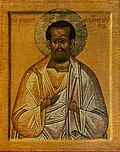 Procopius of UstyugFool-for-Christ · Fool for ChristJul 8
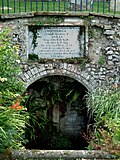 Withburga of DerehamVenerable · Abbess of DerehamJul 8
- Auspicius of ToulSaint · Bishop of ToulJul 8
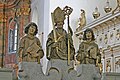 Colman of WürzburgHieromartyr · Irish missionary at WürzburgJul 8
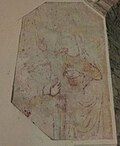 MorwennaVenerable · Saint of CornwallJul 8
 Procopius of UstiaRighteousJul 8
 Theophilus the Myrrh-streamerVenerable · AthoniteJul 8
- Epictetus and AstionHoly Venerable Martyrs · Martyrs of HalmyrisJul 8
- AbdaMartyrJul 8