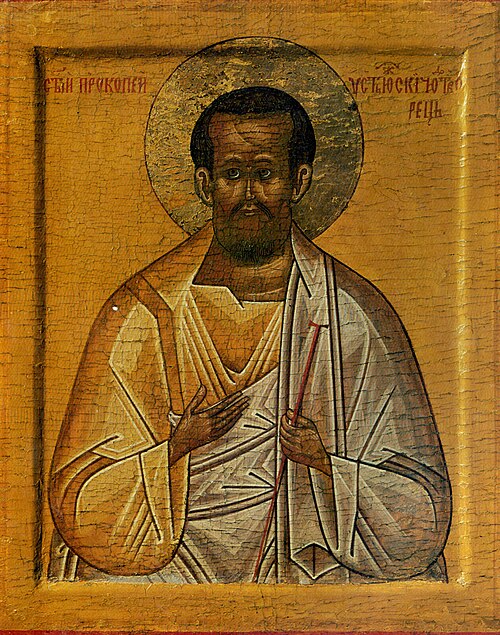
Fool-for-Christ
Procopius of Ustyug
Fool for Christ
Former merchant of Lübeck who became a fool for Christ at Ustyug and a wonderworker; died in 1303.
- Feast
- July 8old style July 21
- Reposed
- 130314th century
- Place
- Veliky Ustyug
- Order
- Fools-for-Christ
Life
Saint Procopius of Ustyug, also called Procopius of Lübeck, was a fool for Christ and wonderworker, formerly a merchant of Lübeck, who lived in Veliky Ustyug and died on 8 July 1303. He is commemorated on 8 July. He is regarded as the first saint glorified by the Russian Church among the fools for Christ.
Life
His worldly name, surname, date and place of birth are not known for certain. According to his life, he was "of the Varangians". The church historian Stefan Lyashevsky considers him to be from the old family of patrician merchants of Lübeck, and a journalist from Arkhangelsk identifies him, on the basis of this research, with the Hanseatic merchant of Lübeck Jacob Potharst, of an old Prussian family, but this is not established with certainty. He was Catholic and turned to Orthodoxy in his travels. After the death of his father, fallen in a battle of the Prussians with the Germans, he had to leave Prussia. He loaded his wealth on ships and went to Great Novgorod, the usual route then of Hanseatic merchants, where the Hansa had a branch, the German Court.
Arriving about 1243, he was astonished by the number and beauty of the churches and monasteries, the pleasant sound of the bells, the devotion of the people and their zeal at the services, things he had not met among believers subject to the Roman See. He visited the cathedral of Saint Sophia and other churches and monasteries, listened to the choir and decided to turn to Orthodoxy. Wishing to follow the labour of the monks, he gave all his goods and his inheritance from his father to the poor of the city and gave a part to the Varlaam monastery at Khutyn, founded shortly before, in 1192. There he had as guide the elder Varlaam Prokshinich, who followed in everything the founder of the monastery, Varlaam of Khutyn (died 1192). When the Novgorodians began to honour him for his righteous life, he began to behave as a fool for Christ: by day he went about as a madman, and at night he stayed awake and prayed unceasingly to the Lord. Later he left Novgorod, where he was praised for his lack of possessions, for Veliky Ustyug, where he lived in the porch of the church of the Dormition of the Mother of God. He lived on alms, clothed in rags, usually sleeping on damp ground, on a heap of rubbish or on stones. His comfort was the righteous couple John Buga (a Tatar tax collector who had accepted Orthodoxy) and his wife Maria, and his friend and companion in talk was Blessed Cyprian, founder of the Ustyug monastery in honour of the Archangel Michael.
The miracle of 1290
In 1290, according to his life, Procopius foresaw a calamity: a violent storm with thunder, forest fires and a terrible whirlwind, the result of the fall of a meteorite twenty versts from Veliky Ustyug. A week before the meteorite fell, Blessed Procopius began to go about the city, calling the inhabitants with tears to repentance and prayer, that the Lord might spare the city the fate of Sodom and Gomorrah. For a week he warned of God's coming judgement, but no one believed him. When the storm broke, people ran to the strongest and safest building in the city, the cathedral, and found Procopius praying for them and for the city's salvation. Church tradition holds that he prayed before the ancient icon of the Annunciation, later carried to Moscow. In honour of this icon, called the "Annunciation of Ustyug", the Russian Church celebrates on 8 July "the Sign from the icon of the Mother of God of the Annunciation in the city of Ustyug". Historical data, however, do not confirm that the icon was then at Ustyug. The Serbian source says his body was found dead in the street, covered with snow.
Glorification and relics
Procopius lived in foolishness for Christ for sixty years. The Church's glorification took place at the Council of Moscow in 1547, with commemoration on 8 July by the Julian calendar, but according to Evgeny Golubinsky local veneration dates from the 1470s and in 1547 was only made lawful; according to V. O. Klyuchevsky, accounts of him began to be written in the second half of the fifteenth century, when his church was built at Ustyug, in 1471. In the 1550s the son of the abbot of the monastery of Solvychegodsk, Dionysius, wrote the "Tale of the Labours and Miracles of Procopius of Ustyug the Fool for Christ", with nineteen posthumous miracles, and toward the middle of the seventeenth century the final form of the life was drawn up, with twenty-eight miracles, among them the deliverance of Ustyug from the Polish-Lithuanian invaders in the Time of Troubles. His incorrupt relics were discovered in the eighteenth century near the church of the Entrance of the Theotokos into the Temple at Veliky Ustyug and placed in the church, where they remained in open view for two hundred years and were the source of numerous healings. In the 1960s the Russian Church Outside of Russia built the church of Saint Prokop at Hamburg. In 1818 his commemoration was established for the whole Church.
Commemorated the same day July 8
 Adrian III of RomeSaint · Bishop of RomeJul 8
 Edgar the PeacefulRight-Believing · King of EnglandJul 8
 Kilian of WürzburgHieromartyr · Bishop of WürzburgJul 8
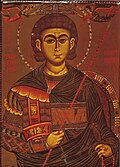 Procopius of ScythopolisGreat Martyr · Reader and exorcist at ScythopolisJul 8
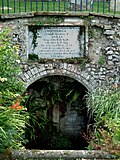 Withburga of DerehamVenerable · Abbess of DerehamJul 8
- Auspicius of ToulSaint · Bishop of ToulJul 8
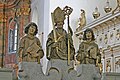 Colman of WürzburgHieromartyr · Irish missionary at WürzburgJul 8
 MorwennaVenerable · Saint of CornwallJul 8
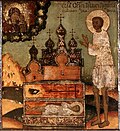 Procopius of UstiaRighteousJul 8
 Theophilus the Myrrh-streamerVenerable · AthoniteJul 8
- Epictetus and AstionHoly Venerable Martyrs · Martyrs of HalmyrisJul 8
- AbdaMartyrJul 8