
Righteous
Procopius of Ustia
Righteous man of the Russian Church whose veneration began when his body was found incorrupt.
- Feast
- July 8old style July 21
- Era
- unknown
- Order
- The Righteous
Life
Procopius of Ustia (or Procopius of Usia), honoured in the Russian Church as a righteous saint, is a special case. Nothing certain is known of his life, not even who he was. His veneration began in the seventeenth century, in the Vaga district, on the bank of the river Ustia, when near the parish church of the village of Veryuga the incorrupt body of an unknown man was found, and he appeared in a dream to a villager and gave his name. He was never officially canonized, his veneration was stopped by the Holy Synod in 1801, but his name has remained in the calendars of the Russian Church. His commemoration is on 8 (21) July.
The finding of the body
In the middle of the seventeenth century (the year is not known, but not earlier than 1641), in the Vaga district, on the bank of the river Ustia, beside the parish church of the village of Veryuga, the incorrupt body of an unknown man was found, from which a sweet fragrance was felt. The coffin, made of willow rods, had come to the surface of the ground. None of the locals knew who had been buried there or when. Above the coffin the villagers set up a chapel. In a dream the dead man appeared to a local man, Savely Ontropov (Antropov), gave his name, Prokopy, and told him to make a new coffin. The villagers, who honoured him as a saint, took the old coffin apart rod by rod. Savely made the new coffin, after which the relics were placed in the church of the Entry of the Mother of God into the Temple, beside the south wall. A villager composed in a little book a church service for Prokopy, and the people began to pray by it, celebrating in the church services dedicated to the dead man.
At the request of the Solvychegodsk merchant Ivan Ermolaev, the icon painter Onisim Karamzin painted in 1652 the first icon of Procopius of Ustia. Ivan Ermolaev said that Prokopy himself had appeared to him and given permission to paint his image. E. E. Golubinsky writes that the celebration was established before 1739. Procopius was not canonized.
The halting of veneration
Prayer to Procopius was stopped by Bishop Arsenius Todorsky of Vologda and Great Perm (1796 to 1802), before the end of 1801, on the ground that, at a second examination, the relics were not found incorrupt, but many parts of the body of this man honoured as a saint were missing. On 16 December 1801 the Holy Synod confirmed the bishop's decision. According to it, from the examinations of 1696 and 1739 many parts of the body were missing, no reliable information had been found on the date of the finding, who he was and where from, and the description of the miracles, from which full recognition as a saint and glorification of the relics had begun, was wholly inadequate, so the relics were to be left in their present state, without general proclamation.
In 1818 Bishop Onisiphorus (Borovik) of Vologda and Ustyug tried to restore Procopius's feast and submitted a petition, but the Holy Synod refused it, invoking its decision of 1801. Despite the decision, Procopius went on being venerated as a saint by the locals. The priest John Veryuzhsky testifies to the singing of molebens beside the relics, and the rumour continued to circulate that the relics are a whole body. Golubinsky, citing three examinations of the relics, in 1696, 1739 and 1818, writes that this is not so, and many parts were missing.
His name in the calendars
Despite the Synod's ban, church writers included his name in lists of saints. Sergius (Spassky) entered it in 1876 in the "Complete Menologion of the East", calling him a fool for Christ. M. V. Tolstoy entered it in 1887 in the "Book Called Description of the Russian Saints". The most information about his relics was given by the priest John Veryuzhsky, later abbot of Kirillo-Novoezersk (1886 to 1901). In 1880 he wrote the book "Historical Tales of the Lives of the Saints who Struggled in the Diocese of Vologda, Glorified by the Whole Church and Locally Venerated", in which he entered Procopius as a saint and devoted a whole chapter to him, and a booklet, "Holy Righteous Prokopy of Usia the Wonderworker" (1879, 1889). John Veryuzhsky reports 20 healings that took place by the coffin with his relics and says the local commemoration was on 8 July and that many locals fasted a whole week before it. Until 1903 there was no official canonization. After the revolution, on 6 March 1919, in the campaign of opening relics, the coffin with Procopius's body was opened and, according to the report of the Eighth Department of the People's Commissariat of Justice, a mummified body was found in the shrine.
At present Procopius of Ustia's name is entered in the calendars of the Russian Church. In some calendars incorrect information has crept in: that he is a fool for Christ and that in 1818 his commemoration was established throughout the Church (citing Bishop Onisiphorus's letter as proof, though it was on it that the Synod refused veneration). These data do not agree with what is set out above.
Commemorated the same day July 8
 Adrian III of RomeSaint · Bishop of RomeJul 8
 Edgar the PeacefulRight-Believing · King of EnglandJul 8
 Kilian of WürzburgHieromartyr · Bishop of WürzburgJul 8
 Procopius of ScythopolisGreat Martyr · Reader and exorcist at ScythopolisJul 8
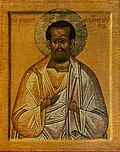 Procopius of UstyugFool-for-Christ · Fool for ChristJul 8
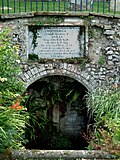 Withburga of DerehamVenerable · Abbess of DerehamJul 8
- Auspicius of ToulSaint · Bishop of ToulJul 8
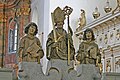 Colman of WürzburgHieromartyr · Irish missionary at WürzburgJul 8
 MorwennaVenerable · Saint of CornwallJul 8
 Theophilus the Myrrh-streamerVenerable · AthoniteJul 8
- Epictetus and AstionHoly Venerable Martyrs · Martyrs of HalmyrisJul 8
- AbdaMartyrJul 8