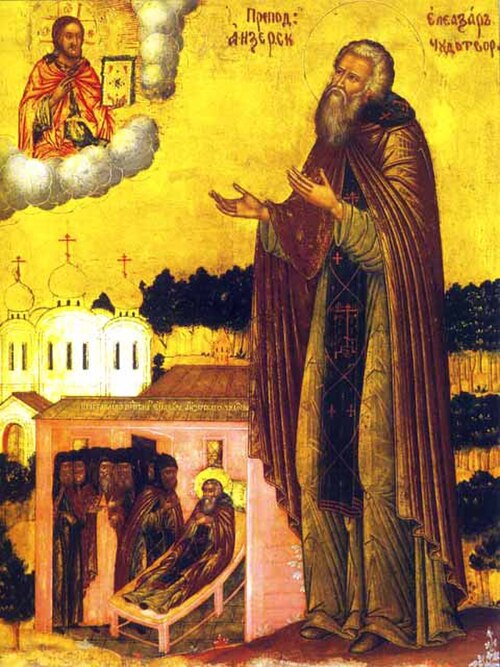
Venerable
Eleazar of Anzer
Founder of the Anzer Skete
Monk of Solovki, founder of the Holy Trinity skete on Anzer Island, who died in 1656.
- Feast
- January 13old style January 26
- Reposed
- 165617th century
- Place
- Solovetsky Monastery
- Order
- Venerables
Life
Venerable Eleazar of Anzer (died 13 January 1656) was a monk of the Solovki Monastery, founder of the Holy Trinity skete on Anzer Island in the White Sea. He was a spiritual counsellor of tsars and established an ordered life of hermits, received the future Patriarch Nikon at the skete and was honoured by Tsar Michael and by Alexis Mikhailovich. His relics were found in 1757. He is commemorated on 13 January.
Life
He was born in the family of the merchant Afanasy Sevryukov of Kozelsk. Very young he entered the Solovki Monastery and received the tonsure from Abbot Irinarkh of Solovki. In the monastery he learned wood carving and took part in decorating the iconostasis of the Transfiguration Cathedral. In 1612, seeking strict ascetic labours, he settled on Anzer Island. He earned his food by making wooden vessels, which he exchanged with passing fishermen for provisions. In 1616 he was tonsured into the schema, and four years later moved to the other side of the island, nearer to the Solovki Monastery, and built beside an old church of Saint Nicholas a cell and a chapel. A community gradually formed around him. For it he set the rule of anchoritic monasticism: the cells were a verst apart, and the monks gathered on the eve of Sunday or feasts for common worship.
Around 1635 Nikita Minin came to the skete and was tonsured by him a monk with the name Nikon, who in 1652 became Patriarch of Moscow. He stayed in the skete three years. Once, according to the life, Eleazar had a vision in which Nikon's shoulders bore the omophorion, and so he foretold his patriarchate. Later, however, Nikon began to reproach the Anzer monks for love of money and accused Eleazar too, and then left the skete. In the Old Believer tradition, instead of the omophorion Eleazar saw round Nikon's neck a very large black serpent coiled while he served the Liturgy, and was terrified.
Eleazar copied several books for the skete, among them three books of the Florilegium, and composed an exposition of the cell rule. His life became known in Moscow, and Tsar Michael Feodorovich, grieved at having no heir, summoned him and asked for his prayers, and Eleazar is said to have foretold the birth of a son. In 1620 Abbot Irinarkh received from the nun Martha, the tsar's mother, a hundred roubles for a wooden church of the Holy Trinity in the skete. After the birth in 1629 of the heir Alexis Mikhailovich, the tsar, considering it the fruit of the venerable one's prayers, on 31 July 1633 granted the skete independence from Solovki and a yearly allowance, and in 1638 placed it under the protection of the governor of Suma. In 1648 Eleazar was summoned to Moscow by Tsar Alexis, who wished to see the man who had foretold his birth. The tsar confirmed all the skete's privileges and ordered a stone church built. Patriarch Nikon, though he had had a conflict with Eleazar, sent generous gifts to the skete after he became patriarch, and in 1654 obtained from the tsar an increase of its allowance.
His end and relics
Before his death he named his disciple Nikodim abbot, received communion and fell asleep on 13 January 1656. In 1757, when a church was built over his grave, his relics were found, declared incorrupt, and a service was composed. In 1925 the relics were opened and removed from Anzer, and their present location is not known. In 2003 a particle of relics was found in the plundered tomb and is kept in the church of the Resurrection of the Anzer skete.
Commemorated the same day January 13
 Hilary of PoitiersSaint · Bishop of PoitiersJan 13
 James of NisibisSaint · Bishop of NisibisJan 13
 Kentigern of GlasgowSaint · Bishop of GlasgowJan 13
 Jeremias I of ConstantinopleSaint · Patriarch of ConstantinopleJan 13
 Irenarch the RecluseVenerable · Recluse of RostovJan 13
 Maximos of KafsokalyviaVenerableJan 13
 Vivenzio of BleraSaint · Bishop of BleraJan 13
- Leontius of CaesareaSaint · Bishop of Caesarea in CappadociaJan 13
- Nicholas the GreekSaintJan 13
- Ailell of Ard MachaSaintJan 13
- Andrew of TrierHieromartyrJan 13
- Berno of ClunyVenerable · Abbot of ClunyJan 13