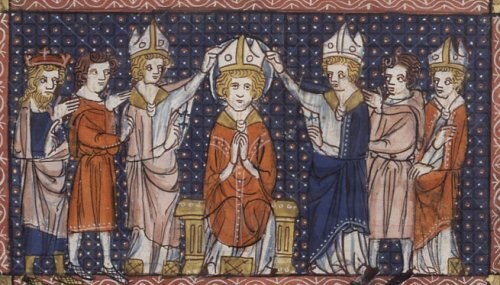
Saint
Hilary of Poitiers
Bishop of Poitiers
Bishop of Poitiers, defender of the true faith against the Arians, called the Hammer of the Arians.
- Feast
- January 13old style January 26
- Reposed
- 3674th century
- Place
- Poitiers
- Order
- Hierarchs
Life
Saint Hilary of Poitiers was bishop of Poitiers in Gaul and a teacher of the Church, called the Athanasius of the West and the Hammer of the Arians for his struggle to defend the Nicene faith against Arianism. The Orthodox Church keeps his memory on 13 January.
Youth and conversion
He was born at Poitiers, at the end of the third or the beginning of the fourth century. The sources give his birth year anywhere between 298 and 320. His parents were pagans of distinction. He received a good education, including Greek, and devoted himself to Neoplatonic philosophy. Through reading the Old and New Testaments he left Neoplatonism for the Nicene faith and was baptized as an adult, together with his wife and their daughter, known as Saint Abra of Poitiers, herself a nun renowned for her charity.
Bishop and defender of the faith
He was elected bishop of his native city around 350, by some accounts in 353. Arianism, which denied the divinity of Christ, was spreading, and the support of Emperor Constantius II made it dangerous. Hilary stood against it, like Saint Athanasius the Great. Wikipedia notes that at the council of Arles the legates of Pope Liberius refused to condemn Arianism, yet Hilary secured the local excommunication of Bishop Saturninus and of Ursacius and Valens, supporters of the Arian cause. Around 355 he wrote the emperor a remonstrance against the persecutions, of which only fragments survive.
At first it did not succeed. At the synod of Béziers in 356, called by the emperor, an imperial decree banished him to Phrygia, a stronghold of Arianism, together with Bishop Rhodanus of Toulouse. Wikipedia notes that the reasons for his exile remain obscure: the traditional explanation is his refusal to sign the condemnation of Athanasius and the Nicene faith, while some recent scholars suggest political opposition to Constantius.
In exile
Hilary spent nearly four years in exile, yet he went on governing his diocese. In Phrygia he wrote two of his most important dogmatic works. One is On the Councils, an epistle of 358 to the semi-Arian bishops of Gaul, Germany and Britain, in which he analyses the professions of faith of the Eastern bishops and shows that sometimes the difference lay more in words than in ideas, which led him to counsel the bishops of the West to be more restrained in condemning them. The other is On the Trinity, in twelve books, written in 359 and 360, the first successful expression in Latin of the theological subtleties first worked out in Greek. Through it he made Eastern theology known in the West.
He also attended the council of Seleucia in 359, which saw the triumph of the homoian party. In 360 he tried in vain to get a personal audience with Constantius and to address the council at Constantinople. When that council ratified the decisions of Rimini and Seleucia, he answered with the bitter Against Constantius, which called the emperor an Antichrist and persecutor of Orthodox Christians. His repeated demands for public debate with his opponents, above all Ursacius and Valens, became so inconvenient that he was sent back to his diocese, which he reached around 361. The OCA says the emperor judged it less trouble to let him return.
Last years
On his return Hilary spent two or three years persuading the local clergy that the homoian confession was only a cover for Arian subordinationism, and several synods in Gaul condemned the creed of Rimini. Around 360 or 361, with his encouragement, Martin, the future bishop of Tours, founded the monastery of Ligugé in his diocese. In 364 he accused Auxentius, bishop of Milan and a favourite of the emperor, of heresy. Valentinian I summoned him to Milan, but Auxentius gave satisfactory answers, and Hilary called him a hypocrite. Back home he published, in 365, the work Against the Arians or Auxentius of Milan.
According to Jerome, Hilary died at Poitiers in 367. Other sources, among them the OCA and doxologia, give 368, and doxologia calls him the one who united the episcopate of Gaul, restored the Nicene faith in Aquitaine and laid the foundations of Western monasticism. He also wrote commentaries on the Psalms and on the Gospel of Matthew, and hymns in Latin.
Veneration
His relics rest in the cathedral that bears his name at Poitiers in France, says the OCA. His name lives on in the Hilary term of the English law courts and universities, which begins around his feast. He is honoured by the Orthodox and the Roman Catholic Churches, the latter naming him a Doctor of the Church (in 1851). He lived before the division of the Churches and is regarded as the beginner of great Latin theology.
Commemorated the same day January 13
 James of NisibisSaint · Bishop of NisibisJan 13
 Kentigern of GlasgowSaint · Bishop of GlasgowJan 13
 Jeremias I of ConstantinopleSaint · Patriarch of ConstantinopleJan 13
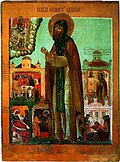 Irenarch the RecluseVenerable · Recluse of RostovJan 13
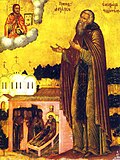 Eleazar of AnzerVenerable · Founder of the Anzer SketeJan 13
 Maximos of KafsokalyviaVenerableJan 13
 Vivenzio of BleraSaint · Bishop of BleraJan 13
- Leontius of CaesareaSaint · Bishop of Caesarea in CappadociaJan 13
- Nicholas the GreekSaintJan 13
- Ailell of Ard MachaSaintJan 13
- Andrew of TrierHieromartyrJan 13
- Berno of ClunyVenerable · Abbot of ClunyJan 13