Venerable
Euthymius of Arkhangelogorod
A venerable monk of Arkhangelogorod, commemorated in the calendar of the Orthodox Church.
- Feast
- January 20old style February 2
- Reposed
- 152316th century
- Order
- Venerables
Life
Holy Venerable Euthymius of Arkhangelogorod was abbot of the Archangel Michael Monastery in Arkhangelsk. Very little information has been preserved about his life. It is known only that he was a native of Voznesenie and that from 1569 to 1585 (according to other data, he reposed in 1523) he was abbot of the monastery. Of his hidden ascetic life no recollections of contemporaries remain, but without doubt it was as the canon to the venerable says: you spent your life in prayers and fasting, in perfect dispassion, humbling the thinking of the flesh by the strength of the Divine Spirit.
The finding of the relics
The testimony to the truth of these words are the accounts of the finding of his relics and of the many miracles worked through them. On 7 July 1647 a blacksmith, Eustathius Trofimov, was digging in the yard of the governor of Arkhangelsk, the boyar Yuri Petrovich Buynosov-Rostovsky, a pit for a forge. Suddenly a wooden lid appeared from the earth; the smith thought he had found a chest with treasure, but, to his disappointment, he dug out an old coffin.
He mocked the unknown dead man, telling him to get up and help dig, and thrust his hand under the coffin board, but the hand did not go in. For this blasphemous act Eustathius suddenly began to shake as in a violent fever and, from weakness, could not move. Then he understood that he had fallen ill because of disrespect toward the unknown ascetic lying in the old coffin, and began to weep for his sin.
He was healed only after, by order of the boyar Buynosov-Rostovsky, who learned the cause of his servant's illness, a memorial service was served for the newly revealed servant of God. This was the first miracle of Venerable Euthymius of Arkhangelogorod.
By the efforts of the governor Buynosov-Rostovsky, the coffin with the venerable's body was moved to a wooden church nearby, dedicated to the feast of the Procession of the Honourable Wood of the Cross, and the relics were transferred from the old coffin to a new wooden shrine. Then several notable miracles occurred: a certain Maxim Medvedkin, who had regarded the veneration of the newly revealed saint with disbelief, lost his reason and was cured of the terror only after a tearful prayer to the one he had mocked.
And the widowed priest of the Resurrection church, Demetrius Kozmin, who had suffered ten years from an incurable disease of the legs, received healing through his faith in the venerable's help, after hearing the liturgy at his tomb.
The name revealed
Despite the many miracles, his name remained unknown for almost two years, until he himself revealed it, in 1649, in a vision to a novice of the Archangel Michael Monastery, Cosmas Ignatiev. He had been sent with other brothers to fishing, but suddenly fell so gravely ill that he lay unconscious, near death, without hope of human help. Then, as Cosmas himself later recalled, an old man came in to him, with a half-grey beard, and said: You are gravely ill, pray to God and call to your aid the one who lies in the tomb at the Procession of the Honourable Cross of the Lord.
Cosmas said: Lord, I do not know his name. The old man answered: My name is Euthymius and I am from Voznesenie, and became invisible. Praying to the venerable Euthymius, Cosmas recovered. Returning to the monastery, he told the miracle to Abbot Antony, and so the saint's name became known. The account of the healing of the novice Cosmas has been preserved to this day as testimony of the power of prayer to the venerable.
Euthymius of the city of Arkhangelsk is also what he called himself when he appeared to other people, for example Xenia of the Emetsk district, who had long suffered from fever and, calling on the saint with faith for deliverance from illness, received healing. How the venerable looked is also known from the accounts of those he healed: they described him as a man clothed in light, with reddish hair, a great greying beard, tall in stature, or as an elder with the face of a faster, a greying beard, not large, in a purple cassock.
Veneration
In 1644 the monk Joseph of the Archangel Michael Monastery collected testimonies of the numerous healings from the tomb of Venerable Euthymius. In 1650, by order of Metropolitan Nikon of Novgorod, the future patriarch, the abbot of the Antoniev-Siysk Monastery, Theodosius, examined the relics: the bones were found, and the investigation of the miracles convinced of the holiness of the venerable, recognized as Abbot Euthymius of the Archangel Michael Monastery.
Then the service to the venerable was composed and his icon painted. Until the beginning of the eighteenth century the relics lay in the church of the Procession of the Honourable Wood of the Cross; later, in its place the church of the Archangel Michael was built, where the relics of the venerable are laid under the slab.
He is commemorated on 2 February (new style). His name is not included in the present calendar of the Russian Church.
Commemorated the same day January 20
 Leo I the ThracianRight-Believing · Byzantine EmperorJan 20
 Euthymius the GreatVenerable · Abbot in PalestineJan 20
 Euthymius of TarnovoSaint · Patriarch of BulgariaJan 20
 Theodore Kuzmich of TomskRighteous · Elder of SiberiaJan 20
 Inna, Pinna and RimmaHoly MartyrsJan 20
AbadiosMartyrJan 20
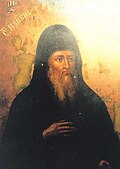 Euthymius of the Kiev CavesVenerable · Schemamonk of the Kiev CavesJan 20
 Bassus, Eusebius, Eutychius and BasilidesHoly Martyrs · Martyrs of NicomediaJan 20
- Aenna ua LaighsighSaintJan 20
- Anna of RomeMartyrJan 20
- Basilides of NicomediaMartyrJan 20
- CronanSaintJan 20