Venerable
Euthymius of Syanzhemsk
A Russian monk of the Vologda region who labored at Syanzhema, dying in 1465.
- Feast
- January 20old style February 2
- Reposed
- 146515th century
- Order
- Venerables
Life
Holy Venerable Euthymius of Syanzhemsk, an abbot, reposed around the year 1465 (according to another life, around 1470). He was born in Vologda and received monastic tonsure at the Spaso-Kamenny Monastery on Lake Kubenskoe. In another version of the life, he came to Spaso-Kamenny from the Volokolamsk region.
For a long time he passed through various obediences in the monastery, then, from love of quiet, left and settled in a desert near the mouth of the river Kushta, on the eastern shore of the lake, two versts from it. There, surrounded by impassable swamps and thicket, he built himself a small cell in which he laboured in fasting and prayer, giving himself no rest.
After a time the monk Alexander came to him, the venerable Alexander of Kushta, also tonsured at Spaso-Kamenny, who had likewise left the monastery from love of quiet and had first settled on the river Syanzhema. Alexander liked Euthymius' place, quite silent, and asked him to give up his cell, offering in exchange his own on the Syanzhema. Euthymius gladly agreed to exchange the place of struggle with Alexander.
At parting he left Alexander his cross as a blessing, went to the Syanzhema and settled in Alexander's cell. There Chariton came to him, to share his monastic labours. There were others too who wished to settle with Euthymius and Chariton. Since there was no church near and the inhabitants round about needed one, Euthymius resolved to build a church of the Ascension of the Lord and founded a monastery beside it.
At Rostov, in the time of Archbishop Dionysius (1418-1425), he received permission to build, and then, it seems, received the rank of priest and was set as abbot of the monastery founded.
Both venerables were an example to the brothers both in prayer and in all building and household labours. They were content with food and clothing that even the brothers thought unfit. In church Euthymius stood in fear and trembling, and the brothers often saw tears of compunction on his face. At handwork he always sang psalms. After his departure to the Lord, his beloved disciple, the venerable Chariton, succeeded him as abbot, continued the labour for more than forty years and reposed in deep old age on 11 April 1509.
Both venerables were buried in the church of the Ascension. The relics of Euthymius rest under the slab in the parish church of the Ascension of Euthymius in the Kadnikov district, which stands in the place of the abolished monastery. The beginning of his local veneration is not known exactly: after 1549 and before the establishment of the Holy Synod. The account of the appearance of his relics was written in the sixteenth century by Bishop Joasaph of Vologda, a known writer of saints' lives.
He is commemorated on 2 February and on 11 July, in the Synaxis of the Saints of Vologda.
Commemorated the same day January 20
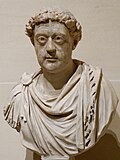 Leo I the ThracianRight-Believing · Byzantine EmperorJan 20
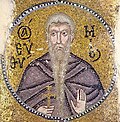 Euthymius the GreatVenerable · Abbot in PalestineJan 20
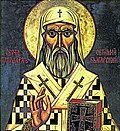 Euthymius of TarnovoSaint · Patriarch of BulgariaJan 20
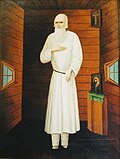 Theodore Kuzmich of TomskRighteous · Elder of SiberiaJan 20
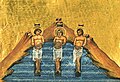 Inna, Pinna and RimmaHoly MartyrsJan 20
AbadiosMartyrJan 20
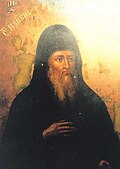 Euthymius of the Kiev CavesVenerable · Schemamonk of the Kiev CavesJan 20
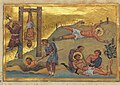 Bassus, Eusebius, Eutychius and BasilidesHoly Martyrs · Martyrs of NicomediaJan 20
- Aenna ua LaighsighSaintJan 20
- Anna of RomeMartyrJan 20
- Basilides of NicomediaMartyrJan 20
- CronanSaintJan 20