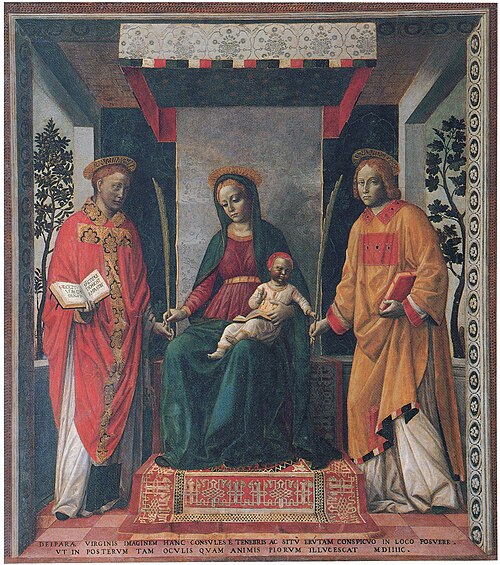
Holy Martyrs
Faustinus and Jovita
Martyrs of Brescia
Martyrs said to have been put to death under Hadrian in 120, patrons of the city of Brescia.
- Feast
- February 15old style February 28
- Reposed
- 1202nd century
- Order
- Martyrs
Life
The holy martyrs Faustinus and Jovita are, according to tradition, two brothers of Brescia (ancient Brixia), put to death for faith in Christ in the time of the Emperor Hadrian, in the year 120. They are patrons of the city of Brescia, and Faustinus is also patron of the town of Pietradefusi. Their feast is on 15 February.
Tradition says that they belonged to a noble family of Brixia. Jovinus, the older brother, was a preacher and Faustinus a deacon. Because they preached the Gospel fearlessly, they were brought before the Emperor Hadrian, who subjected them to terrible torments at Brixia, Rome and Neapolis. Neither pain nor threats shook their faith, and in the end they were beheaded at Brixia. The year 120 is the one accepted by the Bollandists, while the historian Paul Allard gives 118. Their Acts were compiled by Faustinus, a bishop of Brescia who is said to have been their descendant.
Most of the so-called "Acts" are largely the fancy of legend. The Jesuit Fedele Savio questioned nearly every detail except the fact of the martyrdom, which is shown by their inclusion in many early martyrologies and by the extraordinary veneration they enjoy in their native city, where from time immemorial they have been the chief patrons. It is believed that they were killed at a place that either was or later became a Roman cemetery, where the church of Santi Faustino e Giovita ad sanguinem was built, its dedication later changed to Saint Afra; the church of Saint Afra was destroyed in the bombing of the Second World War.
Their joint feast on 15 February was entered in the General Roman Calendar but was removed in 1969, because their Acts are "completely fabulous", presenting Jovita as a preacher although the name is a woman's and Faustinus is a man. The two remain in the Roman Martyrology. Parts of their relics are held at Brescia, Rome, Bologna, Verona, Pietradefusi and Malečnik.
Since 2002, 15 February has become in Italy, and then in other European countries, "Saint Faustinus' Day", the patron of those who are single, as an alternative to Saint Valentine's Day. The asteroid (921) Jovita, discovered in 1919, bears the name.
Commemorated the same day February 15
 OnesimusApostle · Disciple of the Apostle PaulFeb 15
 Sigfrid of VäxjöSaint · Missionary bishop in SwedenFeb 15
 Euphrosyne of AlexandriaVenerableFeb 15
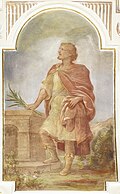 Faustinus of BresciaSaint · Bishop of BresciaFeb 15
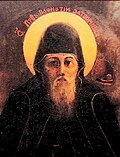 Paphnutius the RecluseVenerable · Recluse of the Kiev CavesFeb 15
- Paphnutius the AsceticVenerableFeb 15
 Anthimos of ChiosVenerable · Patron of lepersFeb 15
- Eusebius the HermitVenerable · Hermit in SyriaFeb 15
- Agape of TerniSaintFeb 15
- Alexis NikitskyHieromartyrFeb 15
- Alexis SmirnovHieromartyrFeb 15
- Baralus of AntiochMartyrFeb 15