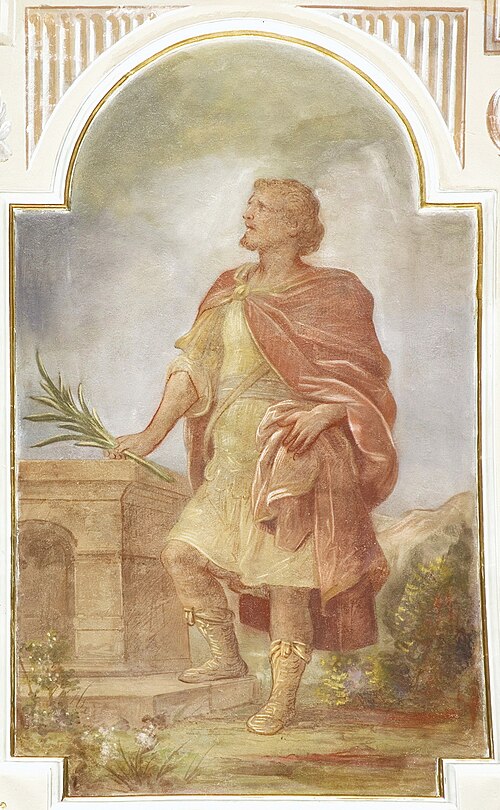
Saint
Faustinus of Brescia
Bishop of Brescia
Bishop of Brescia from about 360, successor of Ursicinus, who died in 381.
- Feast
- February 15old style February 28
- Reposed
- 3814th century
- Place
- Brescia
- Order
- Hierarchs
Life
Saint Faustinus of Brescia was bishop of Brescia from about 360, successor of Ursicinus, and died about 15 February 381. His commemoration is on 15 February in the Roman Catholic Church and on 16 February in the Orthodox Church, according to the English source. Our sources, however, mix his story with that of another Faustinus, and it is not clear whether he is honoured as a saint.
According to tradition, he was a descendant of Faustinus and Jovita, martyrs of Brescia, and compiled the Acts of these two martyrs. His relics were found in 1101. Faustinus appeared in the old Roman Martyrology on 15 February: At Brescia, the holy Confessor Faustinus, Bishop of that see. He is no longer listed in the revision of 2004. This may be because of some doubt that the person existed, or because his cult was never approved.
The Russian source speaks, with the same name, of a Roman presbyter of the fourth century, a Christian writer. He belonged to the party of Ursinus and to the schism of Lucifer, that is, he was a Luciferian. Together with the presbyter Marcellinus he accompanied the Luciferian bishop Ephesius on his journeys in the East, to gain supporters. At Eleutheropolis, after Ephesius's departure for Africa, they suffered harsh treatment from Bishop Turbo. Both for this and for the unfriendly attitude of the Orthodox bishops toward their party, in 383 and 384 they presented to Theodosius at Constantinople the Book of Petitions. Probably, along with this, Faustinus presented a confession of faith, in which he regarded as tritheists those who confessed three hypostases. About this time, it seems, the empress Flaccilla asked Faustinus to write a polemical work against the Arians. Faustinus wrote a work in seven books, The Holy Trinity or the Faith, against the Arians, in which he summarized the thoughts of Tertullian and Hilary. Chapter 16 of the book of Gennadius of Massilia On Illustrious Men is devoted to him. Gennadius considers that, although Faustinus refuted the Arians and the Macedonians, he did so by those very testimonies of Holy Scripture which they had interpreted wrongly and distorted. The writings of Faustinus are published in volume 13 of the Patrologia Latina. The sources do not show that the Luciferian presbyter was regarded as a saint.
Commemorated the same day February 15
 OnesimusApostle · Disciple of the Apostle PaulFeb 15
 Sigfrid of VäxjöSaint · Missionary bishop in SwedenFeb 15
 Euphrosyne of AlexandriaVenerableFeb 15
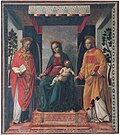 Faustinus and JovitaHoly Martyrs · Martyrs of BresciaFeb 15
 Paphnutius the RecluseVenerable · Recluse of the Kiev CavesFeb 15
- Paphnutius the AsceticVenerableFeb 15
 Anthimos of ChiosVenerable · Patron of lepersFeb 15
- Eusebius the HermitVenerable · Hermit in SyriaFeb 15
- Agape of TerniSaintFeb 15
- Alexis NikitskyHieromartyrFeb 15
- Alexis SmirnovHieromartyrFeb 15
- Baralus of AntiochMartyrFeb 15