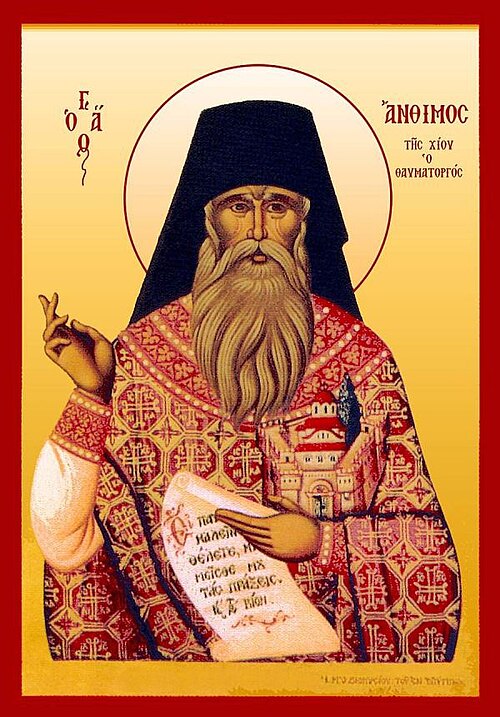
Venerable
Anthimos of Chios
Patron of lepers
Monk and spiritual father of Chios, born in 1869 and died in 1960, patron of lepers.
- Feast
- February 15old style February 28
- Reposed
- 196020th century
- Place
- Chios
- Order
- Venerables
Life
Saint Anthimos of Chios (Chios, 1869 - 15 February 1960), in the world Argyrios K. Vagianos, was a Greek monk of the twentieth century, known for his monastic life and for his care of the sick with Hansen's disease (leprosy). He was placed among the saints by the Ecumenical Patriarchate on 14 August 1992. He is commemorated on 15 February, the day of his repose. He is regarded as the protector of lepers.
Life in the world
Argyrios Vagianos was born in 1869 in the area of Saint Luke in Livadia, on the island of Chios, then under Ottoman rule. From very small he prayed and fasted. Great influence on his life was exerted by the monk Pachomios, who inspired him with love of God and of one another. His education came from his pious and virtuous parents, Konstantinos and Argyro, who took care that he be given a Christian upbringing. From childhood, all the development and upbringing given to the young Argyrios sprang from the strong and deep influence of his Christian family environment. As for schooling, he had no notable learning, since circumstances then did not allow children of poor families to study, so he was content with the simple knowledge of the elementary classes. He taught himself the craft of shoemaking, mainly to earn a living, and had to practice it also during the time he was a novice. Although he had no theoretical knowledge and was not well known, by his intelligence and the penetration of his mind, and with an especially lively desire for the spiritual life, he advanced in a virtuous life, keeping the feeling of faith unshaken.
Monastic life
His bond with the monk Pachomios was decisive in his decision to dedicate his life to the monastic way; so too his visit to the Skete of the Holy Fathers of Chios, to repair an icon of the Mother of God that he owned. To this icon he bound his whole life from then on. The Mother of God became for him a source of inexhaustible strength in his later harsh struggles, but also a source of refreshment and relief. Argyrios submitted to the Elder Pachomios and, through unceasing prayers, fasts and harsh struggles, proved great in ascetic labor and virtue.
At twenty he was tonsured into the small schema and took the name Anthimos from the monk Pachomios. Because of his humility and goodness, many services and duties were entrusted to him from a young age. In 1905 Elder Pachomios reposed and Hieromonk Andronikos succeeded him, who knew very well the wonderful path of Anthimos. When Anthimos was forty, he invested him in the great schema. His virtuous way of life aroused great interest and zeal for monastic life, and he himself was an example to imitate. The intelligence and goodness that marked him brought him the rank of priesthood: he was called to Adramyttion in Asia Minor by his godfather Stefanos Diomatares, in 1910, for this purpose. His ordination was unusual because of the extreme natural phenomena during it.
By bodily and spiritual labor he was exhausted and fell ill. His health had been tried from youth and his condition needed medical attention. In spite of the exhaustion he did not stop monastic labor, fasting and prayer, subjecting himself to continual trial. As soon as his health was partly restored, he withdrew to a small isolated cell on his parents' estate, at Livadia in Chios, continuing his spiritual struggles. There he lived as a monk, practicing at the same time the craft of shoemaking, to help his poor parents and give alms to the sorely tried.
His spiritual radiance aroused the jealousy of his fellow clergy, and so he decided to leave Adramyttion in 1911 and went to Mount Athos, where the Athonite monks showered him with many honors. He was seized with desire to venerate the holy relics of the saints and kiss the wonderworking icons of the Mother of God. He knew that on Athos there were many monks and hermits from whom he could gain spiritual benefit. Later, after the Athonites had filled him with gifts as a sign of recognition, respect and love, he left the Mountain, keeping only a small part of them, and, full of spiritual wealth and love, returned to his native Chios.
Work
Lepers, already from the seventh century in Lombardy, under the edict of Rothari, were expelled as soon as their disease was found; so they lost their rights and their property and were treated as dead. At that time leprosy, blindness and madness were regarded as signs of sin. According to the canons of the Third Lateran Council of the Roman Catholic Church, lepers were confined to cemeteries or chapels. Despite the strict rules, there were cases in which some exceptions were made, such as the partial right to use their goods and the right to make their will.
On returning to Chios, Anthimos, wishing to secure his prayer and thus his quiet, chose to live in the leprosarium of Chios. So he could be near his fellow men tormented by the terrible disease of leprosy, which had struck Chios at that time. Before his coming to the leprosarium, the atmosphere was heavy and unfitting. After his coming, however, the whole environment changed and was turned into an earthly paradise, where order and good arrangement now reigned. Many found in him a loving father, who with kindness... The text of our source breaks off here, so we cannot tell further of his care for the sick.
Glorification
He was placed among the saints of the Orthodox Church by the Ecumenical Patriarchate of Constantinople on 14 August 1992, and his memory is kept on 15 February, the day of his repose.
Commemorated the same day February 15
 OnesimusApostle · Disciple of the Apostle PaulFeb 15
 Sigfrid of VäxjöSaint · Missionary bishop in SwedenFeb 15
 Euphrosyne of AlexandriaVenerableFeb 15
 Faustinus and JovitaHoly Martyrs · Martyrs of BresciaFeb 15
 Faustinus of BresciaSaint · Bishop of BresciaFeb 15
 Paphnutius the RecluseVenerable · Recluse of the Kiev CavesFeb 15
- Paphnutius the AsceticVenerableFeb 15
- Eusebius the HermitVenerable · Hermit in SyriaFeb 15
- Agape of TerniSaintFeb 15
- Alexis NikitskyHieromartyrFeb 15
- Alexis SmirnovHieromartyrFeb 15
- Baralus of AntiochMartyrFeb 15