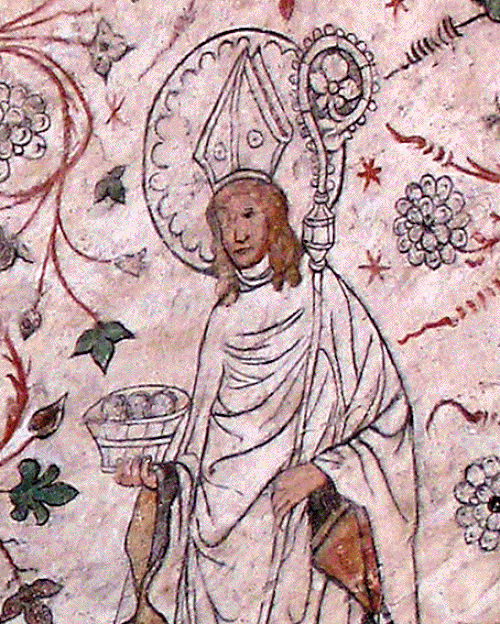
Saint
Sigfrid of Växjö
Missionary bishop in Sweden
Missionary bishop of English origin in Scandinavia in the first half of the eleventh century.
- Feast
- February 15old style February 28
- Reposed
- 104511th century
- Place
- Växjö
- Order
- Hierarchs
Life
Saint Sigfrid of Växjö was a missionary bishop of English origin in Scandinavia in the first half of the eleventh century. Tradition counts him as the apostle of Sweden and as the one who baptised King Olof Skötkonung, the first Swedish king steadfast in the Christian faith. He is venerated mainly in the West, in Sweden, and is commemorated on 15 February.
Beginnings
From England, Sigfrid was a monk and priest, according to some sources at York, according to others at Glastonbury. He is believed to have reached Sweden soon after the year 1000 and worked widely in Götaland and Svealand. One source says that he was sent north by the English king Ethelred II, at the request of the Norwegian king Olaf Tryggvason, together with bishops Grimkel and John.
The mission in Sweden
According to tradition, he baptised King Olof near Uppsala (one source gives the year 1008) and baptised twelve rulers of provinces, whose example many nobles and peasants followed. At Växjö he is said to have built a wooden church with his own hands. He ordained two Swedish bishops for neighbouring regions, but he himself remained bishop at Växjö to the end. Two Swedish dioceses, Växjö and Skara, regard him as their founder.
After 1014 he was for a time based at Trondheim in Norway, but his position there became untenable after the defeat of Olaf Haraldsson. He visited Bremen at least twice, about 1015 and, more certainly, about 1030, when he brought the archbishop good news of his missions in Sweden. The rest of his life was devoted to the Christianisation of Sweden. According to Swedish and Icelandic tradition, he retired to Värend and died at Växjö on an unknown date.
The tradition of his nephews
A legend tells that about 1040 pagans attacked the church at Växjö during the service and killed those inside, among them his three nephews, his helpers in the mission: Unaman the priest, Sunaman the deacon and Winaman the subdeacon. Their heads were cut off, put in a chest and sunk in the lake. Sigfrid was then in Denmark. On his return he sought the chest and, according to the legend, the heads spoke. King Olaf ordered the culprits put to death, but at Sigfrid's pleas their lives were spared. Sigfrid also refused the heavy fine the king set for his benefit, though he lived in great poverty. This is a late legend, and scholars today consider that little can safely be said about his life: the sources are late saints' lives and lists of kings and bishops.
Veneration
His grave at Växjö became a centre of devotion. According to a seventeenth-century statement, he was canonised by Pope Hadrian IV about 1158. His relics were destroyed in the sixteenth century, at the time of the Reformation. He was one of the most honoured patrons of Sweden, venerated also in Denmark and Norway. The Church of England commemorates him on 15 February.
Commemorated the same day February 15
 OnesimusApostle · Disciple of the Apostle PaulFeb 15
 Euphrosyne of AlexandriaVenerableFeb 15
 Faustinus and JovitaHoly Martyrs · Martyrs of BresciaFeb 15
 Faustinus of BresciaSaint · Bishop of BresciaFeb 15
 Paphnutius the RecluseVenerable · Recluse of the Kiev CavesFeb 15
- Paphnutius the AsceticVenerableFeb 15
 Anthimos of ChiosVenerable · Patron of lepersFeb 15
- Eusebius the HermitVenerable · Hermit in SyriaFeb 15
- Agape of TerniSaintFeb 15
- Alexis NikitskyHieromartyrFeb 15
- Alexis SmirnovHieromartyrFeb 15
- Baralus of AntiochMartyrFeb 15