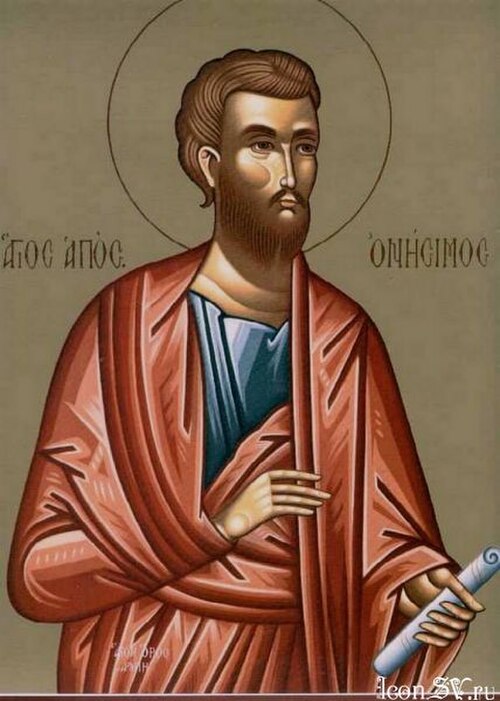
Apostle
Onesimus
Disciple of the Apostle Paul
The slave of Philemon, for whom the Apostle Paul wrote an epistle, who according to tradition became a bishop.
- Feast
- February 15old style February 28
- Reposed
- 1092nd century
- Place
- Rome
- Order
- Apostles
Life
Saint Onesimus the Apostle was the slave of Philemon, for whom the holy Apostle Paul wrote the Epistle to Philemon, and, according to tradition, a disciple of Paul, one of the Seventy Apostles and a bishop. The Church commemorates him on 15 February, and on 4 January in the synaxis of the Seventy Apostles.
In the New Testament
The name Onesimus means "useful" in Greek. He was the slave of Philemon, a prominent Christian of Colossae in Phrygia, in whose house the Church met. Onesimus ran away from his master, perhaps after robbing him, and reached Rome, where Paul was in prison. Hearing the Gospel from the apostle, he received the faith and Baptism. Paul calls him "my son Onesimus, whom I have begotten while in my chains" (Philemon 10).
Paul did not keep him beside him, though he would have been of use, but sent him back to his master with a letter asking Philemon to receive him not as a slave but "more than a slave, a beloved brother," and promising to pay any debt: "If he has wronged you at all, or owes you anything, charge that to my account." The letter plays on the slave's name: the one who was once useless to you is now useful to you and to me. It does not explicitly ask for his freedom, but its spirit, of brothers in Christ, changes the relation between master and slave. In the Epistle to the Colossians (4:9), Paul calls him "Onesimus, our faithful and beloved brother, who is one of you," sent with Tychicus.
Tradition
According to the synaxarion, Philemon forgave him and sent him back to Rome to the apostle, and after Paul's death Onesimus served the apostles and was made a bishop. The Apostolic Constitutions show him as bishop of Beroea in Macedonia. Saint Ignatius the God-bearer mentions in his letter to the Ephesians a bishop Onesimus of Ephesus, whom some identify with this one. According to the synaxarion, in the time of the emperor Trajan he was arrested and tried by the eparch Tertullus, then thrown into prison at Puteoli, stoned and beheaded, in the year 109. A wealthy woman took his body and laid it in a silver coffin. These traditions cannot be proved with certainty.
Veneration
The Church commemorates him on 15 February, on 4 January in the synaxis of the Seventy Apostles, and on 6 July and 22 November together with Philemon, Archippus and Apphia.
Commemorated the same day February 15
 Sigfrid of VäxjöSaint · Missionary bishop in SwedenFeb 15
 Euphrosyne of AlexandriaVenerableFeb 15
 Faustinus and JovitaHoly Martyrs · Martyrs of BresciaFeb 15
 Faustinus of BresciaSaint · Bishop of BresciaFeb 15
 Paphnutius the RecluseVenerable · Recluse of the Kiev CavesFeb 15
- Paphnutius the AsceticVenerableFeb 15
 Anthimos of ChiosVenerable · Patron of lepersFeb 15
- Eusebius the HermitVenerable · Hermit in SyriaFeb 15
- Agape of TerniSaintFeb 15
- Alexis NikitskyHieromartyrFeb 15
- Alexis SmirnovHieromartyrFeb 15
- Baralus of AntiochMartyrFeb 15