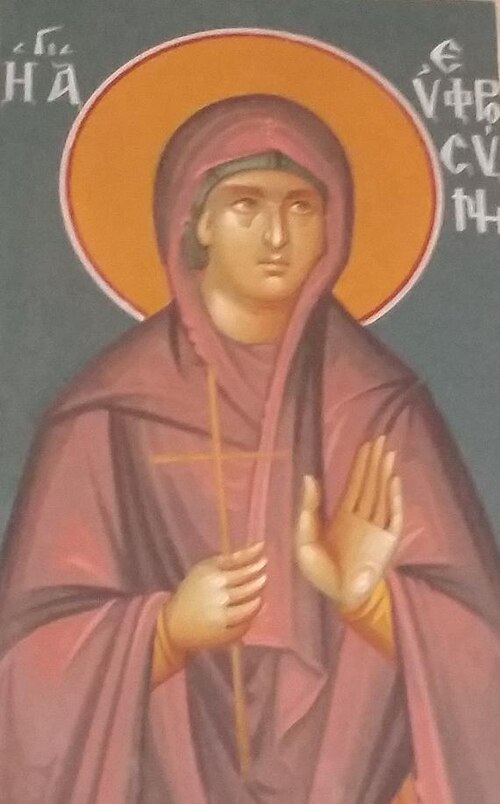
Venerable
Euphrosyne of Alexandria
Woman who disguised herself as a man to enter a monastery and lived as an ascetic for thirty-eight years.
- Feast
- February 15old style February 28
- Reposed
- 4705th century
- Place
- Alexandria
- Order
- Venerables
Life
The Venerable Euphrosyne of Alexandria was a virgin who, according to the story of her Life, put on men's clothes to enter a monastery and lived there as an ascetic for thirty-eight years. She is commemorated on 25 September in the Orthodox Church. Her Life, written in the tenth century by Symeon Metaphrastes, is among the stories of Christian virgins who lived in male guise; the church historian Johann Peter Kirsch considers it a legend.
According to the story, she was born around 410 at Alexandria, into a wealthy and renowned family, the only daughter of Paphnutius, a deeply pious Christian. Her parents had no children and Paphnutius went to a monastery he often visited, to ask the prayers of the abbot, his spiritual father, and of the monks; Euphrosyne was born soon afterward. She was baptised at seven, taught in the Scriptures and known for wisdom and love of learning. At twelve her mother died, and her father raised her alone. At eighteen she had many suitors, and her father chose the noblest and wealthiest. The two went to the monastery to ask the abbot's blessing on the marriage, but the sight of monastic life moved Euphrosyne and she resolved to give herself to God. Returning home, she began to fast, gave away her jewels and no longer cared for her appearance.
A monk who passed by advised her to dress as a man to escape the marriage; a hermit from Scetis gave the same advice. While her father was away she received tonsure from a monk. Fearing that in a convent her father would find her, she went in men's clothes to the abbot of the men's monastery she had visited with her father, and called herself a eunuch of the imperial court, with the name Smaragdus. The abbot received her, gave her to the monk Agapitus for training and, because of the beauty of the young man, which might disturb the brothers, placed her in a separate cell, allowing contact only with her spiritual father. Her father, unable to find her, went to the abbot to ask for prayers, and the abbot sent him to the monk Smaragdus. Paphnutius began to visit him often for talks and counsel, finding comfort for his grief over his lost daughter. In her thirty-eight years in the monastery Euphrosyne told her father the truth only before her death, asking him that no one else prepare her body for burial. Paphnutius fulfilled her wish, then became a monk himself and lived ten years in his daughter's cell, and after death was buried beside her.
According to the Acta Sanctorum, her head and most of her relics are kept at the monastery of Saint John at Beaulieu in France, where until the eighteenth century her day was solemnly celebrated; particles are at the church of Santo Stefano in Bologna and at Sierck-les-Bains on the Moselle. Her feast is on 25 September and on 15 February.
Commemorated the same day February 15
 OnesimusApostle · Disciple of the Apostle PaulFeb 15
 Sigfrid of VäxjöSaint · Missionary bishop in SwedenFeb 15
 Faustinus and JovitaHoly Martyrs · Martyrs of BresciaFeb 15
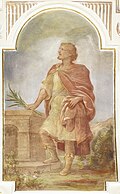 Faustinus of BresciaSaint · Bishop of BresciaFeb 15
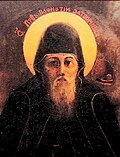 Paphnutius the RecluseVenerable · Recluse of the Kiev CavesFeb 15
- Paphnutius the AsceticVenerableFeb 15
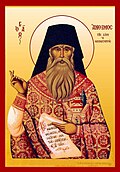 Anthimos of ChiosVenerable · Patron of lepersFeb 15
- Eusebius the HermitVenerable · Hermit in SyriaFeb 15
- Agape of TerniSaintFeb 15
- Alexis NikitskyHieromartyrFeb 15
- Alexis SmirnovHieromartyrFeb 15
- Baralus of AntiochMartyrFeb 15