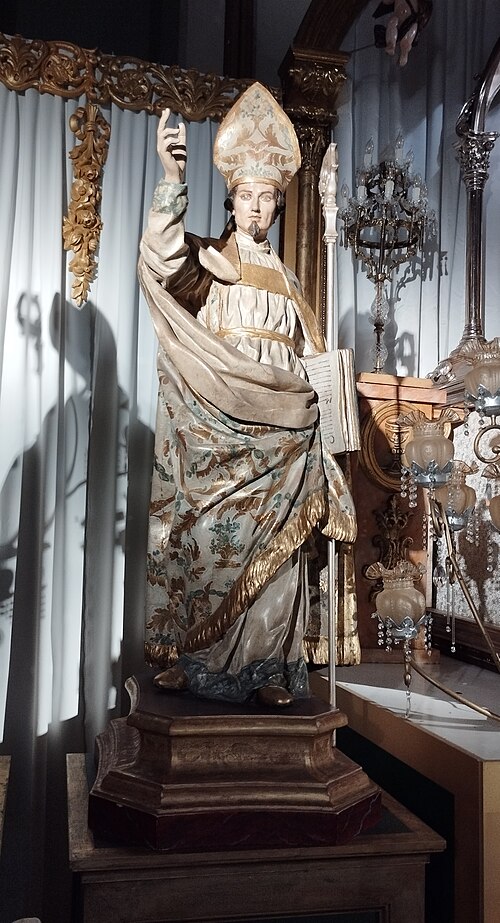
Saint
Fulgentius of Cartagena
Bishop of Astigi (Écija)
Born in Cartagena, he was bishop of Écija in Hispania in the early seventh century.
- Feast
- January 16old style January 29
- Reposed
- 6327th century
- Place
- Écija
- Order
- Hierarchs
Life
The Holy Hierarch Fulgentius of Cartagena (Fulgentius of Ecija) was born at Cartagena and was bishop of Astigi (now Ecija), in Hispania, in the sixth century and the early seventh. He fell asleep in 630 (in another view, 633). His feast is on 16 January (in the Acta Sanctorum of the Bollandists, 14 January).
Family
Like his brothers Leander and Isidore of Seville, two archbishops of Seville, of whom the first was older and the second younger than Fulgentius, he consecrated himself to the service of the Church. A sister of the three was Florentina. Their father Severianus lived at first in Cartagena; he was a Roman and (according to later though doubtful information) an imperial prefect. According to other sources, he was born around 540 to Severianus and his wife Turtura, and the second sister was Theodosia (scholars are divided). Two of his brothers and his sister were counted saints.
Bishop
Exact data on the life of Fulgentius are wanting, since he is mentioned only occasionally in the sources of the time. Leander, in his Libellus on the religious life written for his sister Florentina, says he has sent Fulgentius back to his native town of Cartagena, which he now regrets, fearing that harm may befall him, and asks Florentina to pray for him. Probably through the influence of Leander, who was made archbishop of Seville in 584 and played an important part in the affairs of the Visigothic kingdom, Fulgentius became bishop of Astigi (Ecija), in the ecclesiastical province of Seville. According to another view, Leander made him first bishop of Cartagena, then in 590 moved him to Astigi. As Leander died in 600 and Pegasius was still bishop of Ecija in 590, Fulgentius would have been chosen bishop between 590 and 600. In 610 he signed the decree of King Gundemar (610-614) which established the province of Toledo by separating territory from that of Cartagena, then under the rule of the Byzantines.
Isidore, who succeeded Leander in the see of Seville, dedicated to Fulgentius, "his lord, the servant of God," his work on the offices of the Church, De ecclesiasticis officiis; indeed it was at Fulgentius's solicitation that he wrote this account of the origin and authors of the Liturgy. At the Second Synod of Seville (619), for which Isidore had assembled the bishops of the province of Baetica, a controversy between the bishop of Astigi and the bishop of Cordoba regarding a church claimed by each as belonging to a parish in his diocese was brought up for settlement; a commission was appointed and, based on arguments from Roman law, it was declared that thirty years' undisturbed possession should constitute a legal title. Fulgentius attended the synod in person, his name being found among the signatures to the Acts of the council. It is the last document of his time that mentions his name. He fell asleep sometime before 633, as one Marcianus is shown to have then been bishop of Astigi.
Veneration
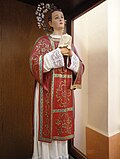
Fulgentius, like his sister and brothers, was reverenced as a saint. In Hispania his feast was celebrated on different days. He is frequently confused in medieval writings with Fulgentius of Ruspe; some works were also attributed to him, of which, however, no traces remain. It is said that long after their deaths a part of the bones of Fulgentius and those of his sister Florentina were carried for safety into the Sierra de Guadalupe and that in the fourteenth century they were found in the village of Berzocana in those mountains. The other part of their bones are in the cathedral of Murcia in Cartagena, where Fulgentius is venerated as patron of the diocese. He is patron also of the city of Plasencia and its diocese. Since the sixteenth century the diocesan seminary of Murcia has borne his name; parts of his relics are also at San Lorenzo de El Escorial, brought by order of King Philip II. At Cartagena a sculpture of Saint Fulgentius by Francisco Salzillo is especially venerated.
Commemorated the same day January 16
 Marcellus I of RomeSaint · Bishop of RomeJan 16
 Honoratus of LérinsSaint · Archbishop of ArlesJan 16
 FurseyVenerable · Irish monk and missionaryJan 16
 Danax of IllyriaMartyr · Reader of IllyriaJan 16
 Gerasimos II of AlexandriaSaint · Patriarch of AlexandriaJan 16
- Maximus of TotmaFool-for-Christ · Fool for ChristJan 16
- Honoratus of FondiVenerable · AbbotJan 16
- Damascene of GabrovoVenerable MartyrJan 16
- CillenSaintJan 16
- Damascene the NewHieromartyrJan 16
- Dianach of Domhnach Mor Muighe EneSaintJan 16
- Diarmaid of Airthear MuigheSaintJan 16