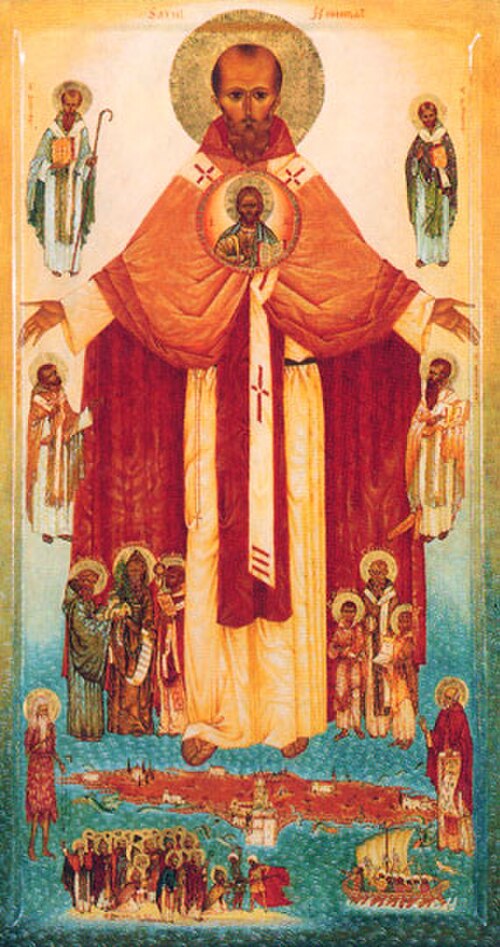
Saint
Honoratus of Lérins
Archbishop of Arles
Founder of Lérins Abbey, later archbishop of Arles, who died in 429.
- Feast
- January 16old style January 29
- Reposed
- 4305th century
- Place
- Arles
- Order
- Hierarchs
Life
Saint Honoratus of Lérins, hierarch, founded the monastery on the islands of Lérins, in southern Gaul, and was afterwards bishop of Arles. He was born into a Roman family of consular rank in the north of Gaul and fell asleep on 6 January 429, in the arms of his disciple Hilary. The Western Church commemorates him on 16 January, and in 2017 the Holy Synod of the Russian Orthodox Church entered him in its calendar.
Youth and journey
Honoratus received an excellent education. With his brother Venantius he converted to Christianity and about 368, under the guidance of a holy man named Caprasius, he set out from Marseille for the Holy Places of Palestine and the lavras of Syria and Egypt. The death of his brother on the way, in Greece (at Methone according to one source, at Corinth according to another), stopped the journey. Back in Gaul, Honoratus settled first in a cave in the Esterel mountains in Provence. Encouraged by Leontius of Fréjus, he then chose the wild island of Lérins, today called the Île Saint-Honorat, to live in solitude.
The monastery of Lérins
Soon many disciples gathered around him, among them Lupus of Troyes, Eucherius of Lyon and Hilary of Arles. Thus the monastery of Lérins was born, which in the fifth and sixth centuries was a nursery of famous bishops and notable ecclesiastical writers. The rule of life he gave was largely taken from that of Saint Pachomius. It is believed that Saint Patrick prepared there for his mission to Ireland. John Cassian, who had visited the monastery, dedicated several of his Conferences to him.
Bishop of Arles
His reputation for holiness was so great in south-eastern Gaul that in 426 or 427, after the murder of Bishop Patroclus, he was called from his solitude to take the see of Arles, which Arians and Manichaeans had disturbed. He seems to have succeeded in restoring order and right belief, while continuing to guide the monks of Lérins from afar. He fell asleep in the arms of Hilary, his disciple and, by all signs, a relative, who succeeded him in the see. Hilary delivered or wrote a discourse on his life, the oldest detailed account of him, in which he says that if love could be given a visible shape, it would have to be shown in the face of Honoratus.
His writings and the rule he gave the monks of Lérins have not survived.
Relics and veneration
His body was buried at Arles, in the chapel of Saint Genesius. In 1391 the relics were moved to the monastery he had founded, where they remained until 1788, and then to the cathedral of Grasse, where they are today. At the end of the twentieth century a small part was brought back to the monastery and is kept in a gilded reliquary under the altar of a chapel of the basilica. In the Middle Ages many pilgrims came to Lérins, above all after the life of him in the Occitan language written about 1300 by the monk Raymond Féraud. One of the Lérins islands, off the French Riviera, bears his name today.
Commemorated the same day January 16
 Marcellus I of RomeSaint · Bishop of RomeJan 16
 Fulgentius of CartagenaSaint · Bishop of Astigi (Écija)Jan 16
 FurseyVenerable · Irish monk and missionaryJan 16
 Danax of IllyriaMartyr · Reader of IllyriaJan 16
 Gerasimos II of AlexandriaSaint · Patriarch of AlexandriaJan 16
- Maximus of TotmaFool-for-Christ · Fool for ChristJan 16
- Honoratus of FondiVenerable · AbbotJan 16
- Damascene of GabrovoVenerable MartyrJan 16
- CillenSaintJan 16
- Damascene the NewHieromartyrJan 16
- Dianach of Domhnach Mor Muighe EneSaintJan 16
- Diarmaid of Airthear MuigheSaintJan 16