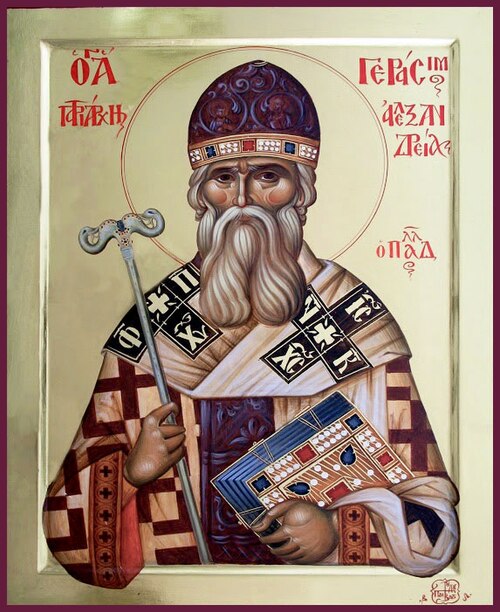
Saint
Gerasimos II of Alexandria
Patriarch of Alexandria
Greek Orthodox Patriarch of Alexandria from 1688 to 1710, commemorated each year on 16 January.
- Feast
- January 16old style January 29
- Reposed
- 171418th century
- Place
- Kalloni
- Order
- Hierarchs
Life
Saint Gerasimos II Palladas was Greek Orthodox patriarch of Alexandria from 1688 to 1710, a learned man, preacher and writer of homilies. He is venerated as a saint in the Orthodox Church and is remembered on 16 January (in some sources 15 January, the day on his tomb's inscription).
He was born in 1633 (in other sources, between 1625 and 1633) in the village of Skillous in Pediada, in Crete, of noble and pious parents. His father, Theodoros, was a protopriest and preacher at Candia, and one of his sermons, delivered in 1633 in honour of the Ten Holy Martyrs of Crete, survives. Gerasimos first received his education from his father, then studied at Corfu and Venice, at the Flanginian College, and became proficient in Greek, Latin and Hebrew. While he was at Venice, Candia fell to the Turks after a long siege, and his father died. Unable to return to Crete, he went to the Peloponnese, where many Cretans had taken refuge, and worked as a teacher, then was teacher and preacher at Kastoria, in the diocese then under the Archbishopric of Ohrid. In 1677 he was elected metropolitan of Kastoria, and in 1686 he was removed from the see by the Synod of Ohrid. In May 1686 the Metropolis of Adrianople was given to him in charge.
On 25 July 1688 he was elected patriarch of Alexandria, succeeding Parthenios, who was killed in an earthquake at Smyrna. He labored above all to spread the word of God, and many of his written homilies survive. He was known for a holy and zealous life, with traits of foolishness for Christ. He was accused of innovations in the order of the Divine Liturgy, at the epiclesis, which brought him into conflict with Ecumenical Patriarch Gabriel III, but he was found innocent. He worked to resolve the long-standing Sinaitic problem and drew up regulations for the poorhouse of the monastery of Saint George in Cairo. He kept up a rich correspondence with figures of his time, such as Peter the Great of Russia, Pope Clement XI, and the Churches of Cyprus and Crete. Because the Patriarchate was heavily in debt, he travelled to Romania and Russia to raise funds, where he was received with honour and given generous gifts, which led to the founding of metochia of the Patriarchate in those lands. He wrote many theological, hymnographic, philosophical and philological works.
Because of illness, old age, Turkish oppression and the disobedience of some Christians, he gave up the throne on 20 January 1710 and named as successor Samuel of Chios, metropolitan of Libya. He withdrew to the monastery of Vatopedi on Mount Athos, where he died in January 1714. His tomb carried the inscription that the servant of God and most blessed patriarch Gerasimos fell asleep in the month of January, on the fifteenth day. His head is still kept at the monastery. The monk Kaisarios Dapontes called him “a most wise and most holy man, theologian, philosopher, searcher of the depth of the divine Scriptures.” The Church of Alexandria honoured him as a saint, and on 7 May 2003 the Holy Synod of the Moscow Patriarchate entered his memory in the Russian calendar.
Commemorated the same day January 16
 Marcellus I of RomeSaint · Bishop of RomeJan 16
 Honoratus of LérinsSaint · Archbishop of ArlesJan 16
 Fulgentius of CartagenaSaint · Bishop of Astigi (Écija)Jan 16
 FurseyVenerable · Irish monk and missionaryJan 16
 Danax of IllyriaMartyr · Reader of IllyriaJan 16
- Maximus of TotmaFool-for-Christ · Fool for ChristJan 16
- Honoratus of FondiVenerable · AbbotJan 16
- Damascene of GabrovoVenerable MartyrJan 16
- CillenSaintJan 16
- Damascene the NewHieromartyrJan 16
- Dianach of Domhnach Mor Muighe EneSaintJan 16
- Diarmaid of Airthear MuigheSaintJan 16