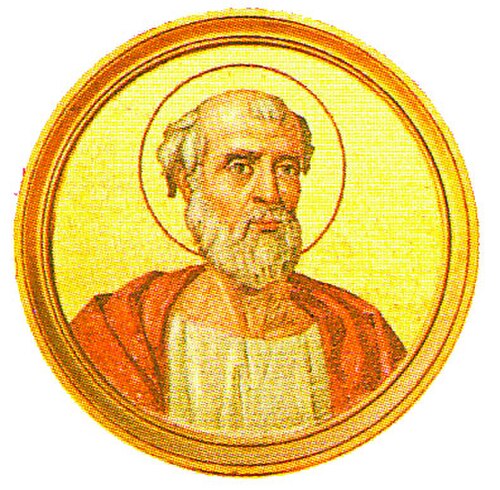
Saint
Marcellus I of Rome
Bishop of Rome
Bishop of Rome from 308 to 309, exiled by Emperor Maxentius.
- Feast
- January 16old style January 29
- Reposed
- 3094th century
- Place
- Rome
- Order
- Hierarchs
Life
Saint Marcellus I of Rome was bishop of Rome from 308 until 16 January 309, after the see had stood empty for several years in the persecution of Diocletian. He set the sorely tried Roman Church in order once more, and he suffered exile because he required penance of the lapsed.
Election and work
After the death of Saint Marcellinus in 304, the persecution did not allow a new bishop to be chosen. When power passed to Maxentius, who was more tolerant toward Christians, Marcellus was elected. The churches and some cemeteries had been confiscated, and the life of the Church was interrupted. According to the Book of the Pontiffs, Marcellus divided the city into twenty-five parishes, called titles, and set a priest over each to care for the baptism of catechumens, for public penance, for the burial of the dead and for the memory of the martyrs. History holds the reorganisation itself to be true, though the number twenty-five may belong to a later time. He also had a new cemetery laid out on the Via Salaria.
Many Christians had denied the faith in the years of persecution. Marcellus required that they first pass through due penance. The verse epitaph that Pope Damasus wrote later says that the lapsed hated him for this strictness. Disturbances broke out, and Maxentius banished him. He died soon afterwards.
Traditions of his end
A later tradition, from the Passion of Marcellus of the fifth century, says that the emperor commanded the pope to lay aside his episcopal office and offer sacrifice to the gods. Marcellus refused and was condemned to serve at a station of the imperial post, tending horses. After nine months the clergy set him free. A wealthy woman, Lucina, had her house on the Via Lata consecrated by him as a church, called the title of Marcellus. Maxentius then condemned him again, and he died in that humble labour. Historians consider these accounts largely legendary.
The Orthodox Synaxarion keeps another form of the tradition, which places Marcellus in the persecution of Diocletian and Maximian, with the deacons Sisinnius and Cyriacus and their companions. Marcellus ordained Sisinnius and Cyriacus deacons. The pope was beaten with rods and made a keeper of cattle, then secretly freed by the clergy. He buried the bodies of the martyrs on the estate of two Christian women, Priscilla and Lucina, and Lucina's house became a church. Under Maxentius the church was turned into a stable, and the saint was condemned to tend the animals for life. He died worn out by hunger, cold and stench.
Relics and commemoration
Some modern scholars think Marcellus was not strictly a bishop, but a priest who governed the Roman Church in the last part of the vacancy, though not all share this view. His veneration is old, since the feast of 16 January appears in the list of 354. His relics rest beneath the altar of the church of San Marcello al Corso in Rome.
The Orthodox Church commemorates him on 7 June (old style), together with the martyrs who suffered in his time, and the West commemorates him on 16 January.
Commemorated the same day January 16
 Honoratus of LérinsSaint · Archbishop of ArlesJan 16
 Fulgentius of CartagenaSaint · Bishop of Astigi (Écija)Jan 16
 FurseyVenerable · Irish monk and missionaryJan 16
 Danax of IllyriaMartyr · Reader of IllyriaJan 16
 Gerasimos II of AlexandriaSaint · Patriarch of AlexandriaJan 16
- Maximus of TotmaFool-for-Christ · Fool for ChristJan 16
- Honoratus of FondiVenerable · AbbotJan 16
- Damascene of GabrovoVenerable MartyrJan 16
- CillenSaintJan 16
- Damascene the NewHieromartyrJan 16
- Dianach of Domhnach Mor Muighe EneSaintJan 16
- Diarmaid of Airthear MuigheSaintJan 16