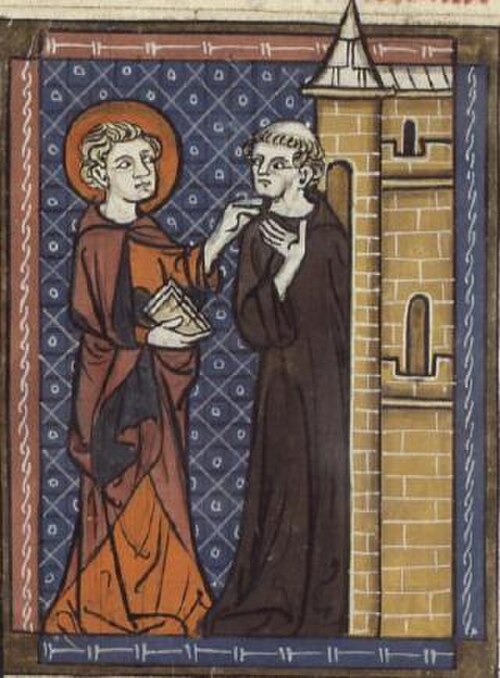
Venerable
Fursey
Irish monk and missionary
Irish monk who spread Christianity in the British Isles, especially East Anglia; died around 650.
- Feast
- January 16old style January 29
- Reposed
- 6507th century
- Place
- Ponthieu
- Order
- Venerables
Life
Saint Fursey was an Irish monk who did much to establish Christianity in the British Isles, above all in East Anglia, and is famed for his visions of the afterlife, known in medieval literature. He fell asleep around 650. He is one of the "Four Comely Saints". The Church remembers him on 16 January. Saint Bede says of him that he came of the noblest stock of the Irish, but was nobler still in spirit than in birth.
Beginnings He was born in the second half of the sixth century in Ireland, son of Fintan and grandson of Finlog, a pagan king; his mother, Gelges, a Christian, was daughter of Aed-Finn, king of the Hy-Bruin in Connacht. According to tradition he was baptized by Saint Brendan, his father's uncle, who ruled a monastery on the island in Lough Corrib. He was educated by Brendan's monks and entered the monastery of Inisquin, under Abbot Meldan, his "soul-friend", where he devoted himself to the monastic life. His holiness was seen early, and a legend says that through his prayers the twin children of a chieftain were raised from the dead. Around 625 he founded his own monastery at Killursa near Headford in County Galway, on the lakeshore, where he became patron of the parish. The ruins of the church can still be seen.
The visions It is said he led an austere life, wearing thin clothing year round. Many came to place themselves under his rule, but he wished to bring relatives into the monastery too. Setting out for Munster with some monks, he was seized near his father's house by an apparently mortal illness and fell into a trance, from the ninth hour of the day until cock-crow, and had the first of the visions that made him famous. The state of man in sin and the beauty of virtue were revealed to him. He heard the angelic choirs singing: "The saints shall go from virtue to virtue, the God of gods will appear in Sion." The two angels who appeared to him ordered him to return to his body and labour with more zeal for the Lord. After three nights the ecstasy was renewed: three angels took him to the heavens, while six times they contended with demons for his soul. He saw the fires of hell, the strife of demons, then heard the angel hosts singing in four choirs "Holy, holy, holy, Lord God of hosts." Among the spirits of those made perfect he recognized Saints Meldan and Beoan, who taught him about the duties of clerics and monks, the effects of pride and disobedience and spiritual sins. They foretold famine and plague. On his return through the fire, a demon hurled a tortured sinner at him and burned him, and the angel said to him: "Because you received the mantle of this man as he died in his sin, the fire consuming him has marked your body too." The mark stayed on his body until his death. After twelve months he had a third vision: the angel stayed with him a whole day, taught him for preaching and prescribed twelve years of apostolic labour, which he fulfilled in Ireland, then, stripped of all earthly goods, withdrew for a time to a small island in the ocean. His brothers Foillan and Ultan joined the community at Rathmat, and he gave up the government of the monastery and preached through the land, often casting out evil spirits.
Mission to East Anglia Fursey was the first recorded Irish missionary to Anglo-Saxon England. He arrived in East Anglia with his brothers Foillan and Ultan in the 630s, shortly before Saint Aidan founded his monastery on Holy Island. The conversion of the kingdom of East Anglia had begun under Raedwald but stopped with the martyrdom of his successor, his son Eorpwald. Sigeberht was already a Christian when he took the throne around 630, and by 633 he had set up at Dommoc the first East Anglian bishopric, appointing a Burgundian, Felix. When Fursey came with his brothers and other brethren, bearing the relics of Saints Meldan and Beoan, the king welcomed him and gave him land for a monastery at Cnobheresburg, in an old Roman fort, by tradition Burgh Castle in Norfolk. There he laboured some years, converting Picts and Saxons. After Sigeberht was killed by an army led by Penda of Mercia, his successor, King Anna, and the nobles endowed the monastery further. After the wars Fursey went to Gaul, where he founded a monastery at Lagny and fell asleep around 650, at Mézerolles near Péronne, where his tomb was venerated.
Commemorated the same day January 16
 Marcellus I of RomeSaint · Bishop of RomeJan 16
 Honoratus of LérinsSaint · Archbishop of ArlesJan 16
 Fulgentius of CartagenaSaint · Bishop of Astigi (Écija)Jan 16
 Danax of IllyriaMartyr · Reader of IllyriaJan 16
 Gerasimos II of AlexandriaSaint · Patriarch of AlexandriaJan 16
- Maximus of TotmaFool-for-Christ · Fool for ChristJan 16
- Honoratus of FondiVenerable · AbbotJan 16
- Damascene of GabrovoVenerable MartyrJan 16
- CillenSaintJan 16
- Damascene the NewHieromartyrJan 16
- Dianach of Domhnach Mor Muighe EneSaintJan 16
- Diarmaid of Airthear MuigheSaintJan 16