Saint
George of Amastris
Bishop of Amastris
Byzantine monk made bishop of Amastris against his will, who died between 802 and 807.
- Feast
- February 21old style March 6
- Reposed
- 8008th century
- Place
- Amasra
- Order
- Hierarchs
Life
Saint George of Amastris was an eighth-century Byzantine monk who was made bishop of Amastris in Paphlagonia, on the Black Sea coast (today Amasra in Turkey), against his will. The Church honours him as a merciful pastor and protector of his city, and his Life, preserved in a single manuscript, contains what may be the earliest Greek mention of the people called the "Rhos", the Rus'.
Birth and childhood
George was born around the middle of the eighth century, between 750 and 760 by some estimates, in the town of Kromna near Amastris. His family was devout and belonged to the local nobility. His parents were named Theodosius and Megetho, or, in the short Greek version of his Life, Theodore and Megethousa.
According to the Life, his parents remained childless until nearly old age, and their son was born in answer to prayer. The same text says that his birth was preceded by signs foretelling the child's name, his priesthood and his holiness.
When he was three years old, the boy fell into a fire while playing. Although he was pulled out at once, he bore scars on both hands and one foot for the rest of his life. As a youth he showed great ability in both church and secular learning.
Hermit and monk
When he came of age, George was taken into the care of an uncle who was a bishop, and he began a career in church administration. He did not stay in it long. Leaving everything, he withdrew in secret to become a hermit on Mount Agrioserike, where he lived in a cave near the summit. Some Slavonic accounts understood the name of the mountain as a reference to Syria.
He soon received monastic tonsure from an elder, who remained his spiritual guide. After the elder's death George joined a cenobitic community at a place called Bonyssa. The Life says this was the local name of the monastery, and the acts of the Seventh Ecumenical Council mention an abbot of a monastery with a similar name. Scholars consider it unlikely that it was Vonitsa in Acarnania, as suggested in the Synaxarion of Saint Nikodemos the Hagiorite.
Raised to the episcopate
Word of George's strict and fasting life spread widely and reached his homeland. Around 790 the see of Amastris fell vacant, probably on the death of Bishop Gregory, whose signature appears in the acts of the Seventh Ecumenical Council. Some historians have suggested that Gregory was George's uncle, although the Life does not say so.
Envoys from the city came to ask for George as their bishop. When he refused, they took him from the monastery by force and brought him to Constantinople. The emperor favoured another candidate, but Saint Tarasios, Patriarch of Constantinople, consecrated George bishop.
The Life relates that the patriarch then recognized him as the young man who, many years before, had refused to accept payment from him for chanting psalms, saying that he looked for a better reward in eternal life. In Constantinople George won the favour of Emperor Constantine VI and of his mother, Empress Irene.
Pastor of Amastris
As bishop, George obtained for his see independence from the metropolis of Gangra, a fact confirmed by the official lists of sees of the Patriarchate of Constantinople. Amastris later became an archbishopric, and some sources call George metropolitan or archbishop.
When the Arabs were ravaging the surrounding country, the bishop called all who had suffered from the raids to take refuge within the city walls. According to the Life, he himself, unarmed, walked around the walls in prayer, and the city was spared. Other sources do not list Amastris among the cities struck by the Arabs, though their presence on the southern and eastern borders of Paphlagonia is well attested.
The Life also tells how George interceded for merchants of Amastris who had been seized and condemned to death in Trebizond, allegedly for breaking customs regulations. Hearing of their plight, he went at once to Trebizond. The local governor at first refused to release them, and according to the Life his wife was struck blind; when the governor repented and handed the prisoners over, she recovered her sight.
Saint John of Gothia, who had fled from the Khazars, lived for four years in Amastris under George's protection. After John's death, Bishop George led the solemn procession that sent his relics to the Crimea, to his native town of Parthenion (today Partenit), for burial.
George cared for the poor and the destitute and gave much attention to adorning the churches, especially to the good order of the holy altar.
George and Emperor Nikephoros I
The Life says that George foretold to Nikephoros, while he was still an official at court, that he would become emperor. Nikephoros I reigned from 802 to 811, and George was one of his notable supporters.
The Life praises Nikephoros for his piety and his indifference to power. It also says that the emperor would lay aside the purple and secretly put on George's garment, believing that this would strengthen his reign.
Repose
Saint George reposed in peace at Amastris early in the reign of Nikephoros I, between 802 and 807 according to most sources. Other estimates extend to 811, and one even to 825.
The Life gives the day of his death in an unusual way, using the Syro-Macedonian calendar: two days before the tenth of the month of Dystros. This produced several commemoration dates. The Russian scholar Vasily Vasilievsky thought that the compiler of the Greek menaion took Dystros to be February, which gave the date of 8 February. The notes to the Lives of the Saints by Saint Dimitri of Rostov give 3 March as the day of his death.
Miracles after his death
The Life records miracles at his tomb. Once a heavy rainstorm caused a flood, and the water in the church rose as high as the saint's coffin. According to the Life, the water drew back and stood around the coffin like a wall.
The best known of these miracles concerns a raid by the "Rhos", the Rus'. The Life describes them as a savage people who laid waste the coasts starting from the Propontis and reached Amastris, killing without mercy, overturning churches and defiling holy things.
When the raiders entered the church and saw the tomb, they imagined a treasure lay within. The Life says that as they tried to break it open, their hands and feet grew weak and they stood motionless, as if bound by invisible bonds. Learning from a captive townsman that they had been struck by the wrath of the Christians' God, their leader ordered all Christians to be freed and the church treasures returned, and so the warriors were released.
The Life and its scholars
George's Life survives in a single tenth-century manuscript, part of a Greek menaion for February, which came to the Royal Library in Paris from the collection of Cardinal Niccolò Ridolfi. A short version stands under 21 February in the Greek liturgical menaia and synaxaria.
The date of the Life is disputed. Vasily Vasilievsky, who published the text in 1893, and Ihor Ševčenko attributed it to Ignatios the Deacon, a near-contemporary of the saint, and dated it before 842. If they are right, it contains the earliest Greek mention of the name "Rhos" and perhaps the first recorded attack of the Rus' on Byzantium.
Other scholars have considered it a later work of the tenth century, or regarded the Rus' episode as a later addition influenced by the homilies of Patriarch Photios on the siege of Constantinople in 860. Some have noted the Life's lack of polemic against the iconoclasts, and Cyril Mango doubted that Ignatios would have written about a saint so little known outside his own city. Constantine Zuckerman linked the raid to the early 830s and to the embassy of the Rus' to Constantinople in 838.
Hymnographer
Tradition ascribes several liturgical canons to Saint George. Among them are the canon for the Procession of the Precious Wood of the Cross (1 August) and canons to Saint Parthenius of Lampsacus (7 February), Saint Porphyrius of Gaza (26 February), the Martyrs of Crete (23 December), Saint Pelagia (8 October) and the Martyr Artemon (13 April).
Veneration
His Life shows that the saint was honoured by common people and nobles alike, and even by the imperial family. His feast is kept on 21 February, and in the older Byzantine calendar on 8 February. Some Greek calendars also commemorate him on 25 October.
Commemorated the same day February 21
 Pepin of LandenRight-Believing · Mayor of the Palace of AustrasiaFeb 21
 Eustathius of AntiochSaint · Patriarch of AntiochFeb 21
- John III ScholasticusSaint · Patriarch of ConstantinopleFeb 21
 Zacharias of JerusalemSaint · Patriarch of JerusalemFeb 21
 Germanus of GranfeldenVenerable Martyr · First abbot of Moutier-GrandvalFeb 21
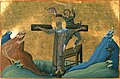 Peter of CapitoliasHieromartyr · Priest of CapitoliasFeb 21
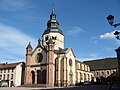 GondelbertVenerable · Founder of Senones AbbeyFeb 21
- Felix of MetzSaint · Bishop of MetzFeb 21
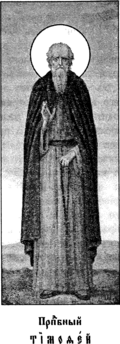 Timothy of SymbolaVenerable · Hermit of BithyniaFeb 21
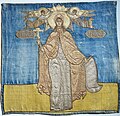 IreneSaintFeb 21
 Avitus II of ClermontSaint · Bishop of ClermontFeb 21
- AndrewSaintFeb 21