Saint
John III Scholasticus
Patriarch of Constantinople
Patriarch of Constantinople from April 565 until his death in August 577.
- Feast
- February 21old style March 6
- Reposed
- 5776th century
- Place
- Constantinople
- Order
- Hierarchs
Life
Saint John III Scholasticus was patriarch of Constantinople from 12 April 565 until his repose on 31 August 577, and a well-known canonist of the Eastern Church. He is venerated as a saint in the Orthodox Church, on 21 February.
He was born around 503 at Sirimis, in the region of Cynegia, near Antioch. At Antioch there was a flourishing college of lawyers, which he entered, doing himself credit; he was an advocate, hence the surname Scholasticus. He then entered the clergy, as a monk, deacon and priest of Antioch, and the patriarch of Antioch sent him to Constantinople as apocrisiarius, that is his representative, where he quickly became known as a scholar. When the emperor Justinian, toward the end of his life, wished to raise the heresy of the Aphthartodocetae to the rank of orthodoxy and deposed Patriarch Eutychius, who had opposed it, the lawyer-cleric of Antioch, already famous for his great collection of canons, was chosen in his place, on 12 or 15 April 565. Seven months later Justinian died, and the patriarch crowned the new emperor, Justin II, on 14 November 565. In this time the churches of Hagia Sophia and the Holy Apostles were adorned and many others were built; tradition says that it was then ordained that the Cherubic Hymn and Of Thy mystical supper be sung at the Liturgy.
His chief work is canonical. He compiled the Synagogue of Fifty Titles, a collection of canons arranged by subject, not by council, in which he added to the canons of the councils of Nicaea, Ancyra, Neocaesarea, Gangra, Antioch, Ephesus and Constantinople, already received in the Greek Church, the eighty-nine Apostolic Canons, the twenty-one of Sardica and the sixty-eight of the canonical letter of Saint Basil. He also made the Collection in Eighty-seven Chapters, with extracts from the Novels of Justinian concerning the Church, and from the two the Nomocanon was later compiled, used in church courts; not all the late redactions are, however, his. He also wrote a teaching on the Holy Trinity, in 568, later attacked by John Philoponus.
Under Justin II he tried to reconcile Chalcedonians with non-Chalcedonians (in 567) and united them for a time, in 571; John of Ephesus, the Syrian historian who himself went through imprisonment, describes arrests, compulsion to communion and interference in the affairs of monasteries. He fell asleep on 31 August 577, shortly before the emperor Justin II, and after his death Eutychius, deposed twelve years earlier, was restored to the throne.
Commemorated the same day February 21
 Pepin of LandenRight-Believing · Mayor of the Palace of AustrasiaFeb 21
 Eustathius of AntiochSaint · Patriarch of AntiochFeb 21
 Zacharias of JerusalemSaint · Patriarch of JerusalemFeb 21
 Germanus of GranfeldenVenerable Martyr · First abbot of Moutier-GrandvalFeb 21
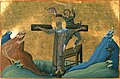 Peter of CapitoliasHieromartyr · Priest of CapitoliasFeb 21
- George of AmastrisSaint · Bishop of AmastrisFeb 21
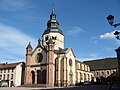 GondelbertVenerable · Founder of Senones AbbeyFeb 21
- Felix of MetzSaint · Bishop of MetzFeb 21
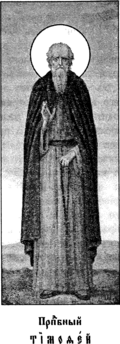 Timothy of SymbolaVenerable · Hermit of BithyniaFeb 21
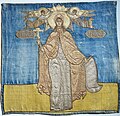 IreneSaintFeb 21
 Avitus II of ClermontSaint · Bishop of ClermontFeb 21
- AndrewSaintFeb 21