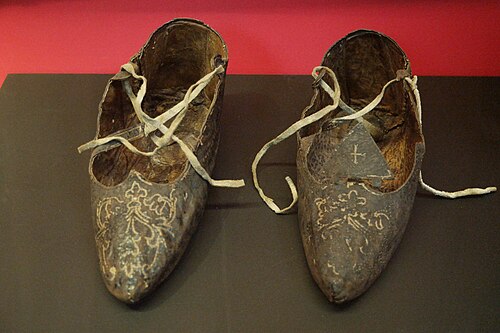
Venerable Martyr
Germanus of Granfelden
First abbot of Moutier-Grandval
First abbot of Moutier-Grandval Abbey, who died in 675 and is venerated as a martyr.
- Feast
- February 21old style March 6
- Reposed
- 6757th century
- Place
- Trier
- Order
- Martyrs
Life
Saint Germanus of Granfelden, martyr, was the first abbot of the monastery of Moutier-Grandval in present-day Switzerland (canton of Bern). He was born around 612 at Trier and died in 675, near Moutier. He is venerated as a martyr in the Catholic and in the Orthodox Church. He is commemorated on 21 February, together with Randoald.
His life was told in the eleventh century in the Vitae, but Bobolenus, a priest probably of Moutier-Grandval and later of Luxeuil, wrote it about 695, at the request of the brothers Chadoal and Aridius, contemporaries of the abbot. The manuscript is preserved as Codex 551 of Saint Gall.
Germanus was the second son of Optardus, a wealthy senator of Trier. His older brother became a courtier, and the youngest, Numerianus, succeeded Modoald as bishop of Trier. Optardus entrusted the young Germanus to Modoald to be taught. At seventeen he decided to live as a monk and left to join Arnulf of Metz, who had retired from the see of Metz to a hermitage in the Vosges mountains, to become a monk. He stayed some time with him; Arnulf tonsured him and then sent him, with his brother Numerianus, who had come to join him, to the recently founded monastery of Remiremont. Desiring greater perfection, he left with his brother and other monks for Luxeuil. Abbot Waldebert received him, ordained him priest and around 640 sent him to organize and govern the monastery of Granfeld (Grandis Vallis, Moutier-Grandval), recently founded by Gundoin, Duke of Alsace. Germanus was abbot thirty-five years. His ties with Remiremont, Luxeuil and Granval show that he belonged to the network of Columbanian foundations, and his relations with Modoald, Arnulf and Gundoin show that he supported the Arnulfings.
According to legend, Gundoin's successor, Boniface, Duke of Alsace, could hardly hold back the people of the Sornegau from revolt, and things got worse under his successor Adalrich, called Eticho, who wanted to subdue the area around Delémont. Germanus and his prior Randoald of Grandval went to meet him for negotiations near Courtételle (southwest of Delémont). After discussion, on the way back they were slain by the duke's supporters. The following night the brothers gathered the bodies and buried them first at Saint-Ursanne, then at Moutier-Grandval.
Germanus and Randoald are regarded as martyrs and became very popular. Miracles are said to have taken place at their tomb, which became a centre of pilgrimage. In 1477 the relics were moved under the high altar. Their cult spread throughout the diocese of Basel and the province of Besançon. The advance of Protestantism and a fire at the abbey, by then a collegiate church, of which nothing remains, led the canons to withdraw and carry the relics of the two saints to Delémont, in the canton of Jura, where they are venerated still. His cult is alive in the Catholic canton of Jura, where many churches bear his name. Germanus's crosier, one of the oldest preserved, is kept at the Musée jurassien d'art et d'histoire in Delémont.
Commemorated the same day February 21
 Pepin of LandenRight-Believing · Mayor of the Palace of AustrasiaFeb 21
 Eustathius of AntiochSaint · Patriarch of AntiochFeb 21
- John III ScholasticusSaint · Patriarch of ConstantinopleFeb 21
 Zacharias of JerusalemSaint · Patriarch of JerusalemFeb 21
 Peter of CapitoliasHieromartyr · Priest of CapitoliasFeb 21
- George of AmastrisSaint · Bishop of AmastrisFeb 21
 GondelbertVenerable · Founder of Senones AbbeyFeb 21
- Felix of MetzSaint · Bishop of MetzFeb 21
 Timothy of SymbolaVenerable · Hermit of BithyniaFeb 21
 IreneSaintFeb 21
 Avitus II of ClermontSaint · Bishop of ClermontFeb 21
- AndrewSaintFeb 21