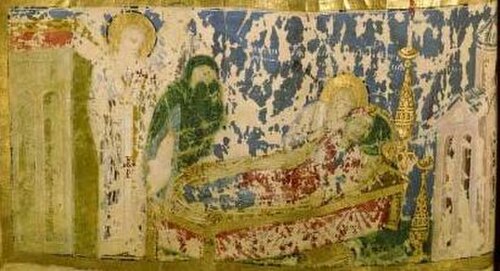
Righteous
Gorgonia
Sister of Gregory the Theologian
Daughter of Saints Gregory the Elder and Nonna, remembered for her piety as a married woman.
- Feast
- February 23old style March 8
- Reposed
- 3724th century
- Place
- Nazianzus
- Order
- The Righteous
Life
Righteous Gorgonia was the daughter of Saint Gregory the Elder and Saint Nonna and the elder sister of Saint Gregory the Theologian. She is remembered as an image of a married woman of holy life, full of almsgiving and prayer. The Orthodox Church commemorates her on 23 February, the Roman Catholic Church on 9 December. The main source is the funeral oration for her, delivered by her brother.
Life
Little is known of her childhood and education. She was born at Nazianzus in Cappadocia, in a family of saints, being the sister of Saints Gregory the Theologian and Caesarius. She married a man of influence in Pisidia, called in the sources Alypius, in other places Vitalian or Meletius, bore several sons and three daughters, of whom Alypiana was remembered most, and had grandchildren. At the same time she led an ascetic life, prayed much, set no store by food and clothes and received clergy in her house. The Greek Church gives her the titles Mother of Orphans, Eyes of the Blind and Keeper of a Refuge of the Poor.
Gregory the Theologian tells of two illnesses with miraculous healings. Once, falling from a carriage, or according to another account trampled by a team of mules, she was gravely injured, and the doctors could not help her. She would not receive a physician, thinking it indecent. Another time, according to her brother's description, in a pious boldness, she bowed her head at the altar with cry and tears, promising not to leave until healed, gathered something from the Holy Gifts, mixed it with her tears and anointed her body with this remedy of her own making, and was healed at once. The symptoms, headache, fever, paralysis and coma, disappeared, the sources say, through the strength of prayer.
She received baptism only before her death, according to the custom of the time, when all life was thought of as preparation for baptism. Gregory writes that for her the sacrament was almost only a seal, not a gift, showing that she had attained spiritual perfection as a catechumen. Once baptized, she brought her husband to baptism as well, and, according to some sources, her sons and grandsons. She died shortly after her brother Caesarius, but before her parents, who were alive though very old. Gregory does not say what she died of, only that she died in peace, surrounded by her family. The year of her death is given differently: 372, around 370 or 375. At the funeral her brother delivered an oration in which he called her a model of a Christian wife and mother, the paragon of women and the diamond of her sex.
Commemorated the same day February 23
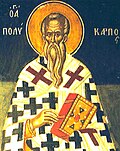 Polycarp of SmyrnaHieromartyr · Bishop of SmyrnaFeb 23
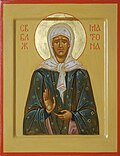 Matrona of MoscowFool-for-ChristFeb 23
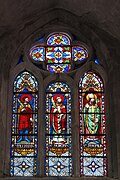 Serenus of SirmiumMartyr · Gardener, martyr of SirmiumFeb 23
 Alexander the UnsleepingVenerable · Founder of the Unsleeping OnesFeb 23
 John TheristisVenerable · Monk in CalabriaFeb 23
 PolychroniusSaint · Bishop of BabylonFeb 23
- John, Antiochus, Antoninus and MosesVenerable · Syrian hermitsFeb 23
- Polycarp of BryanskVenerable · Founder of the Transfiguration MonasteryFeb 23
- ZebinasVenerable · Syrian hermitFeb 23
- PolychroniusVenerable · Hermit of SyriaFeb 23
- 73 MartyrsHoly MartyrsFeb 23
- AntoninusVenerableFeb 23